




Ethereum Overtakes Bitcoin in Institutional Treasuries: A New Era in Digital Assets
In a surprising shift within the cryptocurrency landscape, Ethereum has surpassed Bitcoin in terms of institutional holdings, signaling significant changes in how digital assets are acquired and held. Recent statistics indicate that 4.1% of Ethereum’s total supply is now held by institutional investors, compared to Bitcoin’s 3.6% and Solana’s 2.7%. This shift not only reflects changing investment strategies but also underscores Ethereum’s evolving role in the digital economy.
The Impact of the GENIUS Act
The rise of Ethereum’s institutional appeal can be traced back to the recent enactment of the GENIUS Act, signed by Donald Trump. This legislation created a structured framework for stablecoins, thereby bolstering trust among investors and attracting greater institutional participation in on-chain finance. As large investors strategically increase their Ethereum holdings, they view the cryptocurrency as a crucial element in the infrastructure of decentralized finance (DeFi). This emerging trend emphasizes not only Ethereum’s technological capabilities but also its potential for serving as a long-term store of value amid market volatility.
Strong Support for Ethereum’s Price Action
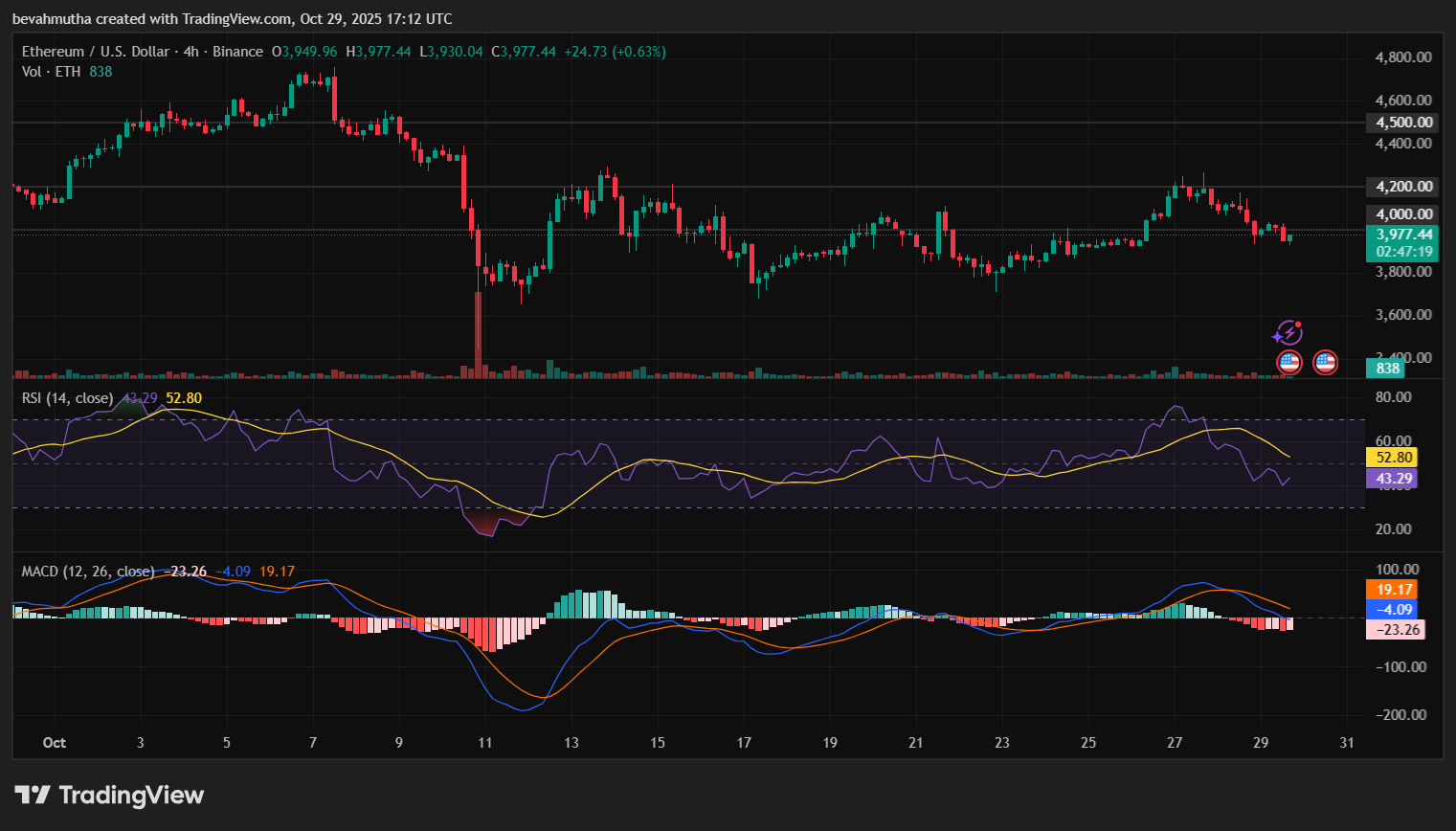
Despite short-term market fluctuations, Ethereum’s price has demonstrated resilience. Currently maintaining support above $4,000, there is a notable bullish momentum that analysts are closely monitoring for a potential rally toward the $4,500 mark. Historical price movements suggest that Ethereum is following a familiar fractal pattern, having tested its support line twice, much like the patterns seen in previous bullish phases. Traders are optimistic, as the market often reacts positively to such repetitive behavior, which could catalyze significant upward movement if the prevailing trend continues.
Analyzing Market Conditions and Key Support Levels
As of recent reports, Ethereum’s price has slightly dipped to around $3,951, exhibiting a 1.52% decline over a short period. The cryptocurrency finds itself precariously poised at the critical psychological support level of $4,000, while sellers are attempting to regain control following a series of failed recovery attempts. The Relative Strength Index (RSI) indicates a diminishing momentum, raising concerns about a potential slide toward the oversold zone if negative sentiment continues to dominate. Furthermore, the MACD indicator depicts a bearish setup, suggesting weakening bullish momentum and the possibility of further price pullbacks in the near term.
Potential Price Predictions and Resistance Levels
Should the vital support level of $3,900 fail, analysts are predicting a possible retracement to $3,600 in subsequent sessions. Conversely, resistance remains robust at $4,100 and $4,200. A confirmed breakout above these zones could pave the way for upward momentum, potentially leading to price levels around $4,400 and even $4,500, contingent on adequate volume supporting the move. This dual scenario underscores the intricate balance within the market, where buyers and sellers continuously vie for control.
Broader Market Sentiment and Comparison with Competitors
The cryptocurrency market, as a whole, has experienced a mild downturn recently, with Bitcoin dipping below $112,000 amid bearish sentiment. The overall market reflected a 2.19% decline within a 24-hour window, highlighting a cautious atmosphere as traders anticipate the forthcoming Federal Reserve rate decision. Notably, while both Bitcoin and Ethereum experienced declines around 3.58%, Solana emerged as an outlier with a substantial weekly increase of 39% following the approval of its ETF. This contrasts starkly with the cautious tone in the market, leading traders to scale back exposure due to uncertainty surrounding commentary from Federal Reserve Chair Jerome Powell.
Conclusion: Ethereum’s Position in an Evolving Market
The current dynamics surrounding Ethereum’s institutional treasury holdings underline its burgeoning significance in the cryptocurrency landscape. The effects of legislative frameworks like the GENIUS Act are apparent, fostering an environment conducive to institutional engagement. With strong support levels in place and historical price patterns suggesting potential for bullish trends, Ethereum is positioning itself as a cornerstone in both DeFi infrastructure and as a credible long-term investment. As the cryptocurrency market continues to evolve, Ethereum’s trajectory may redefine the benchmarks of institutional asset allocation, paving the way for a more stable and innovative financial future.