



The Rising Influence of Stablecoins on U.S. Treasury Bills: A New Era of Financing
As the financial landscape evolves, stablecoins are emerging as crucial players in the realm of U.S. Treasury bills (T-bills). Recent research published by Standard Chartered forecasts that stablecoin issuers will dramatically reshape how the U.S. government finances itself over the coming years. Analysts Geoffrey Kendrick and John Davies predict that the market capitalization of stablecoins could soar to $2 trillion by the end of 2028, generating a significant demand for T-bills.
Increased Demand for Treasury Bills
Analysts at Standard Chartered estimate that the anticipated growth of the stablecoin market will result in an increase in fresh demand for T-bills ranging from $800 billion to $1 trillion. This shift is driven by stablecoin issuers, who are expected to accumulate short-term government debt as reserve assets. The analysis suggests that if current patterns hold steady, T-bills could attract an additional $900 billion beyond existing issuance levels over the next three years, pointing toward a notable transformation in Treasury bill dynamics.
The Role of the GENIUS Act
The passage of the GENIUS Act in July 2025 fundamentally changes the landscape of stablecoin issuance in the U.S. Under this regulatory framework, U.S.-regulated stablecoin issuers are mandated to hold high-quality liquid assets, with a particular emphasis on short-dated Treasurys. This new requirement will likely focus demand on the 0 to 3-month Treasury securities, aligning regulations with market velocities. Standard Chartered also notes that a substantial portion of stablecoin growth—estimated at two-thirds of the projected $2 trillion by 2028—will stem from emerging markets, further driving T-bill demand.
Borrowing Dynamics and Potential Shortfall
The growing interest in stablecoins, coupled with Federal Reserve actions, could lead to total new T-bill demand reaching around $2.2 trillion by 2028. Interestingly, Standard Chartered projects a net T-bill supply of approximately $1.3 trillion over the same period. This imbalance suggests a looming shortfall of $900 billion, creating a potential scarcity of T-bills unless the Treasury adjusts its issuance strategy. Treasury Secretary Scott Bessent has expressed willingness to explore changes in U.S. debt composition to address this issue, echoing the sentiments found in Standard Chartered’s research.
Impact on the Treasury Curve
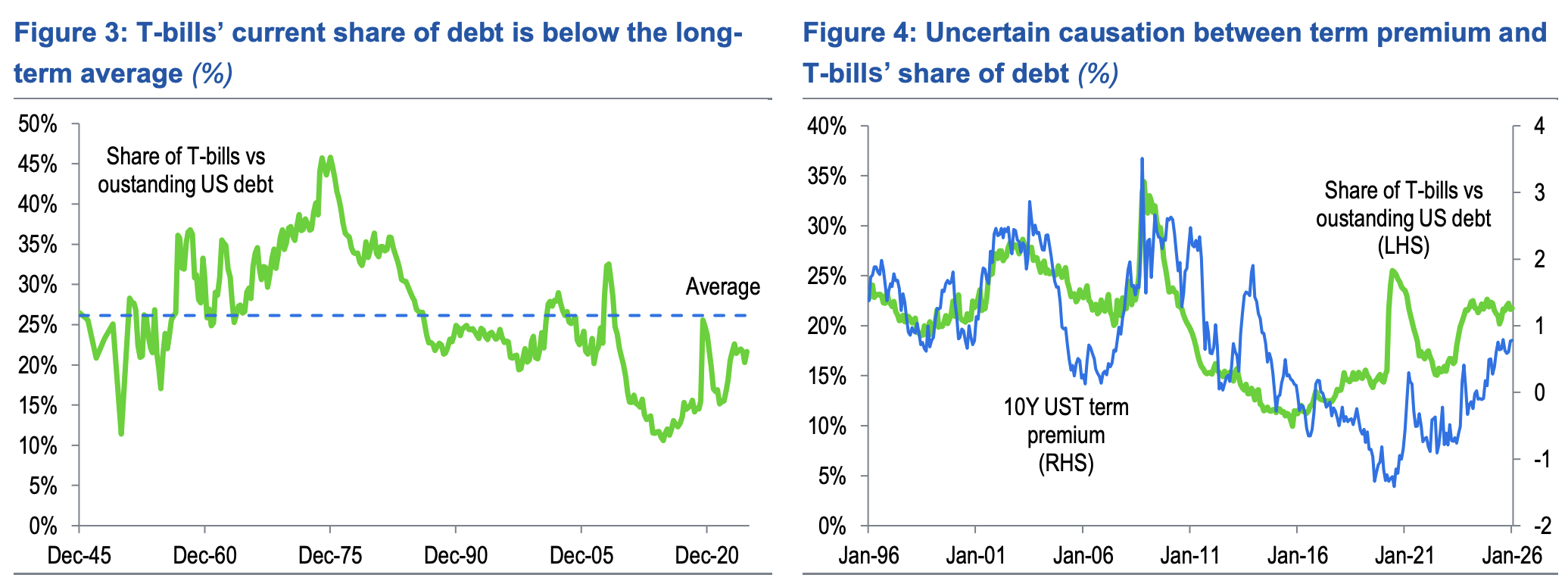
Should the Treasury adjust its issuance strategies and increase the proportion of T-bills in its debt portfolio, the immediate market response could manifest in a "bull flattening" of the Treasury curve. This flattening would involve yields on long-term bonds falling relative to short-term bills, thereby influencing investor sentiment and market dynamics. Nevertheless, Standard Chartered anticipates more complicated outcomes, projecting a "bear steepening" scenario in the near term and recommending that investors remain vigilant about evolving issuance dynamics and front-end scarcity risks.
The Macroeconomic Footprint of Stablecoins
The growing macroeconomic influence of stablecoins cannot be overlooked. Tether, the leading stablecoin issuer, currently holds over $120 billion in U.S. Treasury bills, positioning itself among the world’s top holders of short-term government debt. This transition could have profound implications for traditional banks, with predictions suggesting that up to $500 billion could be reallocated from U.S. bank deposits into government debt markets by 2028, further underscoring the shift in capital flows within the financial ecosystem.
Regulatory Momentum and Broader Implications
As the stablecoin sector expands, regulatory frameworks are beginning to take shape. The GENIUS Act has established a foundational architecture for stablecoin issuance, while the SEC has provided guidance on capital treatment for brokers involved with stablecoins. The continued dialogue among industry leaders, White House officials, and lawmakers inserts stability into this burgeoning market. In tandem with regulatory clarity, data shows increasing everyday usage of stablecoins for savings, retail purchases, and transactions, reinforcing their role as vital components of modern finance.
In summary, the intersection of stablecoins and U.S. Treasury bills represents a seismic shift in financial dynamics. As regulatory landscapes evolve and adoption rates grow, the consequences for both traditional banking and government financing will be profound. Stakeholders must stay alert to the developments in this space, as they will undeniably shape the financial landscape of the near future.