



Bitcoin ETF Outflows: Recent Trends and Market Implications
The cryptocurrency market has recently seen significant fluctuations, particularly within U.S.-listed spot Bitcoin exchange-traded funds (ETFs). On a notable Thursday, these ETFs recorded outflows of approximately $410.37 million, marking the second consecutive day of capital withdrawal as Bitcoin’s value dipped to $65,266. This downturn correlates with stronger-than-expected U.S. payroll data, which has influenced market behavior and expectations regarding Federal Reserve policy.
Recent Withdrawal Trends in Bitcoin ETFs
In total, Bitcoin ETFs experienced a two-day redemption total of $686.27 million, as per data from SoSoValue. The majority of these funds noted either zero or negative flows throughout the withdrawal period. BlackRock’s IBIT fund led the outflow charge, losing $157.56 million, closely followed by Fidelity’s FBTC, which saw a decline of $104.13 million. Additionally, significant redemptions were reported from Grayscale and Bitwise products, accounting for $65 million together. Despite this short-term selling pressure, the long-term institutional presence in Bitcoin ETFs remains robust.
Institutional Interest in Bitcoin Funds
Despite recent outflows, the cumulative impact of U.S. spot Bitcoin ETFs since their launch two years ago is noteworthy. These funds have generated an impressive total of $54.31 billion in net inflows, now holding assets equivalent to 6.34% of the total Bitcoin market capitalization. This substantial interest underscores the confidence institutional investors still place in the digital asset sector. The temporary downturn in capital flows may not necessarily reflect the overall sentiment and potential future growth of these investments.
Impact of U.S. Labor Data on Bitcoin Prices
The sharp selloff on Thursday was primarily influenced by the Bureau of Labor Statistics’ report showing a rise in January nonfarm payrolls by 130,000—far exceeding the Dow Jones consensus estimate of 55,000. This labor market strength has shifted market expectations, signaling that the Federal Reserve is likely to maintain its policy rate, with any cuts likely postponed until after a potential leadership change later this year. Such macroeconomic factors have a considerable impact on digital asset valuations, contributing to the volatility seen in Bitcoin’s price.
Broader Market Dynamics for Digital Assets
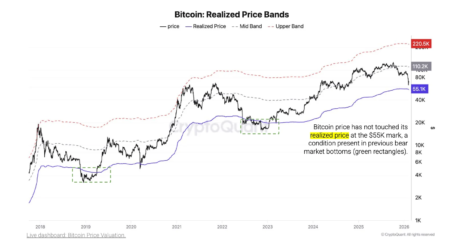
The overall digital asset market contracted by 1.65% in the 24 hours leading up to Thursday’s trading session, with Bitcoin priced at approximately $66,000, which is a stark 48% drop from its all-time high of $126,080 reached in October 2025. This significant price reduction highlights the challenges the cryptocurrency market is currently facing amid evolving economic conditions and regulatory pressures. The correlation between broader market dynamics and virtual currencies is increasingly important to monitor for investors and analysts alike.
Revisions in Digital Asset Forecasts by Financial Institutions
Recent price developments have prompted leading financial institutions to revise their short-term digital asset forecasts. Standard Chartered’s Geoffrey Kendrick predicts a potential decline for Bitcoin, forecasting it could fall to $50,000 or just below, while also lowering the year-end 2026 target to $100,000. This projection represents a significant cut from an earlier $150,000 estimate. Ethereum’s forecast has also been adjusted downward, indicating a shift in market sentiment among institutional analysts.
Long-Term Outlook for Bitcoin and Cryptocurrencies
Despite the downward revisions, JPMorgan has echoed a long-term bullish sentiment for Bitcoin, reaffirming a target of $266,000, while also adjusting its estimate of Bitcoin’s production cost to $77,000 due to decreased hash rate and mining difficulty. Analysts maintain a positive outlook for the broader crypto markets as we approach 2026, suggesting that while short-term volatility persists, the underlying fundamentals could support growth in the long run.
In conclusion, while the recent trends in Bitcoin ETFs show significant outflows and pricing pressure, the overall institutional interest and long-term potential of Bitcoin and the broader cryptocurrency market remain strong. Investors should remain vigilant and informed as market conditions continue to evolve.