



Bitcoin Price Analysis: Understanding the Current Market Dynamics
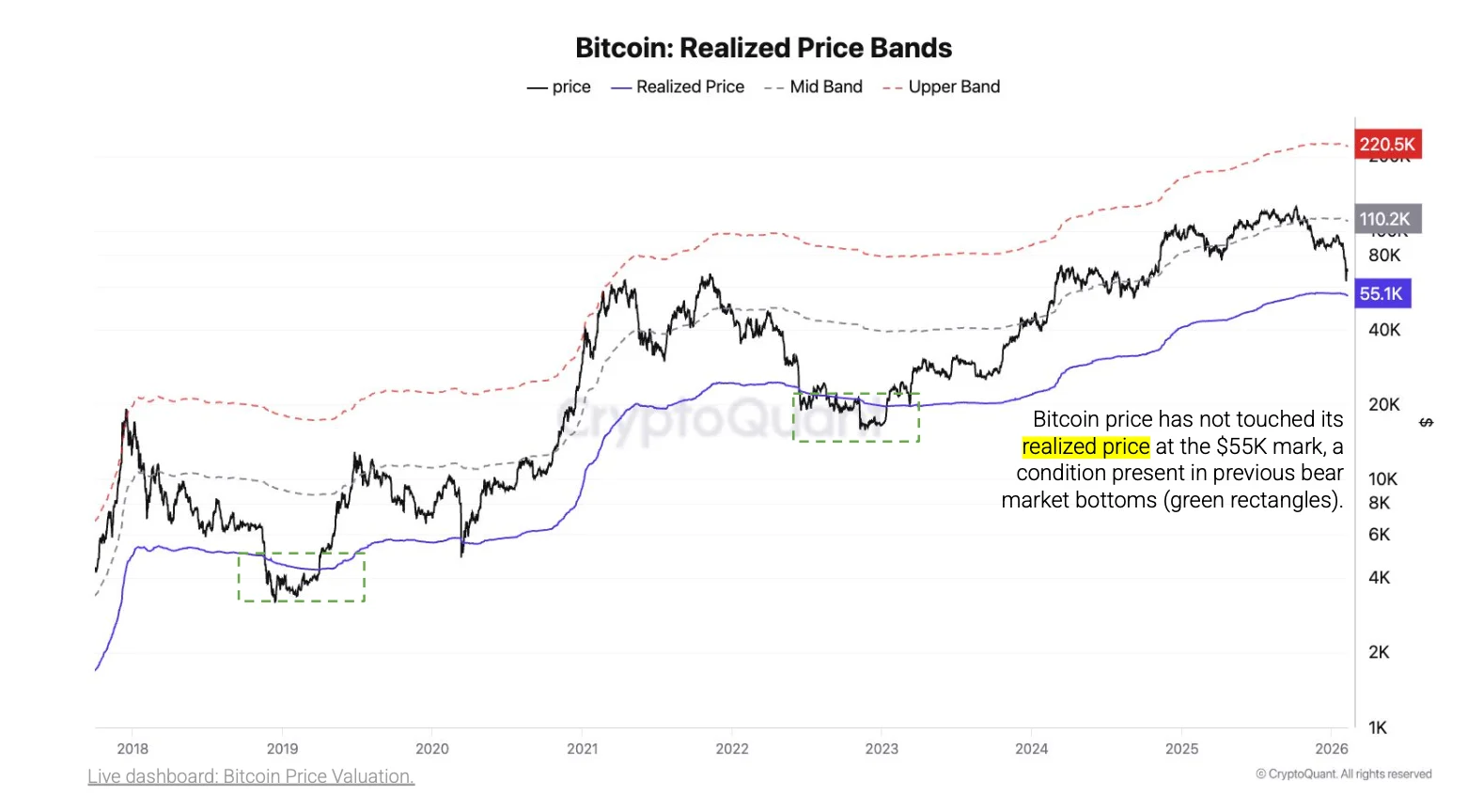
Bitcoin has once again become the focal point of the cryptocurrency market, particularly as analysts delve into the current bear market’s ongoing dynamics. The analytics firm, CryptoQuant, has suggested that Bitcoin’s ultimate bear market bottom may lie around the $55,000 threshold. According to their insights, market bottoms are usually developed over months rather than being established through rapid price drops, which adds a layer of complexity to market predictions.
Historical Context of the Bear Market Bottom
CryptoQuant points out that Bitcoin’s realized price—a key support level in previous bear market cycles—suggests that the cryptocurrency still boasts a significant margin above this crucial benchmark. Currently, Bitcoin is trading over 25% higher than this realized price. Examining historical trends, prices have typically fell around 24% below the realized price after significant market disruptions like the FTX collapse and approximately 30% during the 2018 cycle. In scenarios where these thresholds were reached, Bitcoin has historically spent anywhere from four to six months consolidating before forming a stable base.
Realized Losses Indicate Further Downside Pressure
Another indicator suggesting Bitcoin has not reached a definitive bottom lies in the substantial daily realized losses experienced by holders. For instance, on February 5, Bitcoin reached a staggering $5.4 billion in realized losses when prices plummeted 14% to $62,000. This marks the largest daily losses since March 2023. Yet, despite the alarming figures, CryptoQuant emphasizes that these losses do not create a near-term price bottom. At present, cumulative realized losses remain significantly below the levels typically observed during bear market bottoms, reflecting the still precarious nature of the market.
Valuation Indicators and Their Significance
Several key valuation metrics also lend credence to the notion that Bitcoin’s bottom has not yet been established. The MVRV ratio, which contrasts Bitcoin’s market value with its realized value, remains outside the extreme undervalued territory historically indicative of a market bottom. Moreover, the Net Unrealized Profit and Loss (NUPL) measurement has yet to dip near the approximately 20% unrealized loss threshold that typically characterizes previous cycle low points.
Long-Term Holder Trends and Market Sentiment
An analysis of long-term holder activity further reinforces the claims made by CryptoQuant. Current selling behaviors reflect that long-term holders are predominantly offloading their assets around breakeven prices, in stark contrast to traditional historical benchmarks where these holders typically faced losses of 30%-40% at prior bear market floors. Additionally, around 55% of the Bitcoin supply remains in profit, compared to only 45%-50% at typical cycle lows, indicating that many investors continue to hold onto their positions rather than capitulating.
Bear Market Cycle Indicators
CryptoQuant’s Bull-Bear Market Cycle Indicator enhances this perspective by remaining firmly within the bear market segmentation rather than venturing into what is termed the Extreme Bear Phase. This latter phase, which signifies the start of a prolonged recovery period, historically lasts several months. Therefore, the data suggests that Bitcoin’s bottom has not yet materialized, and that further time and potential market movements are necessary for clearer indications of a sustainable recovery.
Future Price Predictions and Market Outlook
In light of these insights, even prominent financial institutions are adjusting their crypto outlooks. Standard Chartered has recently lowered its short-term Bitcoin outlook, predicting a potential dip to around $50,000 before a recovery may occur by the end of the year. These evolving projections call for investors to remain vigilant and informed regarding the ongoing market fluctuations as they seek to understand the implications of various indicators on Bitcoin’s future price action.
Conclusion
The assessment of Bitcoin’s market dynamics as presented by CryptoQuant and other analysts underscores the complexities surrounding the current bear market. With multiple indicators pointing towards further potential declines before a structural bottom is attained, investors are advised to carefully consider both historical data and present metrics. As a volatile and rapidly evolving asset, Bitcoin continues to invite scrutiny and interest from various stakeholders within the financial ecosystem.