




The Current State of Bitcoin: An Analysis of Market Dynamics
Bitcoin is currently navigating a structurally defensive phase, characterized by price fluctuations between significant key cost-basis levels. Market analysts from Glassnode have reported that Bitcoin remains within a defined range, oscillating between the True Market Mean of approximately $79,200 and the Realized Price around $55,000. This behavior illustrates that the market is absorbing sell-side pressure rather than creating momentum for expansive growth. Bitcoin’s price has shown recurrent support within the $60,000 to $72,000 corridor, which was a significant range during the first half of 2024. However, considerable supply clusters between $82,000 to $97,000 and $100,000 to $117,000 keep exerting downward pressure, creating resistance at these levels.
One critical reason for this resistance is that these upper bands contain coins held at unrealized losses. As a result, holders may opt to sell their assets when prices climb, further complicating any upward movement. Glassnode highlights that short-term holders are currently facing negative profitability, reflecting fragile conviction among new buyers, thus limiting any potential upward momentum. At the time of writing, Bitcoin (BTC) was trading around $66,700, while Ethereum (ETH) remained below $2,000, indicating a broader trend of cautious trading in the cryptocurrency market.
Weak Institutional Demand and Market Sentiment
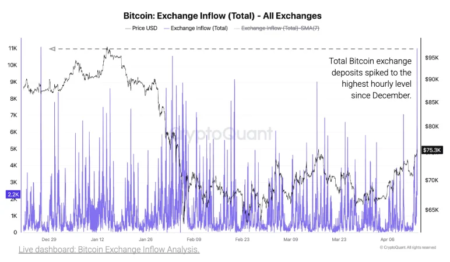
Beyond the on-chain dynamics, off-chain flow data has also presented a cautious market tone. Recent trends in digital asset treasury flows—covering spot ETFs, corporate, and government holdings—have indicated widespread net outflows. This trend is significantly influenced by ETF redemptions, which have accelerated as Bitcoin’s price dipped below $66,000. For instance, U.S. spot Bitcoin ETFs reported a staggering $410 million withdrawal in just one session as prices fell, which raises concerns about the sustainability of any potential recovery.
Despite the spike in spot trading volume during this sell-off, it quickly subsided, implying that the activity was more of a reactive repositioning than a sign of sustained accumulation. Analysts note that perpetual futures premiums have reached neutral levels, indicating that leveraged traders have withdrawn and are not aggressively increasing their exposure. Additionally, the options markets present a similar scenario. Elevated implied volatility across various maturities suggests a persistent demand for downside protection, signifying that many traders are still cautious about further price drops.
Macroeconomic Influences on Bitcoin Prices
Evaluating Bitcoin’s health from a broader perspective shows mixed signals amid global economic challenges. Linh Tran, senior market analyst at XS.com, posits that the rebound from the $60,000 region has stabilized market sentiment; however, it hasn’t been supported by robust capital inflows. He emphasizes that a technical bounce does not necessarily indicate the commencement of a new bullish cycle, especially under prevailing global macroeconomic conditions, like the Federal Reserve maintaining its policy rate between 3.5% and 3.75%, along with the U.S. 10-year Treasury yield hovering around 4.1%.
Tran’s observations highlight that although the total stablecoin market cap has approached $307 billion, sentiment indicators remain in "Extreme Fear" territory. This suggests that capital within the ecosystem is yet to decisively relocate into more risk-oriented investments. Consequently, market participants are being extra cautious, further underscoring the defensive nature of Bitcoin’s current market phase.
Diverging Outlooks Among Analysts and Institutions
The disparity in sentiment is further reflected in the varying outlooks for Bitcoin from major financial institutions and research bodies. Aurelie Barthere, principal research analyst at Nansen, mentions that while ETF outflows continue to dominate overall flows, there are slight signs of institutional players participating in tactical "buy-the-dip" strategies through options rather than directly in the spot market. She states that without a clear catalyst, Bitcoin could remain within a broad range of $52,000 to $70,000.
This cautious forecast is somewhat at odds with predictions from other financial powerhouses. For example, Standard Chartered has warned that Bitcoin may risk falling toward $50,000 and Ether potentially retreating to $1,400 before any signs of a rebound. On the other hand, JPMorgan has identified production cost support near $77,000 and maintains a positive outlook on cryptocurrencies moving into 2026. Bernstein also presents a more optimistic forecast, dubbing the current downturn as the "weakest bitcoin bear case in history" and reaffirming a price target of $150,000 for the year.
Technical Indicators and Price Resistance
As Bitcoin’s price oscillates within the defined corridor, technical analysis reveals several key resistance levels that traders need to monitor closely. The aforementioned clusters of unrealized losses pose significant selling pressure as holders may seek to exit their positions if prices surge. Such resistance characteristics complicate market dynamics and hinder the potential for bullish trends. Without a decisive break above significant resistance levels, the prevailing market sentiment is unlikely to shift significantly.
Additionally, on-chain metrics that monitor miner profitability and network activity may provide insights into forthcoming trends. Miners often respond to price changes by adjusting their behavior based on profitability. An increase in selling pressure from miners during price rallies could deter potential institutional accumulation, further complicating any bullish growth trajectory in the market.
Conclusion: A Cautious Path Ahead for Bitcoin
In summary, Bitcoin appears entrenched in a defensive market phase characterized by resistance from large supply clusters, weak institutional demand, and broader macroeconomic pressures. Ongoing ETF redemptions and cautious trading behaviors indicate that market players are still navigating these uncertain conditions. Analysts are divided on Bitcoin’s future, underscoring the complexities of a rapidly evolving market landscape.
Despite some signs of stabilization in prices, the lack of substantial capital inflows and the prevailing fear in market sentiment suggest that any bullish trends will need clear catalysts to take hold. As investors and analysts keep a close eye on macroeconomic factors and technical indicators, the path forward for Bitcoin remains cautiously optimistic yet riddled with uncertainties. Understanding these dynamics will be crucial for any decision-making as we look ahead into the evolving cryptocurrency landscape.