


Bitcoin’s Struggles: Navigating Between Accumulation and Macro Uncertainty
Bitcoin, the largest cryptocurrency by market capitalization, is currently grappling to reclaim the $70,000 price point, fluctuating around $68,600 as of this week. This struggle arrives amidst a cooling inflation environment and increasing signs of quiet accumulation as investors find themselves at a crossroads between macroeconomic relief and underlying market fragility. The price action has been constrained within a tight range, oscillating between $60,000 and $72,000, with multiple short-lived rallies being stifled by significant overhead supply. Analysts warn that Bitcoin could potentially dip further to the $50,000 level before reaching a definitive bottom.
Institutional Flows and Market Pressure
Institutional interest, a key driver for Bitcoin’s upward momentum, remains under considerable pressure. Timothy Misir, the head of research at BRN, notes that negative institutional flows and a fragile market structure have largely kept cryptocurrency markets subdued. Recently, spot Bitcoin exchange-traded funds (ETFs) recorded a staggering $360 million in net outflows, with Ether products also witnessing significant withdrawals totaling $161 million. While some altcoins like Solana and XRP saw modest inflows, the overall trend indicates a daunting period for institutional demand. According to CoinShares, cryptocurrency exchange-traded products (ETPs) have shed approximately $3.7 billion over the past month, reflecting a heightened degree of risk aversion among institutional players.
The recent shifts in positioning add further caution to an already jittery market. Harvard University recently slashed its Bitcoin ETF holdings by 21%, pivoting instead toward a sizeable $87 million position in Ether. This move exemplifies a trend of selective asset reallocation rather than an expansion of risk across the board, further contributing to the struggle Bitcoin faces in regaining its lost ground.
On-Chain Metrics: A Mixed Bag
On-chain analysis provides additional layers of insight into Bitcoin’s current predicament. The market value to realized value (MVRV) ratio has recently hovered around 1.1, approaching levels historically considered undervalued. Bitcoin’s current price remains significantly below critical markers such as the short-term holder cost basis of approximately $94,000 and the True Market Mean sitting near $80,100. This disparity indicates that many recent investors are presently at a loss, exerting further downward pressure on Bitcoin’s price.
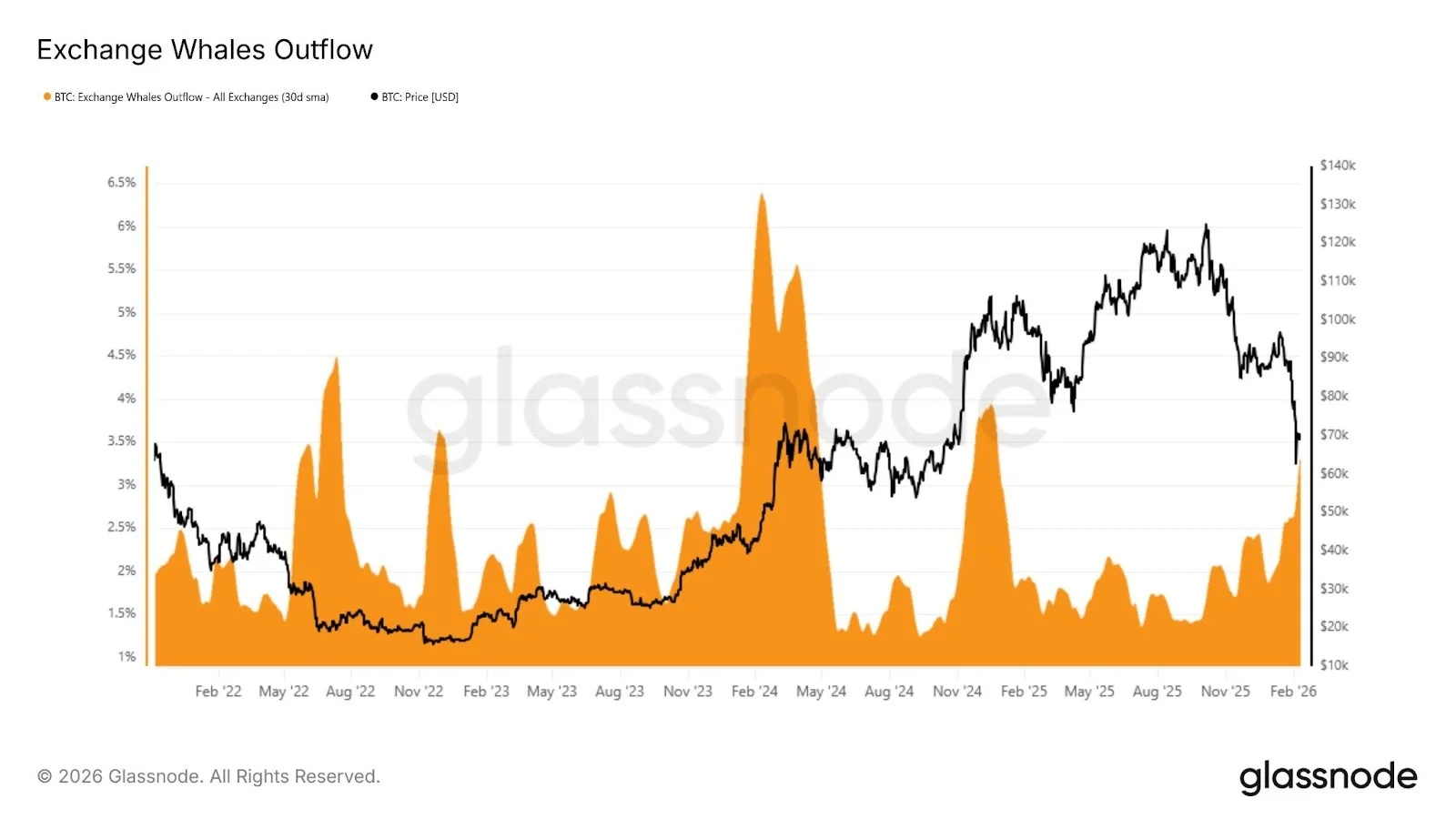
Conversely, aggregate exchange outflows towards large entities have shown an uptick, demonstrating signs of accumulation among long-term holders. Misir notes that this is reminiscent of early 2022 when supply transitioned from weak hands to more steadfast investors, potentially setting the stage for the next cycle of price appreciation. Despite the current turmoil, these on-chain metrics suggest a potential foundational shift within the market.
Derivative Markets and Volatility
The derivatives landscape presents a distinctive asymmetry in positionings. A sizable move upward could lead to the liquidation of approximately $4.3 billion in short positions, compared to only $2.4 billion in long liquidations on a downward move. This outsize risk in short positions introduces an added layer of potential volatility should the market sentiment pivot unexpectedly.
Options markets also reflect structural tension, with recent commentary from Laser Digital noting a significant rise in implied volatility. Specifically, March’s implied volatility has shifted from about 40 to nearly 48 after a selloff that saw figures peak above 55. This volatility remains elevated compared to pre-selloff levels, indicating ongoing macroeconomic uncertainties. As investors grapple with the mixed signals from the market, pricing and volatility dynamics remain crucial in shaping market behavior.
Macroeconomic Influences
Despite the pressures within the cryptocurrency sector, recent macroeconomic data has provided some relief. The U.S. consumer price index recently reported easing inflation at 2.4% year-over-year, slightly below the anticipated 2.5%. Additionally, job growth outpaced expectations, with 130,000 new jobs added in January, contributing to a resilient employment outlook. These factors leave market participants navigating a precarious balance between improving conditions and tight liquidity, as upcoming Federal Open Market Committee (FOMC) minutes and GDP and PCE data are poised to influence market sentiment.
However, despite these calming macro signals, the broader market sentiment remains one of fatigue rather than panic. Bitcoin’s year-to-date performance reveals a downward trajectory of approximately 21%, making this the bleakest first quarter for the cryptocurrency since 2015. Ether, too, is struggling to regain the $2,000 threshold amidst heavy outflows. As the market continues to search for direction, the uncertainty continues to weigh on investor confidence.
A Pivotal Moment for Bitcoin
Looking ahead, the current stage for Bitcoin appears pivotal. With the potential for significant liquidation events on both sides and persistent macroeconomic pressures, analysts suggest that the next major market movement could be sharp and unpredictable. Misir captures this sentiment aptly by stating, "The market shows fatigue, not panic." As liquidity conditions remain tight, focus will shift toward upcoming economic indicators that may inform framework for future market behavior.
In summary, Bitcoin’s struggle to break through the $70,000 mark highlights a confluence of factors, including negative institutional flows, concerning on-chain metrics, and external economic conditions. With uncertainty prevailing, participants should approach the market carefully, as the next decisive move could set the stage for the months to come. A combined assessment of market structure, positionings in derivatives, and prevailing economic indicators will be essential for navigating this complex landscape.
As Bitcoin and broader cryptocurrencies wrestle with these challenges, it remains crucial for investors to stay informed and ready to adapt to evolving market conditions. The forthcoming days and weeks will undoubtedly be critical in setting the tone for the future trajectory of digital assets.