



Understanding the Impact of US PCE Inflation Data on Markets: A Look Ahead
Stock and cryptocurrency market participants worldwide are currently focused on the upcoming release of the US Personal Consumption Expenditures (PCE) inflation data, a metric significantly influencing the Federal Reserve’s interest rate decisions. As the US dollar index approaches 98, a critical juncture is looming for various assets, including stocks, gold, and Bitcoin, all of which are facing downward pressure amid rising market uncertainty. With major Wall Street banks such as JPMorgan, Bank of America, Goldman Sachs, and Morgan Stanley forecasting the upcoming PCE inflation figures, investors are keenly aware of potential implications for their portfolios.
The US Bureau of Economic Analysis is set to release the December PCE inflation report on February 20. Leading up to this announcement, key markets are experiencing turbulence. Following the release of FOMC minutes indicating divisions among Fed officials regarding rate decisions, Bitcoin, gold, and stock indices are trading in the red. JPMorgan predicts a month-over-month rise of 0.37% in both headline and core PCE inflation rates, raising the annual core PCE inflation to 2.9%. This projection reflects a slight increase compared to findings from November, where the rates were 0.2% and 2.8%, respectively.
In contrast, other major financial institutions like Bank of America and Morgan Stanley estimate a marginally higher month-over-month increase of 0.39%-0.40%, alongside a year-over-year rise expected to hit 3%. The headline PCE is similarly projected to rise to 2.9%. While Goldman Sachs, Citi, and UBS have slightly more conservative forecasts, their annual projections still align closely with the estimates from other Wall Street powerhouses. Furthermore, the Wall Street Journal’s Nick Timiraos suggests that forecasters predict December’s core and headline PCE inflation rates at 0.37%, with a 4.5% annualized rate.
Economists are further corroborating the expectations of rising inflation. Predicted core PCE inflation data indicates a rise of 0.3% month-over-month, marking an increase from the previous month. The annualized rate is also projected at 2.9%, surpassing November’s rate of 2.8%. Notably, the Cleveland Fed’s nowcasting model forecasts a year-over-year headline PCE inflation of 2.6% for January, with an annual core PCE rate of 2.78%. This prediction showcases the Fed’s evolving outlook amid subdued inflationary pressures and reinforces the importance of upcoming economic indicators.
Should inflation rise as anticipated, the Federal Reserve could adopt a posture of stabilization, maintaining interest rates between 3.50% and 3.75% during March. This potential stability might further delay any forthcoming interest rate cuts this year. Despite traders scaling back expectations for drastic easing measures, there remains speculation of two 25 basis point rate cuts in the latter half of 2023. Current assessments from the CME FedWatch Tool indicate a 48% chance of a 25 basis point cut by June, yet major financial institutions are leaning toward a first cut in July.
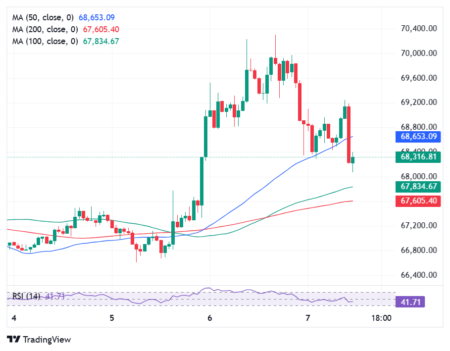
As market participants ponder interest rate trajectories, attention is also drawn to the forthcoming advanced GDP figures for the fourth quarter, especially in light of robust US economic data and hawkish signals. Recent jobless claims hitting a five-week low contributed to a downward trend in Bitcoin’s value, which, however, has recently bounced back. Bitcoin saw a modest increase, rebounding nearly 1% and trading above $67,000, with a 24-hour price fluctuation between $65,637 and $67,456. The trading volume, however, remains subdued, indicating a cautious market environment as participants await both the crypto options expiry and the pivotal US PCE inflation data.
In summary, the interaction between US PCE inflation data and market dynamics continues to captivate the attention of stakeholders across various asset classes. As the inflation figures are expected to rise, its implications can significantly influence the Federal Reserve’s interest rate strategy and consequently alter the landscape for both stock and crypto markets. Investors are advised to remain vigilant and consider these developments when navigating their investment strategies in an increasingly volatile economic environment.