




Bitcoin Wallets Reactivate: Market Insights and Implications
Recently, there has been a notable uptick in activity among dormant Bitcoin wallets, leading to increased speculation in the cryptocurrency market. Over the past few days, large holders have transferred a substantial total of 775 BTC to Binance amidst rising exchange inflows. This trend captured attention when one significant wallet reactivated after an eight-month period of inactivity, sending 500 BTC, approximately worth $36.39 million, to the exchange. Another major holder followed suit, adding 275 BTC, bringing the total whale inflow to around $56.3 million in a mere three hours. These activities often hint at liquidity preparation or strategic moves by seasoned investors aiming to capitalize on market fluctuations.
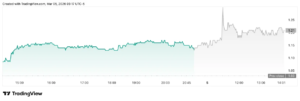
In addition to this reactivation of dormant wallets, Bitcoin’s price has experienced a climb of 6.29% within just 24 hours, now trading close to $72,392. Such price movements suggest that despite heightened exchange deposits, there remains a strong interest in buying among traders. Historically, significant movements from dormant wallets tend to influence market expectations profoundly, particularly as large holders frequently engage in reactivation during phases of recovery. These strategic maneuvers can be crucial, especially when renewed speculative demand aligns with a market rebound.
Bitcoin remains within a broad descending channel, which has determined its price direction since late 2025. As of the latest data, Bitcoin fluctuated around $72,600 after rebounding from a sell-off in February that pushed prices toward the lower boundary of this channel. Support levels in the $68,500 to $67,900 range have been effectively defended, preventing further decline. Furthermore, technical indicators hint at a potential stabilization of price. The 9-day moving average is now positioned above the 21-day average, signaling a tightening short-term price structure. Notably, the Parabolic SAR dots indicate that downside pressure may be weakening, although several resistance levels still pose challenges for upward movement. For a robust recovery, Bitcoin must surpass the crucial resistance level of $78,839, with stronger barriers observed near $84,982 and $97,267.
Interestingly, the recent whale deposits present a contrast to the overall exchange flow data. At present, the BTC spot netflow is around –$43.91 million, indicating that more Bitcoin is exiting exchanges than entering. Negative netflows usually imply ongoing accumulation behavior among long-term investors, who tend to withdraw assets to cold storage as they adopt a long-hold strategy. Nonetheless, the influx from whales introduces fresh liquidity into the market, creating a dual narrative. While large holders are moving coins to exchanges, the broader trend of declining exchange balances suggests that the overall market sentiment remains focused on accumulation rather than liquidation. This divergence illustrates that while whale activity hints at potential market shifts, broader accumulation patterns still dominate Bitcoin’s network.
Another aspect to consider in the current market dynamics is Bitcoin’s Network Value to Transaction (NVT) ratio, which has recently seen a decline to approximately 20.94. This marks a 15.57% decrease in the NVT ratio, positioning it as a critical indicator of network activity compared to market valuation. A falling NVT typically signifies that network usage is increasing relative to Bitcoin’s market capitalization. In this scenario, rising transaction activities emerge against a backdrop of price correction, suggesting that network participants remain actively engaged in transactions even during this period of adjustment. This may signal that despite the current price performance, the utility of the Bitcoin network is strengthening, which can lead to improved demand amongst investors.
To summarize, Bitcoin’s market climate currently exhibits mixed signals. The spike in whale deposits raises the possibility of increased sell-side liquidity in exchanges, yet negative netflows alongside a declining NVT underscore a trend of persistent network activity and accumulation. While Bitcoin continues to navigate through its descending channel, technical indicators hint at potential stabilization. If the buying pressure remains robust, Bitcoin could steadily fortify its recovery structure within the broader market cycle. The resurfacing of long-dormant wallets serves as a reminder of the influence that long-term holders exert on liquidity and market dynamics, particularly during recovery phases. Ultimately, the resilience of Bitcoin’s market will rely on whether widespread accumulation can effectively absorb the supply introduced by sudden whale movements.