




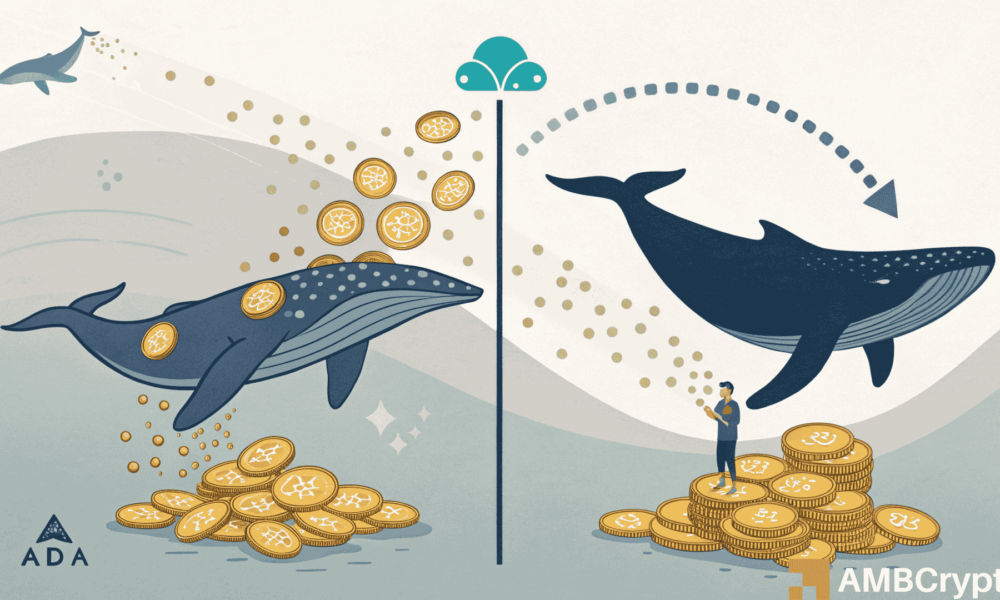
The Diverging Trends in Cardano: Whale Accumulation vs. Retail Selling
A Comprehensive Overview of Cardano’s Current Market Dynamics
Recent on-chain data indicates a significant shift in the Cardano (ADA) ecosystem, one that may be overlooked amid a notable price decline. While ADA has been on a downward trend for the past two months, a closer examination reveals that larger holders, or "whales," are quietly accumulating the asset. This juxtaposition between the buying behavior of major investors and the selling activity of retail traders serves as an essential narrative to unpack.
Whale Accumulation Amid Retail Capitulation
Data from Santiment highlights a stark behavioral divide among ADA holders. Since November 1, wallets containing between 100,000 and 100 million ADA have accumulated an impressive total of 26,770 ADA. In contrast, retail wallets holding less than 100 ADA have offloaded a total of 44,751 ADA during the same timeframe. This scenario—where large holders absorb excess supply while smaller traders exit—has historically signalled potential bullish reversals for ADA, especially near the exhaustion point of bearish cycles. It suggests that seasoned investors may see value in the current price levels that eludes the average retail trader.
Price Action and Market Sentiment
Despite these bullish accumulation trends, ADA’s price remains under pressure, hovering around $0.40. The asset is locked in an ongoing pattern of lower highs and lower lows, indicating weak momentum. The Relative Strength Index (RSI) sits near 40, pointing to the fact that while selling pressure exists, it may be waning. Although there hasn’t been a significant breakdown in mid-term support levels, buyers have yet to reclaim control, resulting in a disconnect between price action and underlying fundamentals.
Importance of Diverging Trends
Historically, Cardano has shown a tendency to rally under specific conditions: when "smart money" increases its holdings, retail investors exhibit fear, and Bitcoin stabilizes after volatility. Santiment highlights that these rallies often occur once Bitcoin calms down following significant market fluctuations. Currently, Bitcoin remains sensitive to macroeconomic conditions and uncertainties arising from the Federal Open Market Committee (FOMC) meetings, putting Cardano in a holding pattern. However, the accumulation by large holders indicates a robust confidence in ADA’s long-term prospects, driven by factors such as staking yields, potential network upgrades, and market corrections after a prolonged decline.
The Path Forward for ADA
Looking ahead, ADA’s future largely hinges on Bitcoin’s ability to stabilize and improve overall market liquidity. The accumulation of ADA by whales amidst a lack of price movement may set the stage for a significant trend reversal if broader market sentiment stabilizes. The ongoing accumulation suggests that informed capital could be positioning itself for a rally, while retail behavior mostly indicates short-term capitulation—often a late-stage phenomenon in downtrends.
Conclusion: The Case for Cautious Optimism
In summary, the contrasting behaviors of Cardano’s whale accumulation and retail selling provide important insights into the market’s current state. Historically, such conditions have preceded price recoveries, signifying that informed investors may be laying the groundwork for future growth. Yet, as ADA’s price continues to struggle, confirming this trend requires broader market stability and a renewed bullish sentiment. The next steps for ADA will depend on the stabilization of Bitcoin and the overall liquidity in the cryptocurrency market, making it a pivotal moment for both current and prospective investors.