



The Dynamic Evolution of Stablecoins: Growth, Competition, and Market Trends
In recent months, the stablecoin landscape has witnessed remarkable growth, with the total circulating supply skyrocketing from approximately $140 billion in early 2024 to around $266 billion. This robust increase is primarily driven by Tether (USDT), which has seen its supply grow from nearly $110 billion to about $193 billion. Nevertheless, deeper analysis of network-level data reveals that Tether’s dominance may be waning, particularly in Ethereum Virtual Machine (EVM) ecosystems, as more compliant and regulatory-focused stablecoins are emerging.
Expanding Ecosystem and Dominance Shift
Currently, stablecoins within major EVM networks account for roughly $190.7 billion of the overall market. Ethereum (ETH) takes the lead with an impressive $159.9 billion. Comparatively, Solana (SOL) and BNB Chain (BNB) account for $15.4 billion and $14.4 billion, respectively. Notably, Tether (USDT) constitutes approximately $90.4 billion, making up nearly 47% of the EVM total. However, this figure is below USDT’s broader global share of roughly 59%, largely due to a significant portion of its supply being active on non-EVM networks like TRON (TRX).
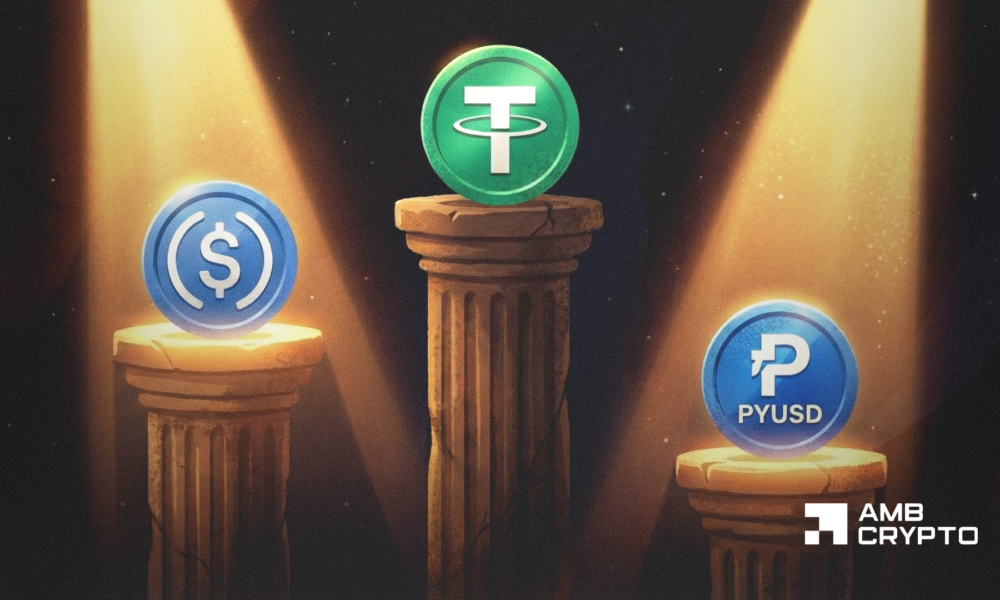
The trends in issuer-level supply reveal a notable rotation in the market. While USDT’s overall supply has decreased by 1.02% over the past month, competitors like USD Coin (USDC) and PayPal USD (PYUSD) have experienced significant growth of 7.42% and 16.66%, respectively. This shift indicates that as compliant issuers scale their market presence, the stablecoin arena is moving toward a regulatory-aligned infrastructure that emphasizes transparency over mere liquidity dominance.
Stablecoins as Global Payment Solutions
An emerging trend in stablecoin usage is their growing role as payment rails rather than merely vehicles for speculative trading. By late 2025, monthly payment volumes reached approximately $10.2 billion, translating to an annualized figure exceeding $120 billion. Additionally, peer-to-peer transfers contributed around $19 billion each year, with crypto card spending nearing $18 billion. This segment has seen an astonishing compounded annual growth rate of 106% since 2023, highlighting stablecoins’ increasing integration into real-world transactions.
When removing exchange noise, the actual payments facilitated by stablecoins amount to nearly $390 billion annually, with remittances accounting for about $90 billion. The increasing frequency of small transfers, particularly on networks like Polygon, indicates a burgeoning micro-payment ecosystem that enhances the velocity of USDC and solidifies stablecoins’ role in transaction infrastructure, reshaping the financial landscape.
Supply Distribution and DeFi Growth
The distribution of stablecoin supply reinforces the notion of evolving utility. Centralized exchanges now hold approximately $80 billion, which makes up 26% of the $304 billion total supply. Meanwhile, decentralized finance (DeFi) balances are expanding, with yield protocols accounting for $9.3 billion. This growth in DeFi highlights a shift towards generating passive income through stablecoin investments as users seek innovative financial solutions.
In addition to DeFi, decentralized exchange (DEX) volume averages around $8.23 billion daily, showcasing a thriving environment for peer-to-peer trading. The demand for cross-chain liquidity is also evident, with significant movements such as $91.65 million USDC shifting to Arbitrum within a 24-hour period, further underscoring the necessity for versatile and accessible stablecoin solutions.
Impact of Regulatory Clarity on Institutional Adoption
The evolving regulatory landscape is significantly impacting the competitive dynamics of the stablecoin market, with institutions increasingly favoring transparent and compliant issuers. This trend is exemplified by the robust growth of USD Coin (USDC), which is underpinned by $75.5 billion in reserves. Over the last 30 days, USDC’s circulation expanded by $3.6 billion, demonstrating a clear influx of institutional capital aligning with regulatory preferences.
Likewise, PayPal USD (PYUSD) has gained traction, achieving a market cap of $4.19 billion, further accentuating the demand for regulated stablecoin alternatives in the marketplace. Despite Tether’s continued dominance, with $192.88 billion in reserves and a market share of approximately 59%, competition is intensifying as issuers adapt to a landscape increasingly focused on compliance, transparency, and institutional-grade infrastructure.
Conclusion: A Market in Transition
As the stablecoin market evolves, Tether (USDT) continues to be the leader by supply. However, its diminishing EVM market share coupled with a deceleration in growth signals that competition is becoming more complex and diversified. The emergence and rapid growth of USD Coin (USDC) and PayPal USD (PYUSD) reflect a market that is increasingly directed by payment functionality, DeFi applications, and a compliance-oriented infrastructure. This transformation not only enhances the resilience of the stablecoin ecosystem but also sets the stage for a more robust and regulated financial future, integrating cryptocurrencies into everyday transactions and fostering greater adoption across various sectors.
The shift from pure liquidity dominance to a focus on regulatory compliance, transaction efficiency, and cross-border settlement illustrates the dynamic nature of stablecoins, positioning them as crucial components of modern financial infrastructure. As these trends continue, it will be essential for stakeholders to navigate the evolving landscape carefully, capitalizing on emerging opportunities while staying attuned to regulatory developments.