



Strategy’s Bitcoin Accumulation: Opportunities and Risks
In the evolving landscape of cryptocurrency, Strategy’s aggressive accumulation of Bitcoin (BTC) through its STRC perpetual preferred stock has raised both interest and concern among investors. Research and brokerage firm K33 has highlighted that while this approach facilitates substantial Bitcoin purchases, it also introduces structural risks influenced by market sentiment and pricing dynamics. This article will explore the implications of Strategy’s methods, the mechanisms of its preferred stock, and the potential risks that could impact Bitcoin’s market stability.
The Mechanics of STRC in Bitcoin Acquisition
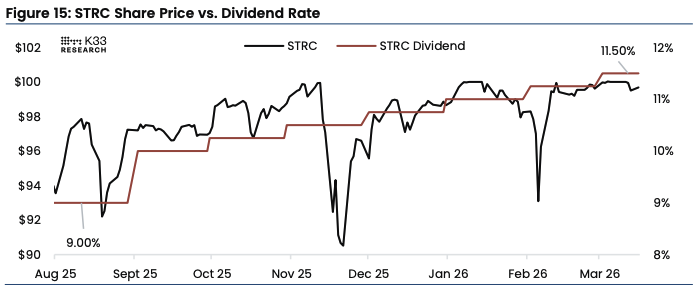
Recently, Strategy announced a record-breaking $1.57 billion in Bitcoin purchases, with a staggering $1.18 billion sourced from at-the-market sales of STRC. Unlike common equity, STRC is a perpetual preferred stock designed to trade near a $100 target while yielding a variable monthly dividend—which currently stands at an annualized rate of roughly 11.5%. By capitalizing on investor demand for attractive yield, Strategy can leverage STRC to boost its Bitcoin portfolio. However, this capital-raising strategy hinges on maintaining the stock’s target price and sustaining market confidence, as outlined by K33’s Head of Research, Vetle Lunde.
Risks Associated with STRC and Market Sentiment
While the accumulation strategy offers substantial benefits in favorable conditions, it is not without risks. Lunde points out that STRC holders face a dual-edged sword: while dividends provide a steady income stream, there’s a constrained upside during market surges, and notable downside risks during market declines. As STRC has witnessed multiple declines in value ranging from 5% to 10%, prolonged weakness below its target price may erode confidence in its stability. The possibility of STRC shifting to a credit-like risk profile poses additional concerns for its holders.
Interdependence and Structural Complexity
K33’s analysis elaborates on the interdependencies within this financial structure. The successful operation of STRC not only depends on its price stability but also requires that Strategy’s equity trades above its net asset value—a status that is largely influenced by market sentiment. Should both conditions deteriorate simultaneously, especially in bearish markets, this could lead to increased vulnerability for Strategy and its stakeholders. Despite holding an approximately $2.25 billion cash reserve (enough to sustain around 25 months of dividend payments), there’s a growing complexity compared to direct Bitcoin investments, which do not share these sentiment-driven dependencies.
Bitcoin Market Impacts from STRC Accumulation
Despite the aforementioned risks, the launch of STRC has indeed facilitated significant Bitcoin accumulation. According to K33, Strategy added 40,331 BTC over two weeks, marking its fourth-largest purchase on record. In the last week alone, the firm purchased 22,337 BTC, representing one of its top-five weekly acquisitions. In bullish market conditions, this mechanism serves as a feedback loop, where capital raised through STRC issuance feeds back into further Bitcoin buying. This dynamic can enhance the overall market performance of Bitcoin, reinforcing its perception as a valuable alternative asset.
Bitcoin’s Resilience in Broader Market Context
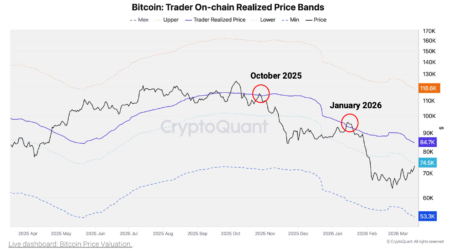
Interestingly, Bitcoin’s recent market performance has contrasted with downtrends in other investment sectors. Since the market closed on February 27, Bitcoin has spiked roughly 13%, while traditional markets like the Nasdaq and S&P 500 have fallen. This relative strength can be attributed to Bitcoin’s prior positioning as “underowned, overshorted, and oversold,” which has alleviated selling pressure and fostered a rebound. As investors adjust their perspectives on Bitcoin’s role within the broader asset spectrum, its appeal as a scarce alternative asset becomes increasingly evident.
Conclusion: Navigating Opportunities and Risks Ahead
In summary, while Strategy’s aggressive Bitcoin acquisition strategy through STRC offers innovative avenues for capital access and market positioning, it also presents inherent risks tied to market sentiment and pricing. As investors and analysts navigate this complex landscape, understanding the interplay of these factors will be essential for making informed decisions. The approach bolstered by STRC not only increases sheer purchasing power but also highlights the delicate balance of confidence in both the cryptocurrency market and the mechanisms underpinning it. While current conditions may favor Bitcoin accumulation, ongoing scrutiny will be necessary to mitigate the potential risks that could arise as market dynamics evolve.