



Crypto Flow Analysis Q1 2026: A Shift in Trends
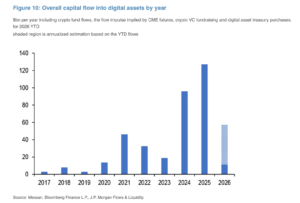
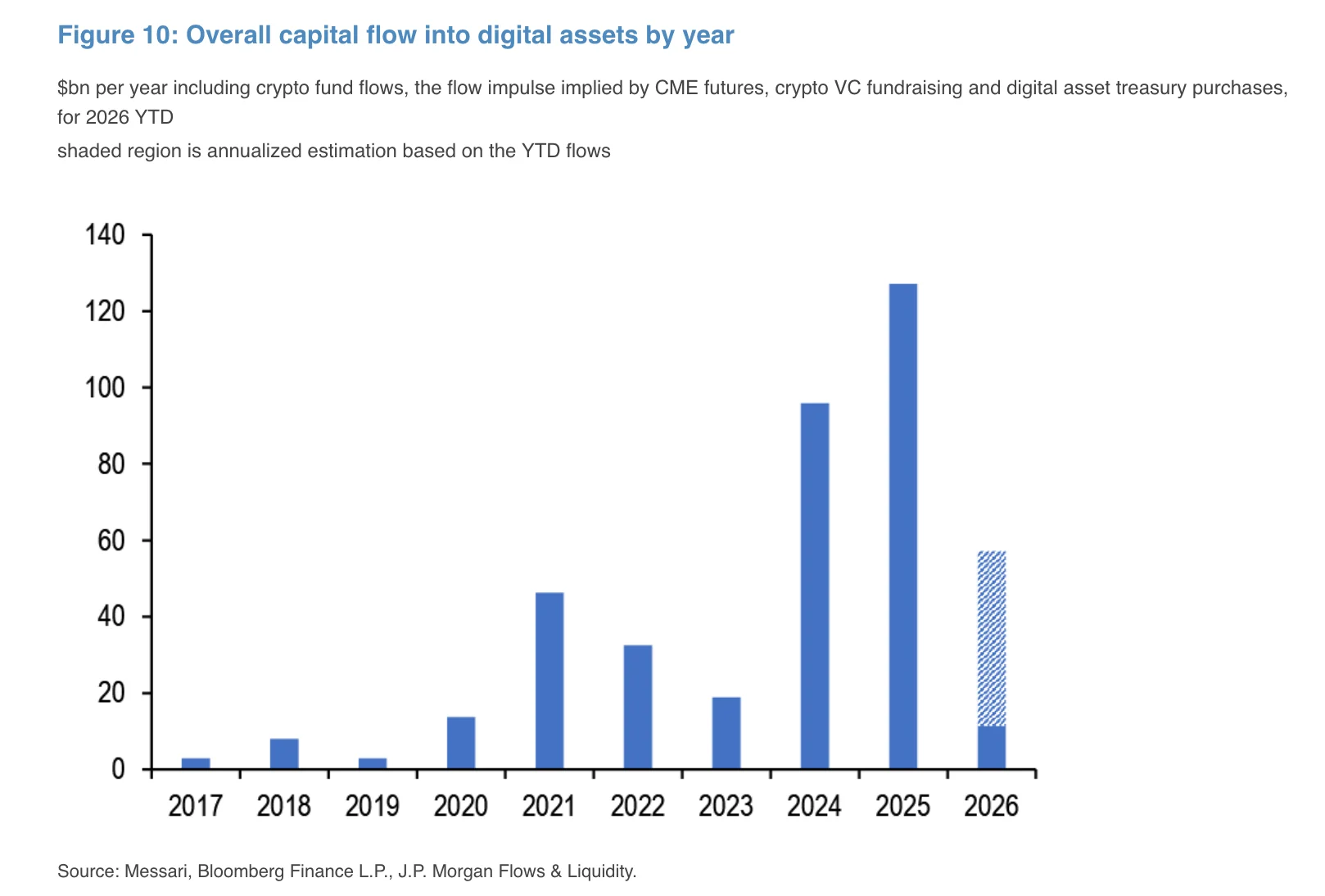
In the first quarter of 2026, crypto flows experienced a significant downturn, contrary to earlier expectations of growth. According to a report by JPMorgan analysts led by Managing Director Nikolaos Panigirtzoglou, overall digital asset flows diminished to approximately $11 billion. This figure represents about one-third of the $33 billion seen during the same period in 2025, indicating a troubling trend for the cryptocurrency market. The annualized flow pace now stands at around $44 billion, markedly lower than last year’s record inflow of $130 billion. This decline reflects a broader sentiment in a market that seems to be grappling with various pressures, including economic conditions and investor sentiment.
The analysis by JPMorgan combines various factors to estimate total digital asset flows, including crypto fund flows, CME futures activity, venture capital (VC) funding in the crypto sector, and corporate treasury purchases. Notably, corporate treasury activity has been one of the primary drivers of inflows in Q1 2026, primarily attributed to companies like Michael Saylor’s Strategy taking significant positions in Bitcoin. However, this new influx of capital is not enough to remedy broader market decline, which has seen weaker retail and institutional investor participation compared to previous years.
Institutional demand through futures trading appears to have slackened in Q1 2026, marking a stark contrast to the more robust positioning seen during 2024 and 2025. Data from the CME highlights this decline, as both spot Bitcoin and Ethereum ETFs faced outflows, particularly in January. Although Bitcoin ETFs witnessed some inflows in March, these early-year outflows suggest a worrying trend among institutional investors. The overall sentiment indicates that while corporate treasuries might be stepping in, retail and institutional investor confidence remains tepid, keeping overall market sentiment in check.
Corporate purchases of Bitcoin are notable as one of the main inflow drivers, although the activity has become more fragmented than in previous years. A handful of companies, including Strategy, continue to accumulate Bitcoin aggressively, while smaller firms have resorted to selling off their holdings to finance stock buybacks or other operations. Interestingly, Strategy has communicated its intent to maintain this trajectory by financing its Bitcoin purchases primarily through equity issuance. This strategic pivot signals a defensive approach among many corporate treasuries, which influences the overall landscape of digital asset purchasing behavior.
On the contrary, Bitcoin miners have transitioned into net sellers in Q1 2026. Several listed mining companies opted to sell off their Bitcoin or use it as collateral to bolster liquidity and manage capital expenditures. This development has been linked to tighter financial conditions within the sector and reflects a growing discipline among miners amid fluctuating market conditions. Instincts toward artificial intelligence have also seemingly influenced some of these operational shifts, prompting miners to reconsider their asset management strategies in light of evolving market dynamics.
While crypto venture capital funding continues to show promise—tracking at an annualized pace more substantial than in the previous two years—the participation of investors has notably decreased. The deal count has declined, with funding now being more concentrated in larger rounds from established firms. This suggests that, although capital remains in the space, a more cautious and streamlined approach is being adopted. Overall, the first quarter of 2026 illustrates a marked slowdown in digital asset flows compared to previous years, primarily fueled by corporate treasury purchases and concentrated crypto VC funding, which overshadow the lackluster performance from retail and institutional investors.
In summary, the initial quarter of 2026 has unveiled crucial changes in the dynamics of crypto flows, showcasing a stark contrast to previous years. While corporate treasuries are stepping up their Bitcoin acquisition, broader market behavior reflects hesitance, with minimal participation from retail and institutional sectors. Although venture capital activity remains a bright spot, it is increasingly concentrated, emphasizing the need for strategic adaptation within the rapidly evolving crypto landscape. As we move further into 2026, the ongoing adaptation and resilience of market players will be essential in navigating these turbulent waters.