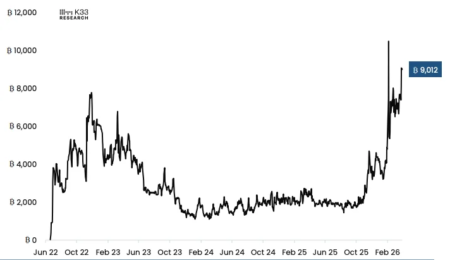





Bitcoin Demand Analysis: Institutional Buying Amid Weak Market Conditions
Bitcoin (BTC) has been experiencing a notable decrease in demand, as highlighted by recent data from on-chain analytics firm CryptoQuant. Despite some signs of institutional buying—most notably through exchange-traded funds (ETFs) and the investment strategies of figures like Michael Saylor—the overall market remains under significant selling pressure. As of late March 2026, the apparent demand for Bitcoin has contracted sharply, with a 30-day apparent demand growth figure showing a decline of approximately 63,000 BTC. This contraction indicates a prevailing bearish sentiment that is more prominent than any institutional buying that may be occurring.
Institutional Buying Is Not Enough
Despite the uptick in Bitcoin purchases by ETFs, where buying increased to around 50,000 BTC, the largest figure since October 2025, and the ongoing accumulation strategies from prominent investors such as Michael Saylor, this influx has not been sufficient to counteract the existing downward trends in demand. CryptoQuant notes that the total apparent demand continues to dwindle, relegating institutional buying to a secondary role amid a broader market environment characterized by significant selling from retail investors and other market participants. This suggests that while institutional interest might have intensified, it has not yet led to a meaningful rebound in overall market demand.
Whale Behavior and Market Dynamics
The behavior of large Bitcoin holders, commonly referred to as "whales," has compounded the market’s difficulties. These investors, holding between 1,000 to 10,000 BTC, have become net distributors, significantly reducing their holdings recently. CryptoQuant indicates that whale positions have declined by about 188,000 BTC over the past year. After accumulating more than 200,000 BTC in 2024, whales began decreasing their holdings around mid-2025, accelerating the pace of distribution into 2026. This trend highlights the structural nature of the current demand contraction rather than a temporary fluctuation, suggesting prolonged challenges for Bitcoin’s market price.
Middle-Tier Holders: A Shift in Accumulation Patterns
Interestingly, the behavior of mid-tier holders or "dolphins," defined as those holding between 100 to 1,000 BTC, reveals a different dynamic. Though these investors are still accumulating Bitcoin on a yearly basis, their pace has notably slowed. Since November 2025, their accumulation has declined significantly from a cycle high of nearly 1 million BTC to 429,000 BTC. This more than 60% drop in annual holdings emphasizes the broader trend of diminished buying interest across all tiers of investors, particularly as market conditions deteriorate.
U.S. Investor Sentiment: A Negative Trend
The overall sentiment among U.S. investors appears to be weakening as well. The Coinbase Premium, which serves as an indicator of U.S. buying interest, has remained predominantly negative, highlighting the lack of significant re-entry into the market despite Bitcoin prices fluctuating between $65,000 and $70,000. This persistent downturn corroborates the contraction in demand observed in various on-chain metrics, further complicating the landscape for Bitcoin’s future price movements and market health.
Potential for Short-term Resurgence
While the current outlook appears bearish, CryptoQuant posits that a short-term price bounce could be achievable if macroeconomic conditions show improvement, particularly amid geopolitical developments like the U.S.-Iran conflict. A stabilization of such tensions could act as a catalyst for a price rally, potentially driving Bitcoin toward key resistance levels between $71,500 and $81,200. Such levels have historically served as significant resistance during bear market conditions, and achieving these may indicate a decoupling from the predominant selling pressure currently reigning over the market.
In summary, the Bitcoin market is currently grappling with a significant contraction in demand that persists despite institutional interest and varying holder behaviors. The sell-off by whales, coupled with weakened sentiment among retail and mid-tier investors, presents an enduring challenge. However, potential macroeconomic shifts could offer rays of hope for short-term price recovery and reinvigorate interest in Bitcoin as a leading digital asset.
Conclusion
In conclusion, although the Bitcoin market is currently characterized by weak demand and pressing selling pressures, a close watch on macroeconomic conditions and investor sentiment can help identify potential opportunities for recovery. Understanding the complexities of market dynamics, including the behaviors of various investor tiers and institutional influences, can provide valuable insights for anyone looking to navigate the turbulent waters of Bitcoin investment. As always, market participants should remain vigilant and informed to capitalize on emerging trends in this ever-evolving landscape.