



Bitcoin’s Price Dynamics Amid Macro Influences: A Comprehensive Overview
Bitcoin recently traded below the $90,000 mark as the cryptocurrency market braces for a week primed with significant macroeconomic data. As analysts weigh the potential implications of impending U.S. inflation reports, traders are adopting a cautious stance. Ether remains stable near $3,100, while BNB and Solana are oscillating around $890 and $132, respectively. This price action mirrors a broader cooling of sentiment that stemmed from last week’s hawkish interest rate cut from the Federal Reserve, which has led to muted market reactions across both spot and derivatives sectors.
The Macro Calendar Takes Center Stage
With the Federal Open Market Committee (FOMC) meetings concluded for 2025, markets have shifted their focus from direct reactions to the recent rate cut towards upcoming U.S. economic data that could reshape liquidity conditions in the future. Among the critical data points are retail sales, jobless claims, the Consumer Price Index (CPI), Personal Consumption Expenditures (PCE), and several Fed appearances. Timothy Misir, head of research at BRN, stated that the current macroeconomic landscape is pivotal, implying that inflation figures will heavily influence market sentiment. Upside surprises in inflation could reinforce the hawkish narrative, whereas softer data might reopen windows for risk assets, especially as the year winds down.
The Unlikely "Santa Rally"
Market observers are now grappling with the Fed’s December decision, which maintained a cautious tone despite a modest 25-basis point cut. According to reports, the anticipated "Santa rally" appears increasingly unlikely. Bitcoin has been struggling to break through key resistance zones since the interest rate announcement, dampening speculative sentiment further. The interplay between rate expectations and crypto market movements has created an air of uncertainty that leaves investors apprehensive as the year closes.
Leverage Liquidations and Mining Dynamics
Recent data indicates a wave of liquidations in the cryptocurrency space, totaling approximately $298 million over the past 24 hours. A staggering 80% of these positions were long-held, according to CoinGlass statistics shared by Misir. While this liquidation serves to decrease speculative leverage, it hasn’t translated into renewed bullish momentum for Bitcoin. Additionally, the Bitcoin mining industry is experiencing disruptions, particularly in China’s Xinjiang region, where reported shutdowns have caused a decline in the network’s hashrate by around 8%. Although such short-term challenges might be disruptive, past occurrences suggest they can lead to tighter supply and eventual market stabilization.
Shifting Onchain Behavior Among Larger Holders
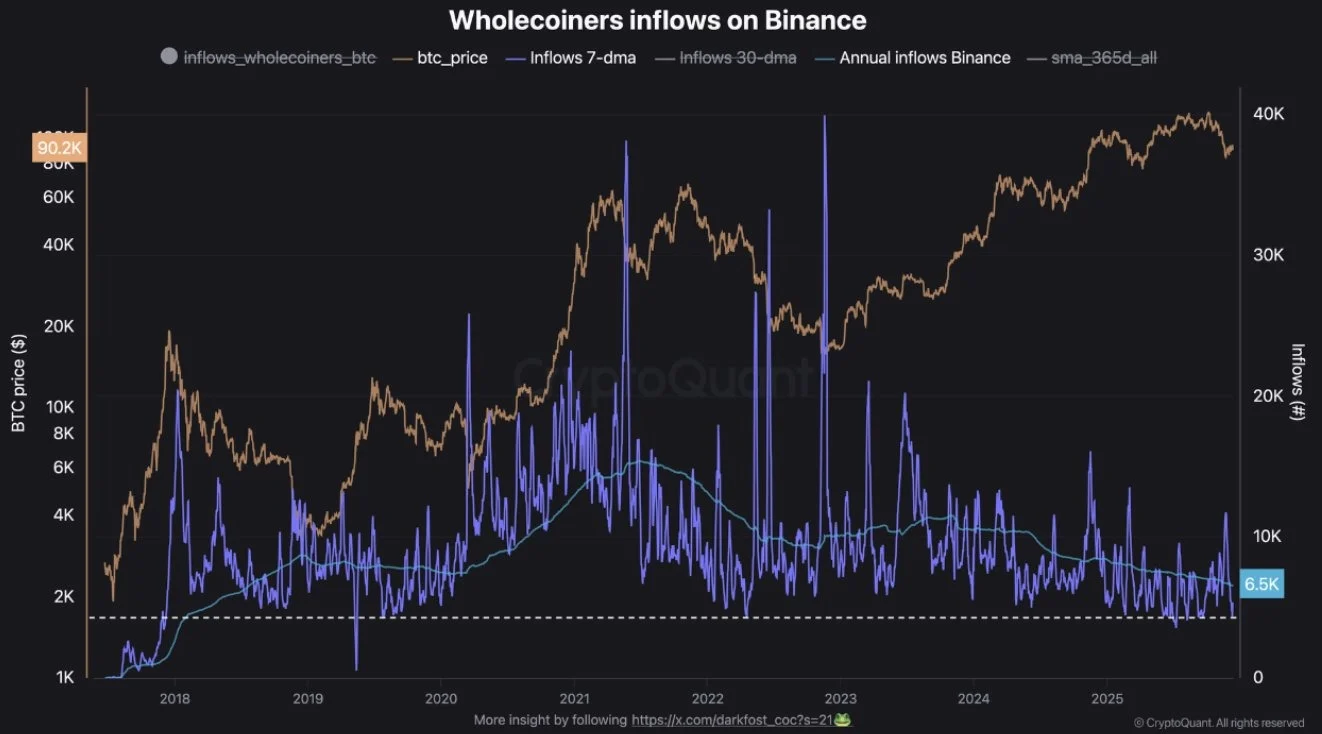
On the supply side, onchain data offers intriguing insights into the behavior of larger Bitcoin holders. According to CryptoQuant, inflows of wholecoiner transactions (those involving over 1 BTC) onto exchanges like Binance have plummeted to levels reminiscent of 2018. With yearly averages dipping to about 6,500 BTC and weekly averages around 5,200 BTC, this trend indicates reduced selling intentions among significant Bitcoin investors. Misir correlates this observation with larger wallets, emphasizing that easing internal stress could be a precursor to a more favorable market outlook even amidst current price stagnation.
A Reevaluation of Bitcoin’s Future Outlook
Standard Chartered’s recent outlook for Bitcoin highlights a growing sense of market hesitation. The bank has revised its end-2025 Bitcoin price prediction from $200,000 to $100,000, attributing this adjustment to a slowdown in corporate treasury acquisitions and less-than-expected ETF inflows. Despite reiterating a long-term target of $500,000 for Bitcoin, the bank has postponed this projection from 2028 to 2030. This cautious stance has heightened market sensitivity, as lower liquidity and mixed positioning contribute to a wait-and-see atmosphere ahead of critical inflation data and rate expectations.
Capital Preservation Over Aggression
As the cryptocurrency market continues to navigate these complexities, analysts stress the importance of capital preservation over tactical moves. The impending inflation data will likely be the determining factor for the next directional shift in the market. Until then, the focus remains on risk management rather than pursuit of short-term gains. As 2023 draws to a close, the interplay between macroeconomic factors and cryptocurrency dynamics will remain a vital area of observation for traders and investors alike.
In conclusion, as Bitcoin and other cryptocurrencies adapt to prevailing economic conditions, remaining mindful of macro influences will be crucial in shaping investment strategies. The forthcoming data releases stand to inform market direction, particularly as the horizon for 2024 approaches.