


Bitcoin’s Market Structure: Comparison with Previous Bear Stages
Bitcoin (BTC) has recently exhibited market characteristics reminiscent of the late phases of the 2022 bear market, indicating a potential consolidation phase rather than an imminent breakout. Research from K33, a brokerage firm, highlights key indicators—including derivatives positioning, exchange-traded fund (ETF) flows, and macroeconomic factors—that suggest a similar trajectory to those observed during critical downturn periods in late 2022.
Indicators of Market Movement
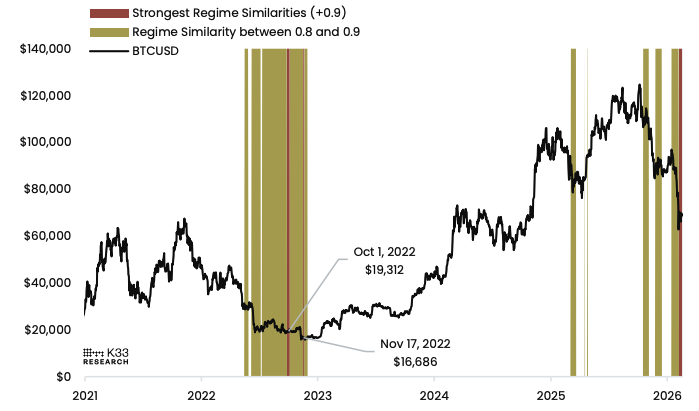
According to Vetle Lunde, K33’s Head of Research, their proprietary regime indicator reveals striking resemblances to market conditions in September and November 2022, correlating with significant lows in Bitcoin’s price. Despite these similarities suggesting a bottom, Lunde emphasized that past performance was often followed by sluggish price activity and extended consolidation phases, which may result in limited forward returns.
The report indicates that since January, Bitcoin has dropped nearly 28% from its highs. Alongside this price decline, various derivatives signals point to defensive positioning, further solidifying the idea that traders are currently unwinding long positions. Remarkably, funding rates have remained negative for over 11 consecutive days, alongside a decrease in notional open interest to below 260,000 BTC. This caution implies that the risk of derivatives-driven market squeezes is low in the near term.
A Consolidation Phase Ahead
K33’s analysis suggests that the current market regime heavily emphasizes derivatives data, which reflects real-time demand for hedging and upward price exposure. Negative yields are indicative of higher hedging demand, while a reduction in open interest signifies that traders are exiting positions rather than shifting into new ones. Although the current indicators align with traditional market bottom signals, they do not necessarily anticipate swift recovery.
Historical data indicates that similar market regimes have yielded an average of about 3% in returns over 90 days during strongly analogous environments. Conversely, moderate similarities led to slightly negative forward returns. Lunde projects that Bitcoin may be trapped within a trading range of $60,000 to $75,000 for an extended period. He identified the current pricing levels as attractive for potential buyers but cautioned that patience is essential during this phase of consolidation.
Reduced Market Activity
Following recent sell-offs, Bitcoin’s market activity has noticeably decreased. Spot trading volumes have plummeted by 59% week-over-week, while futures open interest has sunk to four-month lows. This trend is consistent with markets experiencing drawdowns and attempting to stabilize. Lunde points out that volatility is beginning to normalize as prices settle, further supporting the expectation of a quieter trading environment in the near future.
Institutional Investors Exercise Caution
Institutional traders seem to share this cautious sentiment, as indicated by their muted activity on the CME. Diminished yields and shallow open interest reflect a lack of direction among institutional investors. Notably, Bitcoin exchange-traded products (ETPs) encountered a record drawdown of 103,113 BTC from peak holdings since October. Despite this retracement, around 93% of peak exposure has been preserved, suggesting that while institutional investors have reduced some exposure, many have maintained their core positions during this downturn.
Sentiment Indicators and Their Implications
Currently, sentiment indicators reveal an air of extreme pessimism, although the predictive value of such indicators is questioned. The Crypto Fear and Greed Index recently reached an all-time low of 5, signifying widespread fear. However, Lunde observed that such extreme fear readings historically don’t serve as reliable predictors for strong market rebounds. Historically, purchasing Bitcoin during periods of extreme fear has resulted in average 90-day returns of just 2.4%, which starkly contrasts with returns during periods of extreme greed, where returns soared to about 95%.
Conclusion: Market Stability Over Immediate Recovery
K33’s analysis concludes that Bitcoin’s existing market regime bears similarities to previous late-stage bear market conditions, indicating that while downside risks might be limited, recovery could take more time. The drawn-out stabilization phase that followed the 2022 market bottom serves as a poignant reminder of the potential for prolonged consolidation in the current environment. As Bitcoin navigates this landscape, investors and traders alike should brace for a period of slow movement rather than a quick return to bullish trends.
In summary, Bitcoin’s market dynamics suggest that the current environment may be more suitable for cautious observation rather than immediate action.