




Title: U.S. CPI Inflation Drops to 2.7%: A Bullish Sign for Bitcoin and Crypto Market
Paragraph 1: Understanding CPI Inflation and Its Impact on Bitcoin Investments
Recently, U.S. consumer price index (CPI) inflation data revealed a significant decrease, landing at 2.7% year-over-year (YoY) for November. This drop is well below analyst expectations, forecasted at 3%, and significantly better than the previous month’s figure of 3.1%. This unexpected reduction in inflation has sparked optimism in the cryptocurrency market, especially for Bitcoin (BTC). Investors are closely watching these economic indicators, as they often guide monetary policy decisions made by the Federal Reserve.
Paragraph 2: Economic Data and Bitcoin Price Surge
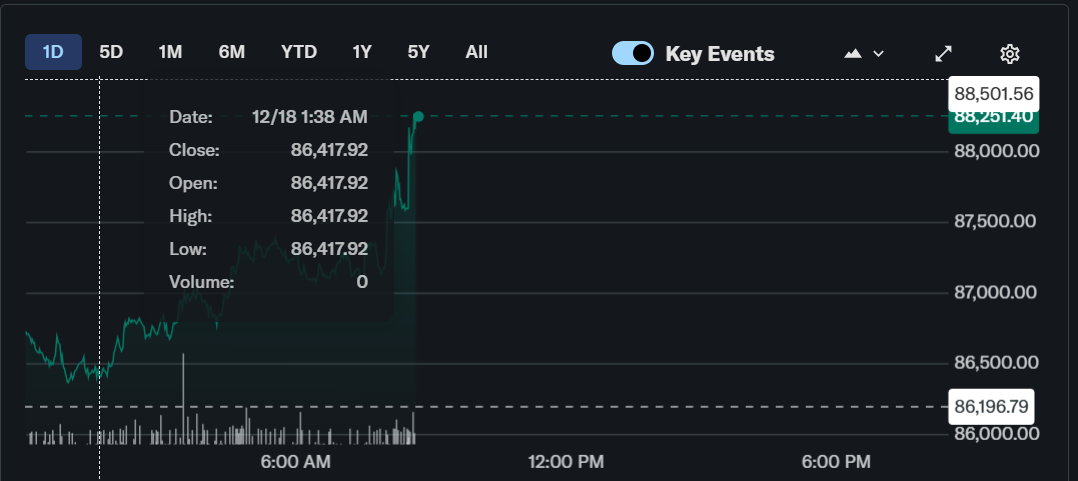
In the wake of the inflation data release, Bitcoin experienced a notable price increase, rising above $88,000 from an intra-day low of approximately $86,000. This nearly 3% gain illustrates a bullish sentiment among crypto traders, who are increasingly optimistic as BTC approaches the psychological resistance level of $89,000. Such price movements highlight Bitcoin’s responsiveness to macroeconomic developments, which can often dictate trading strategies in the cryptocurrency market.
Paragraph 3: Implications of Cooling Inflation for Federal Reserve Policies
The recent CPI data also has broader implications for Federal Reserve monetary policy. While inflation appears to be cooling, discussions among Fed officials indicate some uncertainty regarding future rate cuts. Fed Governor Chris Waller emphasized the need to focus on the labor market, which has shown signs of weakness, with the unemployment rate reaching 4.6%, the highest level since 2021. If inflation continues to soften, it may lead the Federal Reserve to reconsider its rate hike strategy, thus creating a conducive environment for further investment in cryptocurrencies.
Paragraph 4: The Broader Crypto Market Reaction
The decline in inflation figures also signals a potential turning point for the broader cryptocurrency market. Other digital assets typically align their movements with Bitcoin, responding favorably to positive economic news. As inflation cools and the possibility of more favorable interest rates looms, cryptocurrency investors foresee a marketplace that could thrive under better economic conditions. This trend can lead to increased market activity and a surge in altcoins.
Paragraph 5: Future Expectations for Rate Cuts and Crypto Investments
Market analysts are speculating that the robust performance of Bitcoin could lead to a series of rate cuts starting in January. While there remains a segment of traders believing that the Federal Reserve may hold rates steady next month, the current economic indicators support a rationale for a more accommodative monetary policy. Such shifts would benefit both traditional markets and the cryptocurrency landscape, making it crucial for investors to stay informed about these economic factors.
Paragraph 6: Conclusion: Preparing for a Changing Financial Landscape
In conclusion, the recent drop in CPI inflation to 2.7% has stirred significant optimism in the cryptocurrency market, especially for Bitcoin. As traders brace for potential shifts in Federal Reserve policy, it’s essential for investors to remain agile and informed. Understanding macroeconomic indicators and their implications can not only help in navigating the complexities of the crypto market but also position investors to capitalize on emerging opportunities. As we approach 2024, keeping a close eye on inflation trends and labor market data will be key to making well-informed trading decisions.