




Bitcoin’s Market Dynamics: Current Trends and Bearish Indicators
Bitcoin, the world’s leading cryptocurrency, has seen a staggering decline of over 50% within a few months, leaving many investors grappling with uncertainties. Each buy-the-dip strategy seems to be met with further downside pressure, suggesting that the digital currency might not have found its bottom yet. Experts from analytics firms like Matrixport and Glassnode are identifying key bear market signals, urging caution among crypto enthusiasts as the landscape evolves. This article delves into the current market situation, the implications of recent analyses, and potential opportunities that may arise amidst ongoing challenges.
Understanding the Bear Market Signals
Matrixport has highlighted several telltale signs of a bear market, primarily the frequency of large drawdowns. Historically, such corrections—over 20% in a 30-day period—are rare in bull markets but become more frequent during bear markets. According to their insights, momentum indicators began to weaken significantly by mid-2025, aligning with bearish sentiment. For seasoned crypto investors, it is essential to recognize that bear markets are an inherent cycle in the crypto landscape, often preceding the next bull run. This knowledge has prompted long-term Bitcoin holders to start profit booking, especially since July of the previous year.
It’s vital to grasp that bear markets seldom follow a linear trajectory. They often include short-lived, powerful counter-trend rallies that tempt investors to enter the market prematurely. Despite the recent cooling off of U.S. CPI inflation, which initially failed to push BTC upwards, seasoned investors are encouraged to remain vigilant for potential opportunities. As deleveraging in the market stabilizes, some experts suggest that Bitcoin’s network activity may pick back up, warranting attention from buyers seeking bargains.
On-Chain Insights from Glassnode
In addition to Matrixport’s analysis, blockchain analytics firm Glassnode offers critical insights into Bitcoin’s recent price positioning. They report an oversaturation of put options since Bitcoin fell below the $82K mark, indicating that hedging flows dominate current market sentiment rather than optimistic buying trends. Their data highlights that Bitcoin trades near $68.8K, with Short-Term Holder (STH) Cost Basis at $90.9K and Active Investors Mean at $85.8K. Such metrics signify that many recent buyers are nursing unrealized losses, reinforcing a bearish outlook and escalating the risks of panic selling or capitulation among investors.
Furthermore, other metrics like the True Market Mean and Realized Price have also dropped, suggesting a bearish trend. The Realized Price has fallen recently from $55.6K to $54.9K within a week, indicating an ongoing downward pressure that continues to weigh on Bitcoin’s value. This shift illustrates the broader market’s risk factors while painting a somber picture for new and existing investors alike.
Present Market Conditions: Bitcoin’s Struggles
The current state of the crypto market underscores significant uncertainties, as evidenced by ongoing analyses from both Matrixport and Glassnode. Current indicators suggest that Bitcoin’s price may still be center stage in a bearish narrative, with CryptoQuant’s Bull Score Index reflecting severe bearish sentiment—a stark zero score denotes a lack of confidence among traders. Such data indicates that many significant holders, including institutional players like OG whales, are in the phase of liquidating their BTC and ETH assets.
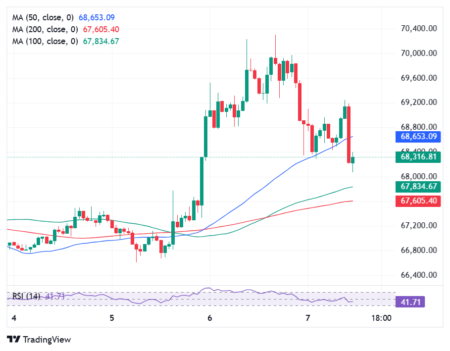
As of now, Bitcoin has experienced a 3% drop in the last 24 hours, bringing its trading price to approximately $68,277. The fluctuations in its price during this duration ranged from a low of $68,052 to a high of $70,939. The situation is compounded by a notable 7% decrease in trading volume, indicating dwindling interest among traders and a possible reluctance to engage in buying, further pushing the market into uncertain territory.
The Role of Long-Term Investors
During downturns, the strategies adopted by long-term investors become critically important. Many seasoned crypto holders understand that cycles of bull and bear markets are inevitable in the volatile realm of cryptocurrency. The ongoing sell-offs by OG whales like Garrett Jin highlight the strategy of profit realization before further price declines, as long-term perspectives often dictate timing in trading decisions.
For these investors, patience and careful analysis of market movements can yield benefits as they navigate through the bearish phase. While the panic of falling prices can deter new entrants, seasoned investors often view bear markets as golden opportunities to accumulate assets at lower prices in anticipation of future recoveries. However, this necessitates a careful approach to risk management, emphasizing the need for up-to-date, comprehensive market analysis.
Looking Ahead: Opportunities Amidst Challenges
Even amidst the current downturn, it’s crucial to remind investors that bear markets can unearth opportunities that may not be prevalent in bullish conditions. The crypto ecosystem is constantly evolving, and when the dust settles, the remaining assets can pave the path for significant returns for those who strategize wisely. Keeping an eye on key metrics about network activity, market sentiment, and potential ETF outflows can provide insights that help in making informed decisions.
In conclusion, while Bitcoin faces substantial challenges, driven by bearish indicators and volatility reflected in the markets, it is vital for both new and existing investors to adopt a thorough approach to market analysis. Understanding the cyclical nature of cryptocurrencies, and leveraging real-time data from analytics firms, can present opportunities worth exploring. Caution, education, and a long-term perspective remain key drivers for navigating this turbulent landscape in the quest for potential rewards in the cryptocurrency markets.