




Analyzing Bitcoin’s Recent Volatility: Market Dynamics and Future Predictions
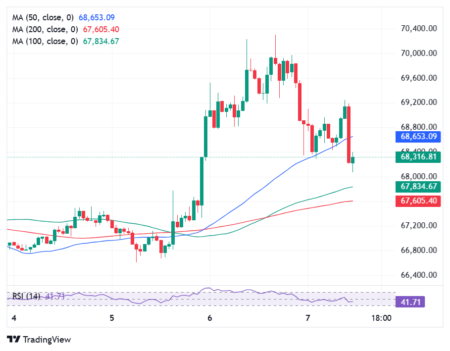
Bitcoin has recently faced significant price volatility following a market breakdown, prompting heightened market sensitivity. As the cryptocurrency attempts to stabilize around a critical demand zone, analysts observe key trends from both higher- and lower-timeframe indicators that suggest a pivotal moment is at hand. With current leverage conditions in mind, we delve into how liquidity compressions and whale trading activities are influencing Bitcoin’s price trajectory.
Understanding the Role of Liquidity
Analyst Ted emphasizes that liquidity, rather than headlines, primarily drives market movements. Universal elements like geopolitical events, economic data, and central bank speeches typically influence investor sentiment. However, liquidity flow ultimately dictates asset price dynamics. Generally, increased liquidity tends to be bullish for risk assets, while decreased liquidity leans bearish. Ted points out that some of the most robust bull markets have occurred amid geopolitical conflicts and economic unrest, highlighting that money flow is more paramount than mere news narratives.
Currently, Bitcoin is trading around the $68,000 mark. Analysts suggest that as long as the cryptocurrency holds within the $65,000–$66,000 range, prospects for a rally to $72,000 appear promising. Notably, despite the recent withdrawal pressure and escalating U.S.-Iran tensions, Bitcoin has shown resilience and found support.
Whale Activity and Market Speculation
In a recent development, Bitcoin whale Garett Jin transferred a staggering 6,318 BTC—valued at approximately $425 million—to exchanges like Binance, contributing to a wider $760 million transfer. This substantial movement has sparked speculation about potential selling pressures, showcasing how significant whale activity can impact market sentiment dramatically.
This kind of movement typically raises red flags for many retail investors. However, understanding the action within the broader market context is essential. Analysts often highlight how such transactions are part of normal trading activity. Traders must remain cautious but also informed about the larger dynamics at play, which could position Bitcoin favorably in the near future.
Weekly Structure and Technical Insights
According to technical analyst Cryptorphic, Bitcoin has maintained a stable weekly structure despite the recent fluctuations. The price action has consolidated around the 200-Week Exponential Moving Average (EMA) and within a known fair value gap. Post-breakdown, the market seems to have consolidated around key support levels, with buyers clearly defending the price.
Cryptorphic characterizes this phase as part of a longer-term correction rather than a complete breakdown. Keeping the price above the mid-$60,000 range is crucial for maintaining a consolidation structure. The week’s closing candle will play a critical role in determining whether Bitcoin is in the early stages of a recovery or gearing up for another downturn. These technical insights serve as important indicators for traders aiming to navigate the complexities of Bitcoin’s current market.
Market Sentiment and Derivative Data
Current derivative data compiles critical insights into market sentiment. Analytical platform CoinGlass reported that Bitcoin liquidations totaled approximately $19.79 million within the last day. Of this amount, long liquidations represented $5.18 million, while short liquidations reached $14.61 million, indicating stronger selling pressure among bearish positions. These numbers illustrate a market that is sharply reacting to volatility, intensifying the narrative around Bitcoin’s price dynamics.
Market sentiment is a crucial factor for traders to consider, as higher liquidation levels often signal traders’ emotional responses to market movements. Keeping an eye on these trends can help traders adjust their strategies, acknowledging the importance of timing and market entry points.
The Impact of Broader Macroeconomic Trends
As Bitcoin navigates its latest challenges, broader macroeconomic trends remain influential. Recently, U.S. President Donald Trump announced an immediate increase in global tariff rates from 10% to 15%. This shift is expected to reshape market dynamics and investor strategies in consequential ways. Economists believe that such tariff adjustments carry implications for global liquidity, which can directly influence Bitcoin’s price.
Understanding these macro-level factors enables traders to better position themselves in the market. While Bitcoin remains moderately insulated from traditional financial systems, its value can still be dramatically affected by shifts in global monetary policy, trade relations, and investor sentiment driven by economic uncertainties.
Conclusion: Navigating Bitcoin’s Future
In conclusion, Bitcoin’s recent market volatility underscores the importance of understanding the interplay between liquidity, whale activity, technical patterns, and macroeconomic conditions. While the asset currently rests near critical support levels, market sentiment and ongoing developments can shift its trajectory at any moment. As Bitcoin approaches a pivotal phase, staying informed and agile will be key for traders aiming to capitalize on the cryptocurrency’s movements. As analysts keep an eye on the critical $65,000 mark and beyond, the potential for a rally remains, warranting cautious optimism in uncertain times.