



Bitcoin Price Plummets Amid US-Iran Hostilities: An In-Depth Analysis
As geopolitical tensions continue to escalate between the US and Iran, the financial markets are feeling the reverberations. On Tuesday, following Iran’s outright rejection of any temporary ceasefire with the United States, Bitcoin (BTC) prices dipped over 1% in just an hour, demonstrating the interconnectedness of international events and cryptocurrency valuations. This article explores the implications of Iran’s refusal to engage in peace talks, the ripple effects on global markets, and the potential future for Bitcoin and other cryptocurrencies amidst these tumultuous circumstances.
Iran’s Rejection of Ceasefire and its Implications
Iran has firmly declined a proposal for a temporary ceasefire with the US, insisting that peace talks could only occur once the United States and its ally, Israel, halt their military strikes. Reports indicate that Iran demands a comprehensive guarantee against future strikes and compensation for damages before it considers any form of peace negotiations. This hardline stance signifies a troubling escalation in hostilities, as indirect talks continue to yield minimal progress towards a ceasefire that has been described as necessary for stabilizing the region.
The implications of Iran’s decision are multifaceted. It not only heightens the risk of further military confrontations but also threatens essential maritime routes like the Strait of Hormuz, a crucial oil transit chokepoint. The refusal to engage in ceasefire talks while maintaining control over this strategic strait starkly reflects Iran’s determination to assert its position against the US. In this tension-filled atmosphere, fluctuating global oil prices react swiftly to news, while Bitcoin and other cryptocurrencies become increasingly volatile as investors gauge the unfolding situation.
Escalating Oil Prices Amidst Geopolitical Conflicts
Following Iran’s refusal to negotiate, oil prices have surged back above $114 per barrel as the deadline imposed by former President Trump to strike Iranian energy infrastructure approaches. The potential for military action poses a significant threat to oil supplies; any disruption could send prices skyrocketing even further. Oil markets are particularly sensitive to geopolitical events, and the timing of Trump’s ultimatum adds urgency to the already tense situation.
Iran’s Islamic Revolutionary Guard Corps (IRGC) has issued stern warnings that if the US follows through on attacks against Iranian energy plants, they would retaliate by inflicting long-term damage on oil and gas supplies. With such strong rhetoric from both sides, the energy sector remains on high alert, further exacerbating market volatility. As traders react to these developments, the interconnected nature of energy and cryptocurrency markets has become increasingly evident.
Bitcoin’s Recent Plunge: Analysis of Market Trends
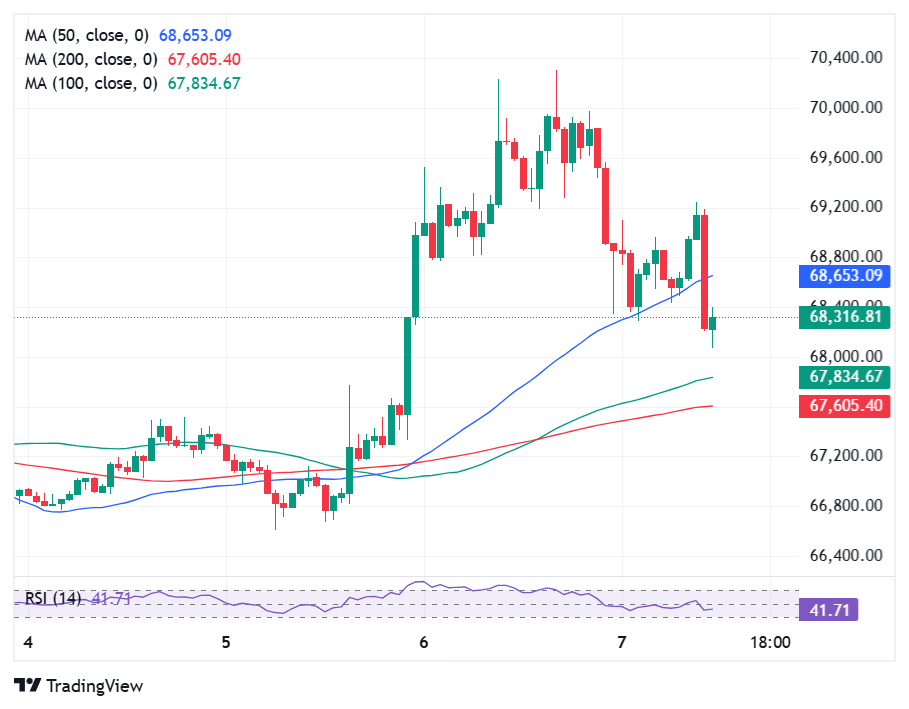
In response to the heightened tensions, Bitcoin’s price has taken a significant hit, falling more than 1% shortly after Iran’s ceasefire rejection. Currently trading at around $68,264, BTC has demonstrated considerable volatility, with a 24-hour low and high of $68,069 and $70,305, respectively. As market sentiment grows increasingly bearish, analysts have observed a decline in trading volume, suggesting reduced interest among traders as they await further developments.
Recent data from CoinGlass indicates that selling interest in the derivatives market has seen a marked increase. With total futures open interest for Bitcoin down 1.21% to $48.50 billion, this trend suggests that traders are positioning themselves defensively amid swirling uncertainties. The drop in open interest on major exchanges like the CME and Binance signals growing caution among market participants, as many seek to minimize risk given the potential fallout from ongoing geopolitical struggles.
The Broader Impact on the Cryptocurrency Market
The fallout from the US-Iran conflict extends beyond Bitcoin, impacting a wide range of cryptocurrencies, including Ethereum, XRP, Solana, and Cardano. Reports indicate that the entire crypto market is experiencing declines, leading many traders to reevaluate their positions as global conditions evolve. The overarching uncertainty surrounding geopolitical tensions has led to a flight to safety, with traditional assets becoming more appealing in contrast to the unpredictability of cryptocurrencies.
Moreover, with the Strait of Hormuz remaining closed, fears surrounding energy supply disruptions are gripping market participants. This situation further complicates the relationship between the crypto market and traditional financial assets, as investors attempt to gauge the potential for sustained volatility. As the global landscape remains fraught with uncertainty, the correlation between geopolitical events and cryptocurrency prices is likely to grow more pronounced, compelling traders to stay vigilant.
Future Predictions and Market Sentiment
Looking ahead, it’s clear that the ongoing military tensions between the US and Iran will continue to exert pressure on both oil and cryptocurrency markets. As Trump’s deadline looms, any military escalation could result in a further downturn for Bitcoin and other cryptocurrencies. Investment strategies may need to shift dramatically as traders respond to short-term fluctuations born out of these high-stakes geopolitical scenarios.
Despite the current bearish sentiment, it’s essential to recognize that the cryptocurrency market has historically demonstrated resilience following periods of volatility. As investors absorb the implications of Iran’s position and the potential for prolonged conflict, some may find opportunities in the inevitable market corrections that follow significant geopolitical developments. Thus, while immediate reactions may present challenges, a closer look could reveal paths to potential recovery in the long run.
Conclusion: Navigating Uncertainty in Cryptocurrency Investments
In conclusion, the rejection of a ceasefire by Iran amidst growing tensions with the US has led to immediate effects on Bitcoin and the broader cryptocurrency market. As oil prices soar and geopolitical uncertainty looms, traders face an increasingly volatile environment. While caution is warranted, it is crucial for investors to remain informed about the evolving landscape and adapt their strategies accordingly.
As the situation unfolds, both geopolitical dynamics and market fundamentals will play decisive roles in shaping the future of cryptocurrencies like Bitcoin. Adapting to this volatile environment while keeping a long-term perspective may provide savvy investors with opportunities to navigate these turbulent waters successfully. Whether through a focus on potential recoveries or a watchful approach to risk management, the interplay between global events and cryptocurrency valuations will undoubtedly continue to unfold in the weeks and months to come.