



The Rise of Solana and Hyperliquid: Dominating Blockchain Revenue in 2025
In 2025, two distinct blockchain networks have emerged as the champions of revenue generation: Solana and Hyperliquid. According to data from CryptoRank, Solana has taken the lead with a remarkable $1.3 billion in revenue, while Hyperliquid follows closely with $816 million. These figures not only place them at the forefront of blockchain performance but also highlight a significant shift in the market. This shift indicates that on-chain value is increasingly being harnessed by networks that prioritize execution and throughput, rather than just simply relying on liquidity depth, as seen with larger chains like Ethereum, which reported approximately $524 million.
Solana’s Resilient Revenue Model
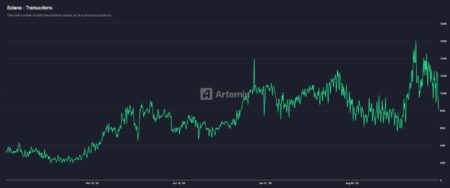
Throughout 2025, Solana’s Total Value Locked (TVL) has displayed remarkable stability, fluctuating between $7 billion and $12 billion. This stability, paired with consistently high transaction volumes, suggests that Solana is successfully extracting more revenue from its existing capital rather than waiting for liquidity to grow. The network’s diverse applications, including decentralized exchanges (DEXs), consumer apps, and activities related to memecoins and decentralized physical infrastructure networks (DePIN), have resulted in robust fee generation. This indicates that Solana’s revenue is driven by active usage, distinguishing it as primarily a high-throughput execution layer, rather than one reliant on speculative enthusiasm.
Sentiment Dynamics around Solana
An analysis of social sentiment data around Solana reveals a pattern of volatility, with sentiment frequently oscillating between positive, negative, and neutral states. Interestingly, these sentiment shifts have not significantly impacted either user activity or revenue generation. The demand for Solana appears to be more influenced by usage patterns than market narratives, strengthening its position as a blockchain built for high levels of transaction throughput rather than one that thrives on market speculation.
Hyperliquid: Specialization in Derivatives Trading
On the other side, Hyperliquid has carved out a niche as a dedicated derivatives trading platform. This specialization has allowed it to generate impressive revenue figures, outpacing many major Layer-1 and Layer-2 networks. Its TVL showed considerable growth, rising from around $2 billion at the year’s onset to a peak of $6 billion, before settling at approximately $4.1 billion. This increase indicates that the capital in Hyperliquid remains sticky, even amid shifting market conditions. The sustained trading activity on the platform evidences its ability to generate fees consistently, which bodes well for its long-term viability.
Resilient Trading Activity on Hyperliquid
Despite a cooling of social sentiment around Hyperliquid in the latter half of the year, the platform exhibited resilience, with TVL and revenue remaining stable. The platform’s ability to attract traders despite softer market moods suggests a deep-rooted trust in its capabilities. This aligns with the notion that traders are committed to using Hyperliquid for their trading needs, reaffirming the relevance of consistent performance over fleeting market enthusiasm.
The Broader Shift in On-Chain Value Capture
The journey of Solana and Hyperliquid exemplifies a broader trend in on-chain value capture, emphasizing the importance of execution quality and transaction throughput over passive liquidity pools. Solana serves as a general-purpose blockchain offering a diverse range of applications, while Hyperliquid caters specifically to high-intensity derivatives trading. Yet, despite these differences, both networks are adept at converting active trading directly into revenue — a capability that appears to outpace their counterparts in the blockchain arena.
Conclusion
In conclusion, the revenue dominance of Solana and Hyperliquid in 2025 serves as a clear indicator of the evolving nature of on-chain value generation. Their success underscores the fact that execution quality and sustained user engagement are far more critical in determining a blockchain’s revenue potential than mere growth in total value locked or fluctuations in social sentiment. As capital efficiency remains a priority for blockchain networks, those that can continually convert active engagement into fees are likely to outperform larger, less productive competitors, thereby reshaping the future landscape of blockchain economics.