



Rising Unrealized Losses in Ripple (XRP): A Market Analysis
The cryptocurrency market is notoriously volatile, and recent trends show a stark increase in unrealized losses for Ripple (XRP). After reaching a peak of approximately $3.65 in July 2025, XRP’s value has fallen sharply. This article delves into the factors contributing to this downturn, the implications for both retail and institutional investors, and the historical context surrounding these movements.
The Price Drop and Accumulation Patterns
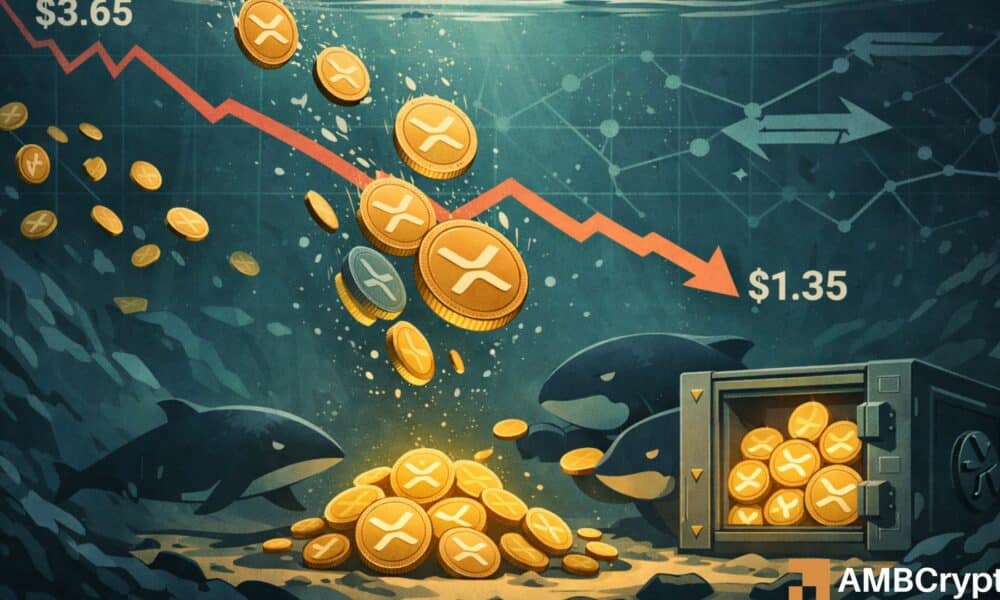
From the height of the July rally, many investors entered the market, accumulating XRP positions within a significant price range of $2.50 to $3.50. This caused the formation of a dense cost basis, surrounding the average holder cost of approximately $1.38. However, as market momentum weakened, prices slipped towards $1.35, pushing a large proportion of these investors into underwater positions. Current data from Glassnode indicates that around 36.8 billion XRP is now held at a loss, amounting to roughly $50.8 billion in unrealized losses. This trend reflects a broader shift in sentiment as late-cycle buyers experienced the brunt of the market’s pullback.
Historical Context: Patterns of Loss
Analyzing historical patterns can shed light on the current market dynamics. The losses experienced by XRP investors are reminiscent of the downturn witnessed during 2021–2022. In that era, the market underwent an extended consolidation period, stabilizing the market structure without leading to immediate capitulation. Such historical precedents highlight that while the losses are significant, they may not necessarily indicate an irreversible decline. Instead, they could pave the way for eventual recovery if market conditions stabilize.
Retail Capitulation: The Shift in Trading Activity
As XRP prices decreased from the July 2025 peak, transaction profitability steadily eroded. Initially, the Spent Output Profit Ratio (SOPR) reflected profitable transactions above 1.1, driven by early buyers taking profits. However, once the rally faded, the ratio slipped below the break-even line to approximately 0.96. This indicates a shift where many sellers began accepting lower prices to exit their positions, rather than holding onto investments that had soured. The transaction activity reveals that smaller wallets are significantly engaged in selling, signaling retail-driven capitulation rather than widespread institutional distribution.
Large Holders Seize the Opportunity
Amid the retail selling pressure, large XRP holders appear to be capitalizing on the declining prices. As XRP slid from $3.65 to $1.35, exchange flows demonstrated considerable net outflows of 7.03 billion XRP—the largest since November 2025. Meanwhile, wallets holding over 100,000 XRP are expanding their share of the circulating supply, hinting at a strategic accumulation phase among larger investors. This dynamic underscores a market scenario where retail investors are liquidating positions at a loss, while larger players are methodically absorbing this supply during the downturn.
Derivatives Market and Caution Among Investors
In the derivatives market, caution continues to prevail among investors. As of now, Open Interest stands at approximately $2.3 billion, with Funding Rates slightly negative at around -0.0012%. Liquidations have also been notable, totaling $3.77 million in 24 hours, primarily affecting long positions. These metrics indicate that while retail investors seem to be providing liquidity, larger holders are leveraging the situation to acquire more XRP, reflecting a clear divergence in strategies between retail and institutional players.
Conclusion: A Market in Transition
Ripple’s recent unrealized losses nearing $50.8 billion highlight a phase of deep retail capitulation as XRP price falls below the pivotal $1.38 average cost basis. While many small holders are exiting underperforming positions, larger investors are taking the opportunity to accumulate XRP during this downturn. This ongoing transition from retail to institutional ownership may influence future market trends, signaling a broader shift in sentiment and investment strategies as the market seeks stability in a notoriously volatile environment. Investors must remain vigilant and consider these dynamics as they navigate the complexities of the cryptocurrency landscape.