




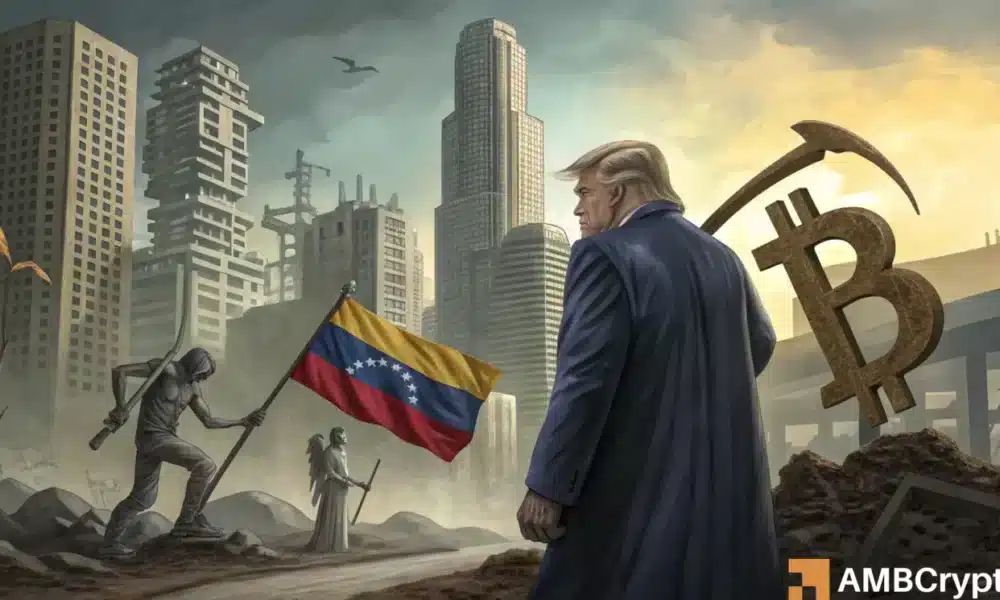
The Future of Venezuela: Bitcoin, Political Uncertainty, and María Corina Machado’s Vision
As global attention shifts to the U.S. military’s capture of Nicolás Maduro and his subsequent transfer to New York, a less publicized yet significant transformation is unfolding in Venezuela’s political landscape. María Corina Machado, a prominent advocate for Bitcoin and a Nobel Peace Prize laureate, is now viewed as a key contender for the country’s leadership, according to prediction markets like Polymarket. Amid rampant inflation and the near-total devaluation of the Venezuelan bolivar, Machado’s political rise raises intriguing questions about the future role of Bitcoin in Venezuela’s recovery.
The Venezuelan economy has been plagued by hyperinflation, resulting in the bolivar losing an astonishing 99.99% of its value. Amid these challenges, Machado’s ascent signifies a potential reprioritization of resources, with Bitcoin emerging as a central element in the narrative around national recovery. Recently, Machado declared, "Venezuelans, the hour of freedom has arrived," capturing the essence of her vision for a nation longing for economic stability.
It’s noteworthy that Machado’s momentum didn’t merely ignite following Maduro’s arrest; rather, her advocacy for Bitcoin has been consistent. In a revealing interview earlier this year with Alex Gladstein from the Human Rights Foundation, she highlighted how Bitcoin has served as a lifesaver for Venezuelans during economic turmoil. “Venezuelans found a lifeline in Bitcoin during hyperinflation,” she explained, emphasizing its role in wealth protection and facilitating escapes from the country. As she put it, Bitcoin has transitioned from a humanitarian tool to an essential means of resistance against oppressive economic conditions, positioning it as pivotal for a new democratic Venezuela.
However, Machado’s political ambitions have faced significant hurdles, particularly from U.S. political figures such as President Trump. Trump has publicly dismissed her potential to lead a transitional government, indicating that she lacks the necessary support and respect for such a role. This rejection could substantially dampen Machado’s prospects and reflects broader dynamics at play in Venezuelan politics, where external influence from larger powers can heavily impact local leadership.
The betting activity on platforms like Polymarket further underscores the prevailing uncertainty surrounding Venezuela’s future. Current data reveals that Machado’s chances of success stand at just 19%, signalling a lack of market confidence in her immediate ascension to power. In contrast, Edmundo González Urrutia, representing the Unitary Platform, currently enjoys stronger backing at 24%, while Vice President Delcy Eloína Rodríguez tops the charts with a commanding 34% support. These numbers illustrate the complexity of Venezuelan political dynamics, wherein diverse factions vie for legitimacy in an increasingly unstable environment.
In light of these developments, the crucial question arises: Will Venezuela lean towards Machado’s Bitcoin-centric vision or opt for a traditional path rooted in established political structures? The events of early 2026 suggest that geopolitical secrets are now more likely to be uncovered through blockchain technology than through conventional diplomatic channels. This trend points to a future where transparency, once restrained by political barriers, becomes possible through decentralized platforms.
In conclusion, while Machado’s Bitcoin-first vision may seem radical to some, it resonates deeply with a populace that has witnessed the collapse of its currency in real time. Despite her accolades and well-founded ideology, the intricate web of real-world power dynamics—exemplified by Trump’s remarks—reveals the fragility of her political journey. As Venezuela navigates its uncertain path ahead, the interplay between Bitcoin and traditional political forces will undoubtedly shape the nation’s quest for recovery and stability.