



Solana’s Rise in the Blockchain Ecosystem: A 2026 Overview
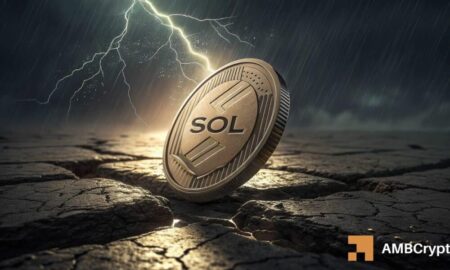
As we look into the ever-evolving cryptocurrency landscape, Solana [SOL] continues to make headlines. Recently, the platform has seen significant activity despite ongoing price fluctuations, with major organizations like Citi taking interest in its potential. This article breaks down the key developments surrounding Solana and what they imply for its future.
Solana’s Expansion and Institutional Interest
On February 13, 2026, it was revealed that banking giant Citi has successfully conducted a proof-of-concept focusing on tokenization, utilizing the Solana network in collaboration with PwC. This initiative simulated the entire lifecycle of tokenized bills of exchange—from issuance to settlement—within a controlled environment. The goal is to explore how traditional financial instruments can be efficiently migrated to blockchain technology. Such high-profile involvement suggests a growing acceptance and utility of Solana in established financial systems.
Transaction Speeds and Scalability
One of Solana’s most compelling advantages is its ability to handle massive transaction volumes. Recent data indicates that Solana manages roughly three times the daily transactions of Ethereum [ETH]. Notably, this figure surpasses Ethereum’s mainnet alongside all Layer 2 networks combined. This impressive scalability positions Solana as a formidable player in the blockchain realm, attracting users seeking efficiency and reliability.
Financial Metrics and User Engagement
Solana’s ecosystem is further supported by robust financial metrics. As reported by DeFiLlama, the total value locked (TVL) on the network stands at approximately $6.36 billion. While this figure is slightly below its late-2025 highs, the decentralized exchange (DEX) activity remains vibrant, with roughly $3.72 billion in DEX volume recorded. Additionally, perpetual futures volume is also noteworthy at about $1.45 billion. Such sustained activity indicates that users continue to engage with Solana, highlighting its resilience in a volatile market.
Long-Term Vision and Investor Confidence
In light of recent market fluctuations, Solana spot ETFs have recorded substantial inflows, amounting to $8.89 million in just one week. This influx occurred despite SOL experiencing an 11% loss during the same period, underscoring a shift in investor sentiment toward long-term growth rather than short-term volatility. According to Zheng Jie Lim, a Research and Data Engineer at Artemis, Solana leads in essential areas like user engagement, transaction volume, and developer growth. This roadmap signifies a commitment to establishing Solana as a cornerstone in the realm of internet capital markets.
Institutional Experimentation and Future Outlook
The collaboration between financial institutions and blockchain networks like Solana represents a pivotal transition in the traditional finance landscape. Citi’s tokenization test illustrates that major players are keen to explore how blockchain can integrate with existing frameworks. As institutions continue to experiment and invest in platforms like Solana, the conjunction of traditional finance and decentralized networks has the potential to reshape capital markets, enhancing efficiency and accessibility.
Conclusion: The Future of Solana
The recent developments surrounding Solana reinforce its position as a growing force within the blockchain space. Citi’s tokenization project and the impressive transaction metrics signal that the network is set to play a critical role in the future of finance. The overall ecosystem is buoyed by substantial investor interest, even during challenging market conditions. As Solana continues to scale and attract institutional attention, it is likely to remain a key player in realizing the broader vision of decentralized finance and capital markets.