




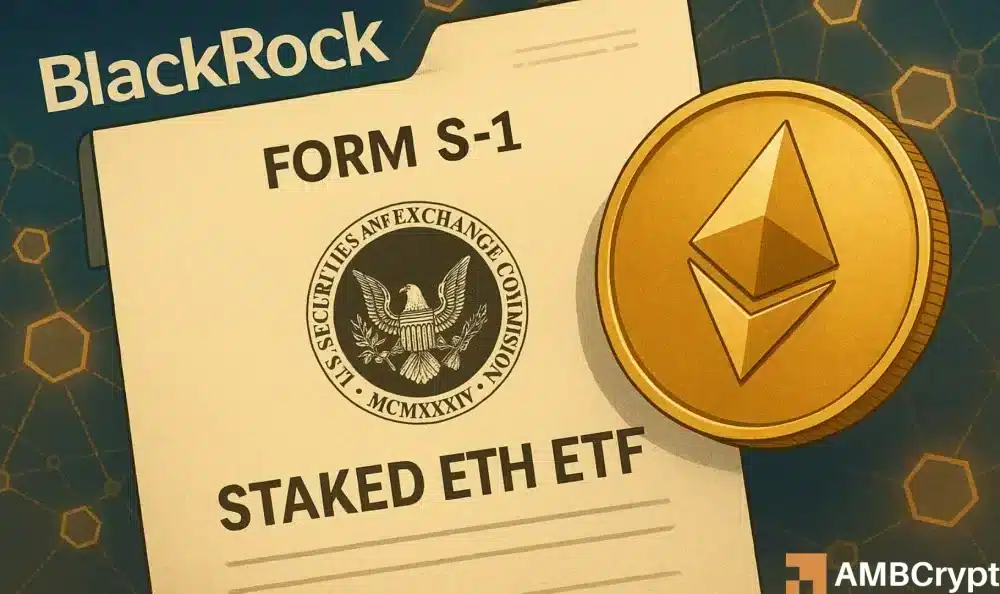
Institutional Dominance in the Crypto Market: The Rise of BlackRock’s Staked Ethereum Trust ETF
The institutional crypto landscape is undergoing a significant transformation, particularly with the shift away from solely price-driven investment strategies towards yield generation. At the forefront of this evolution is BlackRock, the world’s largest asset manager, which has recently filed for the iShares Staked Ethereum Trust ETF. This groundbreaking product aims to provide institutional investors with direct exposure to Ether’s staking rewards and is poised to reshape how institutions engage with digital assets, marking a critical moment for the sector.
BlackRock’s iShares Staked Ethereum Trust ETF
The iShares Staked Ethereum Trust ETF represents more than just an investment vehicle; it signals a seismic shift in the way institutions perceive cryptocurrency. Rather than treating crypto assets as speculative investments, BlackRock is encouraging investors to explore the economic potential and yield opportunities brought forth by blockchain technology. The proposed ETF will effectively capture not only the price performance of Ethereum (ETH) but also generate staking rewards from a portion of its holdings. The combination of price appreciation and staking rewards is intended to enhance the trust’s net asset value, making it an appealing prospect for institutional clients.
However, this innovative move brings to light significant operational and regulatory challenges. Although BlackRock aims to create a vehicle that offers staking yield, the distribution of these rewards could still face uncertainties stemming from regulatory ambiguities. The filing puts pressure on the U.S. Securities and Exchange Commission (SEC) to clarify how staking rewards should be classified, a matter that has remained murky for years, thereby influencing institutional strategies moving forward.
Decoding the SEC’s Evolving Stance
BlackRock’s latest filing marks a crucial turning point in the SEC’s policy concerning Ethereum ETFs, particularly after the tenure of former Chair Gary Gensler, who had taken a stringent stance against such products. In July 2024, when BlackRock launched its iShares Ethereum Trust (ETHA), the SEC mandated that all staking services be omitted, categorizing them as unregistered securities offerings similar to those provided by platforms like Kraken and Coinbase. However, the newly appointed Chair Paul Atkins seems to signal a more accommodating approach, leading to a recent flurry of amended ETF filings that incorporate staking features.
In a noteworthy strategic choice, BlackRock has opted to create an entirely new fund rather than modify its existing Ethereum trust. This decision ensures that the original trust, which currently holds over $11 billion in ETH, remains separate from the staking-enabled ETF. This structure allows investors to gain institutional-grade exposure to Ethereum’s yield generation while maintaining regulatory compliance—an important distinction in today’s evolving landscape.
Institutional Interest in Ethereum
Recent on-chain activity indicates a growing interest in Ethereum among large institutions. Reports from Lookonchain highlighted substantial withdrawals from Binance, with significant transactions involving Amber Group and Metalpha pulling out 6,000 and 3,000 ETH, respectively. In an even bolder move, Bitmine acquired an additional 138,452 ETH, bringing its total holdings to approximately 3.86 million ETH valued at around $12.4 billion. This concerted accumulation of Ethereum aligns with recent remarks from Ethereum co-founder Vitalik Buterin, who suggested that a price rally for ETH could be on the horizon. As the cryptocurrency trades around $3,114 following a minor dip, institutional buying suggests a robust market structure poised for ETH’s next adoption phase.
The Broader Implications for Crypto Regulation
The SEC’s evolving stance under Paul Atkins signals a potential realignment of U.S. regulation with the economic principles of Proof-of-Stake (PoS) systems. The recent approval for Grayscale, allowing the first issuer to offer staking rewards through U.S.-listed spot-market ETFs, has created momentum within the sector. Additionally, firms like REX-Osprey are launching staking-enabled funds for both Solana (SOL) and Ethereum, reflecting a broader institutional embrace of yield-generating blockchain strategies.
This transformation underscores the growing conviction among institutional players that digital assets can no longer be dismissed as mere speculative tools. Instead, recognizing the economic potential of blockchain will be essential in establishing frameworks that facilitate safer and more effective participation from traditional finance.
Conclusion: Preparing for a Macro-Rally
The landscape of institutional investment in cryptocurrency is distinctly changing. As major players like BlackRock lead the charge with innovative products designed for yield generation, it is increasingly evident that institutions are positioning themselves strategically ahead of a potential macro-rally. The accumulation of ETH by firms such as Amber Group, Metalpha, and Bitmine emphasizes a conscious effort to capitalize on the opportunities offered by Ethereum’s staking mechanism.
As the SEC continues to clarify its stance on staking rewards, institutional interest is expected to rise significantly. This confluence of regulatory clarity and increasing accumulation points to a bright future for Ethereum and the broader crypto market, suggesting we may be on the brink of a new era for digital assets.
In summary, BlackRock’s iShares Staked Ethereum Trust ETF is more than a mere financial product; it embodies a fundamental shift in institutional attitudes toward cryptocurrency and blockchain economics. As momentum builds, all eyes will be on the SEC to provide much-needed clarity that could determine the trajectory of institutional investment in digital assets for years to come.