


The Current Landscape in Cryptocurrency: Insights from Standard Chartered
As the cryptocurrency market navigates a period of volatility, Standard Chartered recently identified this selloff as an opportune moment for investors. Geoffrey Kendrick, the bank’s global head of digital assets research, emphasized that this market stress is creating a clear differentiation between high-quality protocols and speculative projects. Kendrick expressed his commitment to buy during this dip, noting that we are witnessing the beginnings of greater performance disparity across the sector.
A Shift in Forecasts for Solana (SOL)
In a recent note, Kendrick modified his price forecast for Solana (SOL), adjusting his expectations for the end of 2026 from $310 to $250. This revision stems from the anticipated time needed for Solana’s next dominant use case to fully scale. Nevertheless, Kendrick remains optimistic about Solana’s long-term potential, with predictions of SOL reaching $400 by 2027, $700 by 2028, $1,200 by 2029, and potentially soaring to $2,000 by the end of 2030. This optimistic outlook underscores Standard Chartered’s belief in Solana’s adaptability and strength in the evolving digital asset landscape.
From Memecoins to Micropayments
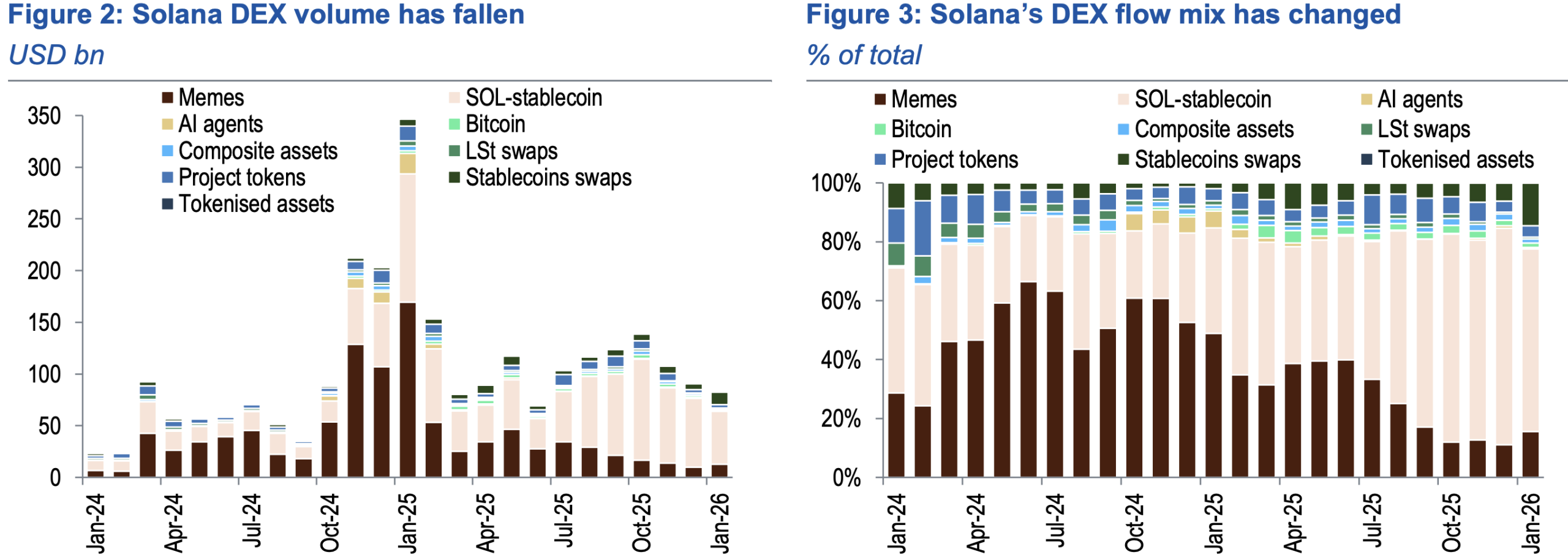
Standard Chartered’s analysis reflects a significant evolution within Solana’s ecosystem, transitioning from the increased trading activity of memecoins to more pragmatic use cases such as micropayments. This change is evident as decentralized exchange (DEX) activities on Solana shift towards SOL-stablecoin pairs. Kendrick highlighted that during 2025, there was a noticeable shift in capital, moving away from meme-focused trading towards more stable financial instruments, suggesting that Solana is maturing and no longer reliant on memecoins as its primary driver.
Understanding Solana’s Growth Potential
Kendrick attributes Solana’s growing appeal to its ultra-low transaction costs, which are fostering new use cases—most notably AI-driven micropayments. Standard Chartered found that stablecoin transactions on Solana are occurring with a velocity two to three times faster than those on Ethereum. This notable differential suggests a burgeoning transactional role for stablecoins within Solana’s framework as innovative projects like Coinbase-backed x402 gain traction.
Gradual Transition and Future Outlook
Despite the positive developments, Kendrick warns that the transition in Solana’s adoption will not be instantaneous. Standard Chartered anticipates Solana will trail Ethereum in performance through 2026 and 2027. However, there is a belief that as micropayment adoption ramps up, Solana will gradually catch up, particularly between 2027 and 2030, when SOL is predicted to outperform bitcoin. This outlook indicates a future where Solana could gain a competitive edge as its narratives around micropayments mature.
Ethereum: The Preferred Digital Asset
In contrast, Standard Chartered has reaffirmed its preference for Ethereum as the leading large-cap digital asset in the near term. Analysts suggest that Ethereum will continue to outshine its peers, largely due to its established ecosystem for stablecoins and tokenized real-world assets. As institutional adoption of these assets accelerates, Ethereum is expected to dominate, while Solana’s development narrative unfolds over a longer timeframe.
As the cryptocurrency landscape continues to evolve in the wake of recent market shifts, the insights from Standard Chartered provide valuable perspectives on investing strategies and the potential growth trajectories of these digital assets. This underscores the importance of informed, selective positioning in the market, given the ongoing volatility and the shift toward a more differentiated ecosystem.