



The Future of Crypto: Integrating Digital Assets into Finance by 2026
As the crypto market stabilizes following a year of volatility, industry executives predict that 2026 will not be defined by a singular breakthrough moment but rather by a gradual integration of digital assets into mainstream financial infrastructure. This evolution signifies a move away from speculative trading towards a more structural role for cryptocurrencies within the global financial system. Insights from industry leaders at Coinbase, Matter Labs, CoinShares, Gate.io, Bitfinex, and Hashdex highlight the ongoing transformation that will reshape how digital assets function in the financial landscape.
Emergence of Hybrid Finance
Key players in the crypto space note a profound shift towards "hybrid finance," merging traditional financial systems with crypto-native infrastructure. Keith Grose, CEO of Coinbase UK, remarked that the next iteration of the internet is being constructed "onchain," underscoring a pivot towards programmable financial activities that utilize public blockchains. This integration includes developments in onchain identity verification and settlement mechanisms. CoinShares emphasizes that digital assets are finding their place within established financial systems, showcasing applications such as tokenized funds and blockchain-based settlement networks, thus marking the end of crypto’s operation on the periphery of finance.
Regulatory Developments
The evolution of regulatory frameworks is pivotal in shaping this integration, as clearer regulations provide industry clarity and facilitate responsible growth. For instance, Europe’s MiCA (Markets in Crypto-Assets Regulation) offers legal certainty for digital asset issuance, custody, and trading, while the U.S. is witnessing momentum towards enabling regulations despite fragmented oversight. In Asia, regions like Hong Kong and Japan are advancing toward Basel-style standards aimed at fostering institutional participation. Hoolie Tejwani, head of Coinbase Ventures, asserts that well-defined rules will encourage responsible development and bolster investor confidence, which could be critical for broader adoption in 2026.
The Rise of Stablecoins
Stablecoins are expected to play a significant role in this regulatory landscape, with experts like Hashdex projecting the market capitalization of stablecoins to double from its current $300 billion by 2026. The anticipated passage of clearer legislation, such as the GENIUS Act in the U.S., positions stablecoins as fundamental components of financial infrastructure rather than mere niche payment solutions. This development aligns with the concept of a "cryptodollar," facilitating dollar-denominated settlement in global commerce while some countries seek alternatives to U.S. reserves. In this evolving scenario, Matter Labs anticipates regulatory frameworks becoming increasingly programmable, paving the way for jurisdiction-aware blockchain architectures that ensure compliance with varying geographic regulations.
Tokenization Takes Center Stage
With regulatory barriers beginning to dissolve, the focus in 2026 will shift from experimentation to execution, particularly in the realm of tokenization. Bitfinex’s CTO, Paolo Ardoino, asserts that tokenization is on the verge of mainstream adoption as a capital-raising method, driven by efficiency and accessibility. Recent examples include large institutions, such as BlackRock and JPMorgan, venturing into tokenized deposits and funds on public chains. Furthermore, Matter Labs’ Omar Azhar expects distinct roles to emerge, with stablecoins dominating retail cross-border transactions and tokenized bank deposits focusing on institutional treasury activities, fostering real-time settlements and enhanced liquidity management.
Intersection with AI Technologies
The intersection of cryptocurrency and artificial intelligence is another area of interest, as firms foresee AI systems increasingly depending on blockchain for their operational needs. Hashdex estimates the AI-crypto market could reach $10 billion by 2026, fueled by decentralized computing and data provenance solutions. While current adoption levels remain modest, rising interest in AI applications is expected to stimulate further development within the crypto landscape, influencing how infrastructure is utilized in upcoming years.
Bitcoin as a Macro Asset
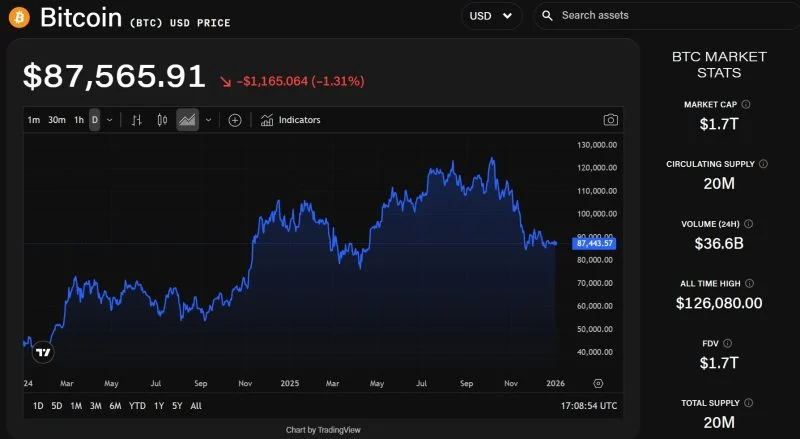
As this transformative phase unfolds, Bitcoin is poised to shift from being viewed as a speculative asset to a macro-sensitive benchmark. The outlook for Bitcoin in 2026 increasingly relies on macroeconomic data and the Federal Reserve’s decisions regarding interest rates. Recent market trends show Bitcoin struggling to regain upward momentum, trading around $87,600, a slight drop from its opening level of $93,300 in 2025. Consequently, analysts from Standard Chartered have revised their short-term expectations, although they remain optimistic for a long-term Bitcoin target of $150,000 by 2026, fueled by institutional investment inflows.
Conclusion
In summary, the crypto landscape is transitioning from speculative fervor to a more stable integration within the financial ecosystem. Through enhanced regulatory frameworks and technological advances, digital assets are on track to assume a central role in finance by 2026, characterized by hybrid finance models, the rise of stablecoins, and a growing intersection with AI technologies. As institutions increasingly adopt these innovations, the crypto market is set to mature, providing substantial opportunities for both investors and users across the globe.