



Bitcoin Market Consolidation: Signs of a Potential Bottom
Bitcoin (BTC) has recently entered a prolonged consolidation phase, raising speculation among investors and analysts about a potential shift in its market structure. According to K33, a research and brokerage firm, the easing of selling pressure suggests that BTC may be nearing a bottom. In this article, we delve deeper into this phase of consolidation, examining critical trends that might indicate Bitcoin’s future trajectory.
Stabilization in Price Ranges
Head of Research at K33, Vetle Lunde, pointed out that Bitcoin has experienced relatively stable trading within the range of $60,000 to $75,000 in recent weeks. This sideways price action often signals market bottoms, making Bitcoin an increasingly attractive option for medium- and long-term investors, particularly around the low $70,000 mark. With both exchange-traded product (ETF) flows and the behavior of long-term holders stabilizing, the market appears to be finding its footing after significant fluctuations.
ETF Flows and Demand Dynamics
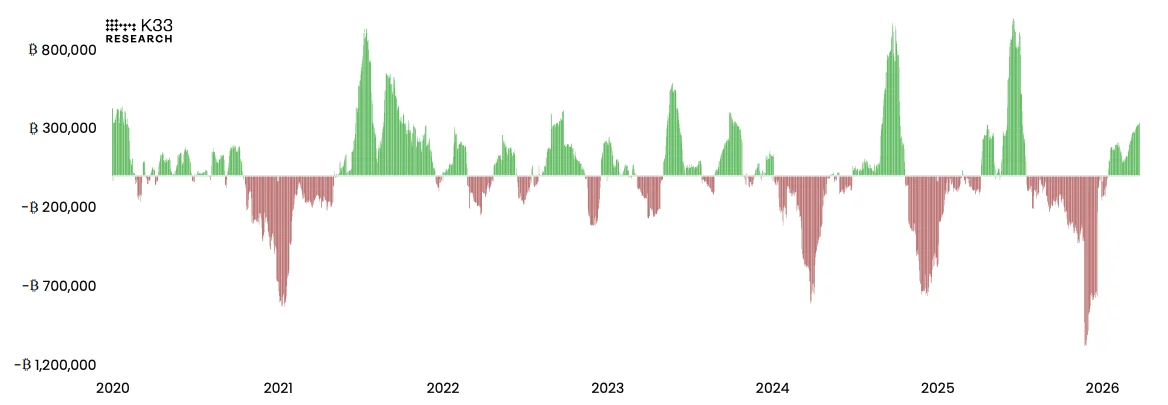
Since late February, Bitcoin ETF flows have turned mildly positive after a prolonged period of heavy distribution that began following its all-time highs last October. Lunde attributes earlier outflows to profit-taking when Bitcoin prices dipped below investors’ cost basis, leading to a cycle of increasing supply. However, as Bitcoin’s price slowly declined, selling incentives weakened, which allowed demand to stabilize. This adjustment may be paving the way for the end of the intense selling phase observed earlier in the market.
Trends Among Long-Term Holders
Interestingly, a parallel trend is emerging among long-term holders of Bitcoin. Data from K33 shows that the supply held for over six months has begun to increase again after experiencing a sharp decline in late 2025. With Bitcoin currently trading below the $100,000 mark, fewer investors are motivated to liquidate their positions, contributing to price stabilization within the existing range. This trend underscores a growing confidence among long-term holders, further reinforcing the potential for a market bottom.
Macro Environment and Market Sentiment
Despite signs of stabilization, broader market conditions remain uncertain. Geopolitical tensions, particularly in the Middle East, alongside rising oil prices, have led to increased volatility in financial markets. Additionally, the hawkish stance of the Federal Reserve has dampened expectations for immediate interest rate cuts, affecting risk appetite across asset classes, including cryptocurrencies. This environment has made it challenging for fresh inflows into crypto markets to materialize, as highlighted by Lunde’s analysis.
Positioning Data and Market Engagement
Positioning data offers further insight into the cautious sentiment prevailing in the market. Current figures indicate a drift toward yearly lows in open interest for Bitcoin perpetual swaps, with persistently negative funding rates suggesting weak demand for long positions. Institutional traders appear to be sitting on the sidelines; the CME futures open interest has remained flat, reflecting a lack of conviction to extend positions further out the curve. This cautious engagement underscores the fragility of current market momentum, despite signs of potential stabilization.
Transitioning Towards a Bottoming Process
K33’s Vetle Lunde characterizes the current market environment as “constructive.” The combination of reduced selling pressure, stabilized ETF flows, and range-bound price actions suggest a transition away from the distribution phase and toward a possible bottoming process. While macro uncertainties continue to pose hurdles for significant price appreciation in the near term, the underlying fundamentals indicate that Bitcoin may be preparing for a more resilient future. As various factors stabilize, investors may find renewed opportunities to engage with the cryptocurrency market.
In summary, while uncertainties loom in the macro environment, behavioral trends among long-term holders, alongside stabilizing demand metrics, offer a cautious optimism for Bitcoin’s future. The ongoing consolidation phase could well serve as a critical indicator for medium- to long-term investment strategies in the ever-evolving landscape of cryptocurrencies.