




Current Crypto Market Trends and Influences: An In-Depth Analysis
Today, the cryptocurrency market experienced a notable drop in its overall market capitalization, primarily attributed to weakened global risk sentiment. Investors are currently navigating macroeconomic uncertainty and rising geopolitical tensions, which have directly affected both cryptocurrency and traditional equity markets. As Bitcoin and other major altcoins like Ethereum, XRP, and Solana saw declines, the landscape of digital assets becomes increasingly precarious. With market forces responding to fluctuating equity volatility, interest-rate expectations, and the strengthening U.S. dollar, this situation calls for a comprehensive analysis of what’s driving these changes.
Cryptocurrency Market Performance
According to data from CoinMarketCap, the total crypto market capitalization fell approximately 1.04%, settling around $2.29 trillion. Bitcoin, often viewed as the flagship of the crypto realm, traded around $67,408, marking a 1.11% decrease over the previous 24 hours. Ethereum, another significant player, hovered near $1,967, witnessing a decline of about 2.07%. XRP’s price retreated to about $1.35, a fall driven primarily by overall market weakness and notable outflows from spot ETFs. Specifically, the past two trading days saw U.S. XRP ETFs experiencing an exodus of roughly $22 million. Additionally, Solana fell by approximately 0.79%, trading at around $82.45, further illustrating the risk-off sentiment enveloping the market.
Equity Market Volatility and Crypto Correlation
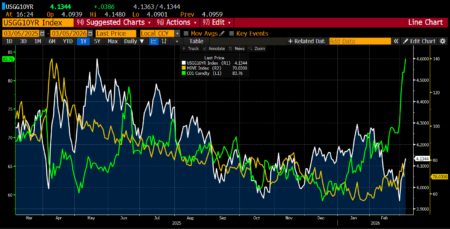
Analysis from Bloomberg reinforces the notion that current cryptocurrency fluctuations are closely tied to volatility in traditional equity markets. Investors are demonstrating heightened caution as they await the U.S. Federal Reserve’s forthcoming policy decisions. Presently, the CME FedWatch Tool indicates that the target rate cut is estimated to be between 3.50% and 3.75%. Market participants are now anticipating a 95.5% chance that the Federal Reserve will opt to maintain these rates unchanged following the Federal Open Market Committee (FOMC) meeting on March 18, 2026. Amid such uncertainty, the crypto space continues to grapple with heightened short-term volatility, influenced significantly by the broader financial climate and Fed rate expectations.
Geopolitical Tensions Impacting Investor Sentiment
In addition to economic factors, the ongoing geopolitical climate has significantly contributed to declining investor confidence within the crypto market. The escalating war between the United States, Israel, and Iran is fostering uncertainty across global financial sectors. The situation intensified with coordinated military actions against Iranian targets in late February 2026, provoking retaliatory missile and drone strikes throughout the region. CoinGape has reported that these developments have prompted many analysts to issue warnings about the potential for Bitcoin’s price to fall further. Analyst Captain Faibik pointed out a bearish flag formation on Bitcoin’s 8-hour chart, suggesting that a breakdown could lead the cryptocurrency to dip to the $55,000 range.
Underlying Market Dynamics
While the Bitcoin and broader crypto market face downward pressures, some assets are seeing a counter trend. For instance, despite the ongoing geopolitical tensions, stocks like CRCL have seen an uptick, suggesting selective investor confidence. Additionally, the increase in demand for USDC, a stablecoin, has led to heightened transactional volumes in this asset class. This indicates that even amid market turmoil, certain segments may present opportunities for strategic investment. The crypto landscape is marked not only by its volatility but also by the resilience of certain cryptocurrencies which can benefit from alternative demand dynamics.
Future Outlook for Cryptocurrencies
As the crypto market braces for further developments tied to both monetary policy and geopolitical dynamics, the future remains highly uncertain. Analysts and investors alike will be closely monitoring these variables as they guide market sentiment and price movements. If the U.S. Federal Reserve chooses to maintain interest rates, we may see stabilization in traditional markets, potentially allowing for recovery within the cryptocurrency sector. However, ongoing geopolitical tensions will likely exert continued pressure, making it vital for investors to stay informed and adaptable to rapid changes in market conditions.
Conclusion
In summary, the cryptocurrency market is currently navigating a challenging landscape marked by macroeconomic uncertainty and geopolitical tensions. As Bitcoin, Ethereum, XRP, and Solana grapple with declines, the implications of U.S. Federal Reserve monetary policy loom large over market sentiment. The interplay between traditional equity volatility, interest rate expectations, and rising geopolitical risks continue to shape investor behavior in the crypto space. While caution remains paramount, some segments of the market may offer opportunities for thoughtful investments amid the prevailing uncertainties. As we move forward, it will be crucial for market participants to remain agile and informed to manage risks effectively in this dynamic financial environment.