



FOMC Meeting Highlights: March 2026 Summary
In March 2026, the Federal Open Market Committee (FOMC) held a significant meeting in which it decided to maintain the interest rates steady in the range of 3.5% to 3.75%. This decision aligns with market expectations, reflecting the careful balance the Federal Reserve (Fed) seeks to achieve amidst uncertain economic conditions. Fed officials noted that while economic activity is expanding, low job gains and rising inflation—largely attributed to elevated oil prices—pose challenges. Additionally, the situation remains complex due to ongoing geopolitical tensions arising from the Israel-Iran conflict, which further cloud the economic outlook.
Interest Rates and Economic Outlook
During the FOMC meeting, Fed Chair Jerome Powell emphasized that rising oil prices could negatively affect the U.S. economy, leading to near-term inflation increases. However, he downplayed concerns regarding stagflation, insisting that progress will be made on inflation—albeit not to the extent previously anticipated. Despite this cautious optimism, one of the key takeaways was the Fed’s indication of expecting at least one rate cut in 2026, though the CME FedWatch Tool currently shows no rate cuts occurring this year. Instead, two potential cuts are likely on the horizon, with one planned for 2027.
Balancing Risks: Labor Market vs. Inflation
Chair Powell expressed that the Fed is navigating two conflicting goals. On one hand, risks to the labor market suggest that lower rates might be appropriate to stimulate job growth. On the other hand, risks to inflation point toward the necessity of maintaining or increasing rates until inflation shows signs of cooling down. This dual focus illustrates the Fed’s approach of balancing economic growth with inflation control, which continues to be a focal point in monetary policy discussions.
Revised Inflation Projections
In an important update, FOMC officials have revised their projections for Personal Consumption Expenditures (PCE) inflation, now forecasting a rise to 2.7%, up from earlier estimates of 2.4%-2.5%. This increase reflects the impact of higher oil prices on overall inflation indicators. It was noted that there are expectations for a notable uptick in headline PCE in early 2027, driven mainly by the current oil market dynamics.
Oil Prices and Economic Indicators
The meeting highlighted the current state of oil markets, where WTI crude oil futures rose by 1% to $97.25 per barrel, while Brent crude jumped by 5.25% to $112.70 per barrel. Analysts from 10x Research noted that sustained elevated oil prices could elevate U.S. Consumer Price Index (CPI) from 2.43% to nearly 3.4%. Furthermore, the Producer Price Index (PPI) inflation for February also surprised markets with a higher-than-expected rise of 3.4%, alongside a core PPI that reached 3.9%, marking its highest level since February 2023.
Market Reactions and Future Outlook
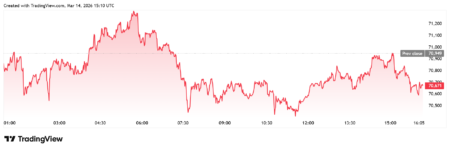
In reaction to these economic indicators and the FOMC’s announcements, Bitcoin experienced a significant drop of over 4%, settling around $70,764. The cryptocurrency’s volatility remained pronounced, with an intraday low of $70,503. Trading volume surged by 23%, reflecting increased market activity amidst these developments. The dynamics of both traditional and digital asset markets, influenced by Fed policies and economic sentiment, underscore the interconnected nature of today’s financial landscape.
In summary, the March 2026 FOMC meeting reflects a cautious yet proactive approach by the Fed as it navigates rising inflation and a complex economic scenario. With projected rate cuts on the horizon and ongoing adjustments to inflation expectations, market participants are keenly watching for further developments in the coming months.