



Crypto Market Recovers Amid U.S.-Iran Ceasefire: An Analysis
The crypto market experienced a significant rebound following a ceasefire agreement between the U.S. and Iran, which effectively alleviated geopolitical tensions. This diplomatic breakthrough, spearheaded by Pakistan’s Prime Minister Shehbaz Sharif, forestalled what could have been a disastrous escalation of conflict in the Middle East. As risk sentiment improved across global financial markets, digital assets such as Bitcoin, Ethereum, and XRP witnessed notable gains. The strategic importance of the Strait of Hormuz, a vital passage for global energy supplies, underscored the significance of this cessation of hostilities.
The Ceasefire’s Impact on the Crypto Landscape
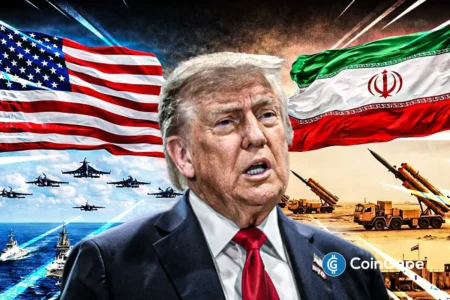
With the announcement of a conditional two-week ceasefire just before a proposed military deadline, investors reacted positively in the crypto market. This statement from Iran, which included assurances for safe passage through the Strait of Hormuz, significantly reduced uncertainty that had gripped global markets. Just hours before the ceasefire, U.S. B-52 bombers were reportedly en route to the area, amplifying the risk of conflict. By intervening diplomatically, Pakistan helped pivot the situation toward peace, which in turn buoyed market expectations and reduced energy supply risks globally. The results were immediate, leading to upward momentum in various digital currencies.
Bitcoin’s Leading Role in Market Recovery
Bitcoin emerged as the frontrunner in this market resurgence, climbing to $71,324.12 with a 3.71% increase in just 24 hours. Trading volume surged to $47.3 billion, pushing Bitcoin’s market capitalization to an impressive $1.42 trillion. Technical indicators like the MACD, which stands at 463.79, also showed a significant uptick, suggesting a potential bullish phase ahead. With the Relative Strength Index (RSI) reaching 57.42, Bitcoin’s buying strength is on the rise, allowing it to challenge resistance levels that lie between $73,000 and $75,000.
However, maintaining the RSI above 55 is crucial; a slip could push prices back toward the important support level at $68,000. The positive sentiment suggests that investors remain optimistic in the short term, allowing Bitcoin to retain its key position in the crypto ecosystem.
Ethereum’s Ascendancy in the Market
Ethereum also followed Bitcoin’s bullish trend, experiencing a robust 6.10% increase to $2,237.46. Its trading volume hit $24.4 billion, allowing its market capitalization to reach $270 billion. The MACD indicates convergence at 17.57, shifting from a bearish to a neutral momentum, which is promising for future growth. The RSI for Ethereum stands at 59.28, well above its moving average, signaling strong demand in the market. If the momentum continues, Ethereum may test resistance levels between $2,350 and $2,500.
At the same time, traders should be cautious; a potential decline in the RSI below 55 could trigger a pullback, leading prices toward the $2,050 support level, a key marker that could determine the future performance of this leading cryptocurrency.
XRP’s Recovery and Future Prospects
Similarly, XRP’s price rallied by 4.05%, trading at $1.37, with a market cap of $84.1 billion and a trading volume of $2.8 billion. While XRP’s recovery trend appears less certain than Bitcoin and Ethereum’s, bullish indicators are nonetheless emerging. The MACD shows a crossover, signaling potential upward momentum. Although the histogram remains negative at -0.0238, it continues to contract, hinting that bearish pressure could be easing.
The RSI for XRP is at 50.48, placing it in a neutral zone of positive strength, which may indicate further potential for growth. If this uptrend persists, XRP could challenge resistance levels at $1.45 to $1.55. However, a drop below RSI 50 might trigger a reassessment of support levels, particularly the $1.30 mark.
Broader Market Implications and Future Outlook
The recent geopolitical developments and the subsequent ceasefire have a far-reaching impact beyond just the crypto market. As risk appetite increases, traditional financial markets may also benefit from eased tensions. The notion of stability in global energy routes, particularly the Strait of Hormuz, is critical for investor confidence. Crypto markets are often sensitive to external circumstances, and such geopolitical agreements can serve to bolster not only digital assets but also equities and commodities.
Conclusion: Navigating the Crypto Market Landscape
As the crypto market finds its footing amid easing geopolitical tensions, investors are presented with potential opportunities for growth across various assets. Bitcoin, Ethereum, and XRP have all demonstrated resilience and potential for further advances, responding to improved sentiment in the wake of the U.S.-Iran ceasefire. However, market participants will need to stay vigilant, monitoring key technical indicators and resistance levels. In this ever-evolving landscape, informed decision-making will be crucial to navigating the complexities of digital assets in uncertain geopolitical climates.