




The Resilient Bitcoin Strategy: Michael Saylor’s Bold Moves Amid Market Fluctuations
As the cryptocurrency landscape continues to evolve, uncertainty surrounding Bitcoin’s future remains prevalent. Currently, Bitcoin (BTC) faces significant scrutiny, particularly as its price hovers near the $65,000 mark. Amidst these tumultuous market conditions, prominent Bitcoin advocate Michael Saylor stands resolute in his conviction to acquire more Bitcoin. His latest revelation, shared on February 22, features an “Orange Century” chart on social media platform X, reflecting the notable upward trajectory of his company’s Bitcoin holdings.
Since 2020, Saylor’s firm, Strategy, has fundamentally shifted its business model to revolve around Bitcoin, a move that’s both ambitious and audacious. As it stands, Strategy currently holds approximately 717,131 BTC—amounting to nearly two-thirds of all Bitcoin held by corporate entities. This staggering reserve illustrates both the potential impact of institutional investment in Bitcoin and the inherent risks associated with such concentrated holdings.
The response from the Bitcoin community has been varied and insightful. A notable commentary from X account Satoshi Stacker highlighted the soon-to-be-announced 100th Bitcoin purchase since the inception of Strategy’s treasury strategy. This reflects a sustained commitment to accumulating Bitcoin, with a recent addition of 1,142 BTC valued at over $90 million. Over the years, this strategy has accrued an impressive total of 99 purchases, allowing the company to amass an astonishing Bitcoin reserve valued at roughly $48.7 billion.
However, financial analysts caution about the potential risks involved. With an average purchase price of $76,027 per Bitcoin, the current market price, which is hovering around $66,000, leaves Strategy exposed to substantial unrealized losses. These losses amount to approximately $5.8 billion, translating to a 10.7% decrease in investment value. This precarious situation serves as a stark reminder of the volatility associated with the cryptocurrency market.
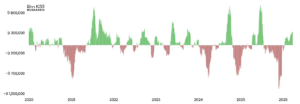
Amid these developments, the broader market dynamics tell a nuanced story. While Strategy’s stock, MSTR, experienced a slight uptick of 1.24%—now priced at $131.05—Bitcoin itself has seen a downturn of 2.36%. Additionally, the inflow of $88.1 million into Bitcoin ETFs signals that major institutional investors remain interested in Bitcoin, even as the asset’s retail appeal appears to be waning. Since August 2025, the number of active users on the Bitcoin network has been in decline, failing to return to the higher user activity levels characteristic of previous bull markets.
This slowdown in retail participation raises alarms, as the previous uptick in Bitcoin prices has been largely driven by daily users engaging in trading and transactions. The current weakness in this sector casts doubt on whether Saylor’s aggressive acquisition strategy will yield the desired results or lead to further financial strain.
Ultimately, the future of Michael Saylor’s Bitcoin strategy hangs in the balance, largely determined by Bitcoin’s price trajectory. As evident, his determination to bolster Bitcoin reserves remains unwavering, even amid the market’s current underperformance. However, the pressure mounts as unrealized losses grow and retail engagement dwindles. Only time will elucidate whether Saylor’s high-stakes investment will pay off or prove to be a risky endeavor in the volatile world of cryptocurrency.
In conclusion, while the journey through cryptocurrency investments can be wrought with challenges and uncertainties, the bold moves made by figures like Michael Saylor remind investors and enthusiasts alike that belief in the potential of Bitcoin can drive strategic decisions. Yet, navigating the complexities of market fluctuations and maintaining user engagement remains critical for the long-term viability of such investments. The road ahead is unpredictable, but the commitment to Bitcoin continues to shape the landscape in profound ways.