



Cardano’s Institutional Support Amid Retail Panic: A Long-Term Perspective
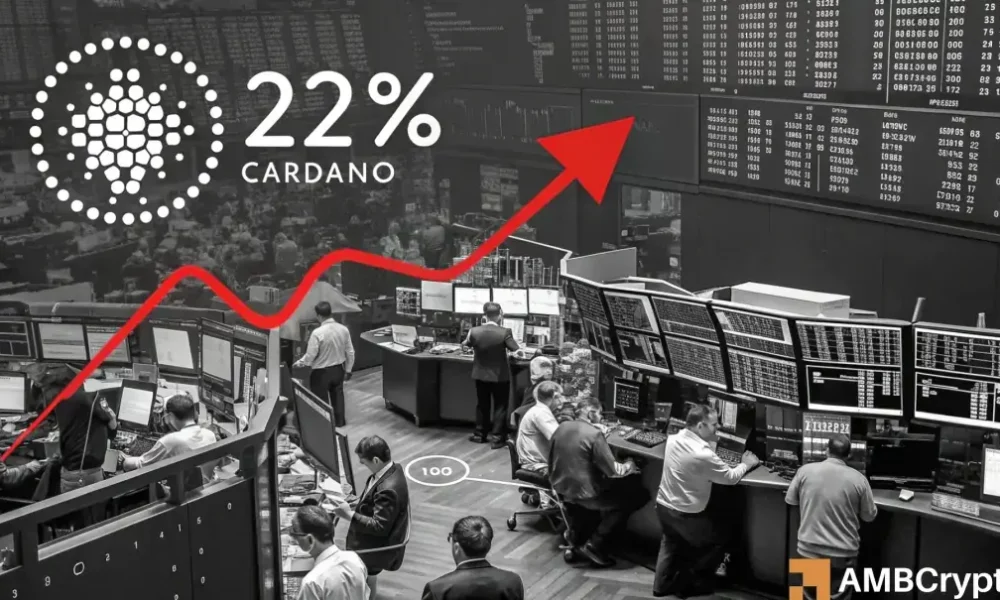
In recent weeks, retail investors have been gripped by fear, particularly concerning Cardano (ADA), as its price has plummeted over 22%, struggling to maintain a value above $0.27. This decline, however, contrasts sharply with the actions of major institutional players. Grayscale, a leading digital asset manager, has notably increased Cardano’s allocation in its Smart Contract Fund, now constituting 20.34% of the portfolio. This illustrates a divergence in sentiment, with institutional investors leaning toward a long-term perspective on Cardano, even as small investors react to short-term fluctuations.
Institutional Investments Rise Despite Market Downturn
The increase in Cardano’s share within Grayscale’s fund is significant, as it elevates ADA to the third most crucial asset, following Solana (SOL) and Ethereum (ETH). This choice signals a commitment to Cardano as a viable long-term investment, particularly in the face of a volatile market. Since January 2026, Cardano’s percentage in the Smart Contract Fund has grown steadily from 18.5% to the current level, reinforcing the notion that large entities are actively choosing to accumulate during this bearish phase. As Grayscale operates under fixed rebalancing rules, their buying of ADA underscores a systematic approach rather than reactive trading behavior, suggesting confidence in Cardano’s future potential.
Technical Indicators and Market Conditions
Despite this positive institutional interest, it’s essential to acknowledge the concerning metrics surrounding Cardano. Notably, the MVRV (Market Value to Realized Value) Ratio has seen a marked decrease, indicating that a significant number of holders are currently at a loss. History shows that when the 30-day MVRV falls below -20%, weak investors tend to divest their holdings, leaving primarily long-term holders remaining in the market. This trend often signifies market bottoms where selling pressure declines, creating a more stable environment for potential recovery.
Similarly, a decrease in Open Interest points to diminished activity among short-term traders and speculators. When both price and Open Interest are declining, it often suggests that the market is clearing excess speculation. Such conditions can indicate a strategic resetting period, which could pave the way for an upward trend as the pressure from sellers eases.
The Future of Cardano: Balancing Challenges and Innovations
Cardano now finds itself at a crossroads, caught between the narrative of its declining price and the promising advancements in its underlying technology. While retail investors express anxiety over current valuations, significant upgrades are underway that could transform its ecosystem. Over the next 45 days, Cardano is preparing for substantial changes, the most notable since the Alonzo era. These upgrades are:
- Enhancing scalability
- Strengthening security
- Improving overall network functionality
Moreover, the introduction of the Midnight privacy chain is set to debut by the end of March, offering selective privacy features in compliance with regulations. This new development, backed by partnerships with notable companies like Google and Telegram, further enhances Cardano’s ecosystem and could attract a new user base.
Contrasting Sentiments: Institutional Confidence vs. Retail Anxiety
The current environment illustrates a fundamental contrast in how different market participants are approaching Cardano. On one hand, many retail investors are feeling disheartened by falling prices and are reacting by selling off their holdings. On the other hand, institutions such as Grayscale are viewing this same scenario as an opportunity to increase their investments. This divergence highlights a critical aspect of market dynamics where short-term fluctuations can obscure the long-term potential of an asset. For institutions, Cardano represents a foundational component of smart contract technology that is poised for future growth, irrespective of short-term price trends.
Conclusion: A Potential Turning Point for Cardano
As Cardano navigates this complex landscape, its rising allocation in Grayscale’s portfolio suggests that smart money is betting on its potential. The prevailing metrics, like the declining MVRV and Open Interest, indicate that weaker market participants are exiting, often seen near turning points in the market. Given the significant upgrades on the horizon and institutional backing, there lies a plausible scenario for Cardano to rebound from its current lows.
In summary, while retail investors may be fearful and reacting to immediate price movements, the long-term outlook for Cardano remains promising, especially as it solidifies its position among institutional portfolios. As the market transitions away from speculative trading towards a more strategic, infrastructure-focused investment perspective, Cardano may well emerge stronger, paving the way for a recovery that aligns with its technological advancements.