



The Market Dynamics of Solana: Transaction Dominance and Challenges Ahead
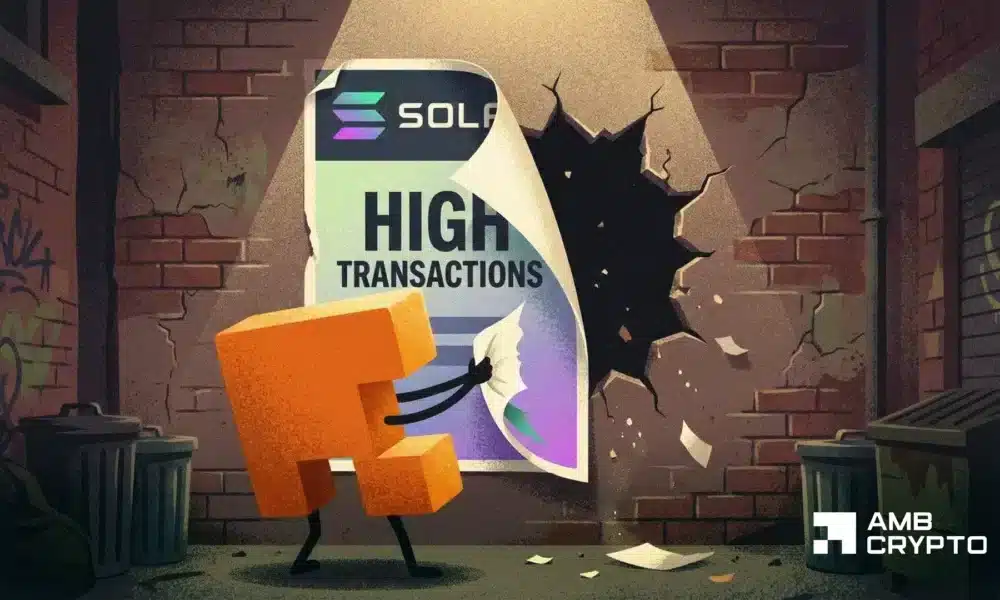
In the ever-evolving landscape of cryptocurrency, Solana (SOL) has emerged as a powerhouse, defined by transaction dominance rather than mere price strength. Recent data from TokenTerminal highlights that Solana processes approximately three times more daily transactions than Ethereum (ETH) Layer 1 and all Layer 2 solutions combined. This remarkable scale establishes Solana as a leader in high-throughput executions, with an impressive figure of around 285 million daily transactions and a throughput rate of 3,300 transactions per second (TPS). This algo-driven efficiency fosters user engagement, boasting 2.6 million active addresses. These metrics position Solana as a desirable platform for decentralized finance (DeFi) trading, payments, and other high-frequency applications.
The Power of Transaction Volume
Transaction volume is a critical metric in evaluating blockchain networks, and Solana’s numbers speak volumes. The network’s capacity thrives on ultra-low fees, averaging just $0.003 to $0.007 per transaction. This pricing structure encourages massive user engagement; however, the composition of these transactions is vital. A significant number of these transactions are voting transactions, which inflate total counts, while actual user transactions yield lower TPS rates. Moreover, a concerning success rate of 40-50% indicates potential network congestion and reliance on automated bot demand. While Solana’s throughput leadership has accelerated ecosystem adoption and liquidity velocity, attention must be directed toward enhancing reliability. Ensuring a consistent user experience is essential for sustaining long-term growth and minimizing potential disruptions.
Understanding Usage vs. Value
While Solana shines in transaction volume, this dominance does not accurately reflect monetary throughput. The network handles about 86 million non-vote transactions daily, generating approximately $622,000 in chain fees. In contrast, the Tron network (TRX), despite lower activity, manages to produce around $948,000 in daily fees, largely thanks to stablecoin transfers that provide consistent revenue streams. The ultra-low transaction costs on Solana—although advantageous for user engagement—hinder the network from capturing significant protocol value.
Value formation, therefore, shifts to the application layer. Data shows that Solana has recorded about $7.57 million in total fees paid, of which $6.66 million comes from decentralized applications (dApps). However, Ethereum surpasses Solana in this regard, generating approximately $18 million in total fees and $11.7 million in application revenue. Ethereum’s model also allows it to capture deeper economic value through mechanisms like token burns and miner-extractable value (MEV). As such, while Solana exhibits thriving execution volume and application momentum, a noticeable gap persists between its extensive usage and effective monetary capture.
Whale Activity and Market Volatility
Despite Solana’s technical advantages, vulnerabilities in its economic structure have become apparent. Whale behavior is indicative of these stressors, especially concerning capital positioning. Recently, significant transactions were noted, including a wallet depositing 60,000 SOL, worth an estimated $4.42 million, into Binance through phased transfers. Earlier deposits totaling over 100,000 SOL, valued at approximately $17.16 million initially allocated for staking, reveal a push toward liquidation amidst unfavorable market conditions.
This series of transactions, especially a notable withdrawal preceding the deposits, demonstrates how strategic moves can reduce slippage during liquidation. The rise in loss realization at such scales introduces localized sell pressure, influencing market sentiment. As SOL struggles near post-drawdown ranges, defensive sentiment looms heavy in the market, signaling potential volatility ahead.
Strategic Outlook
As we analyze the broader implications of Solana’s transaction supremacy, it becomes evident that while it fosters adoption and liquidity velocity, the ultra-low fees inhibit revenue generation for the protocol. This structural disconnect reveals the challenges Solana faces in converting high transaction activity into sustainable economic value. Additionally, rising levels of whale liquidation pose near-term sell pressure, which can influence SOL’s market dynamics and lead to increased volatility.
To sustain its position as a leading blockchain network, Solana must optimize its reliability and address the economic challenges juxtaposed to its rapid scaling. Strengthening its framework for monetization will be essential in effectively capturing value commensurate with its extensive user engagement.
Conclusion
In summary, Solana’s transaction dominance marks a significant chapter in the blockchain narrative, affirming its potential as a leader in high-frequency applications and decentralized finance. However, the challenges surrounding its economic structure and reliance on ultra-low transaction fees present hurdles that could inhibit long-term growth and stability. As whale activity indicates increased market volatility, Solana’s capacity to adapt and optimize its network for value capture will be crucial in navigating the future landscape of cryptocurrency. The coming months will reveal how deftly Solana maneuvers these challenges to maintain its leadership position in an increasingly competitive market.