


The Rise and Fall of Solana’s Pump.fun: Insights on Memecoin Creation and Legal Challenges
In the rapidly evolving world of cryptocurrency, Solana’s platform Pump.fun ([PUMP]) has gained significant attention for enabling creators to easily develop, deploy, and launch memecoins. This functionality triggered an explosive surge in memecoin creations, skyrocketing daily numbers to an impressive 71,000 and resulting in a total of 14 million tokens being launched. Consequently, myriad new addresses have emerged, with figures soaring to around 48,000 at press time. However, despite the platform’s apparent capacity for fostering innovation, it has come under substantial scrutiny as many of these tokens experienced drastic declines, raising concerns among investors and market participants.
The situation escalated further when retailers decided to take legal action against Pump.fun, leading to critical developments in a federal courtroom. Recently, a judge approved an expanded class-action lawsuit against Pump.fun, Solana Labs, and related entities. The lawsuit centers on allegations of liquidity issues and significant imbalances within the cryptocurrency market, citing that the network enabled unfair advantages for insiders involved in memecoin trading. Accusations point to insiders purchasing tokens at lower prices before public offerings, inflating prices through strategic trading practices, and subsequently selling off tokens, leaving everyday investors to contend with substantial losses.
One of the most alarming revelations from the lawsuit is that 98.6% of the 14 million memecoins have reportedly collapsed to zero. The financial implications for traders are estimated to range between $4 billion and $5.5 billion in losses. This extensive misuse of the platform allegedly involved collusion between the Pump.fun team and Solana Labs, with internal communications suggesting coordinated efforts around the early purchase of tokens. Moreover, allegations related to the Racketeer Influenced and Corrupt Organizations (RICO) Act have surfaced, pointing to serious misconduct that exacerbates the situation. A troubling aspect of the token dynamics is the fact that the PUMP token was initially launched and then subsequently shut down, with a mere ten holders controlling an overwhelming 70% of its supply.
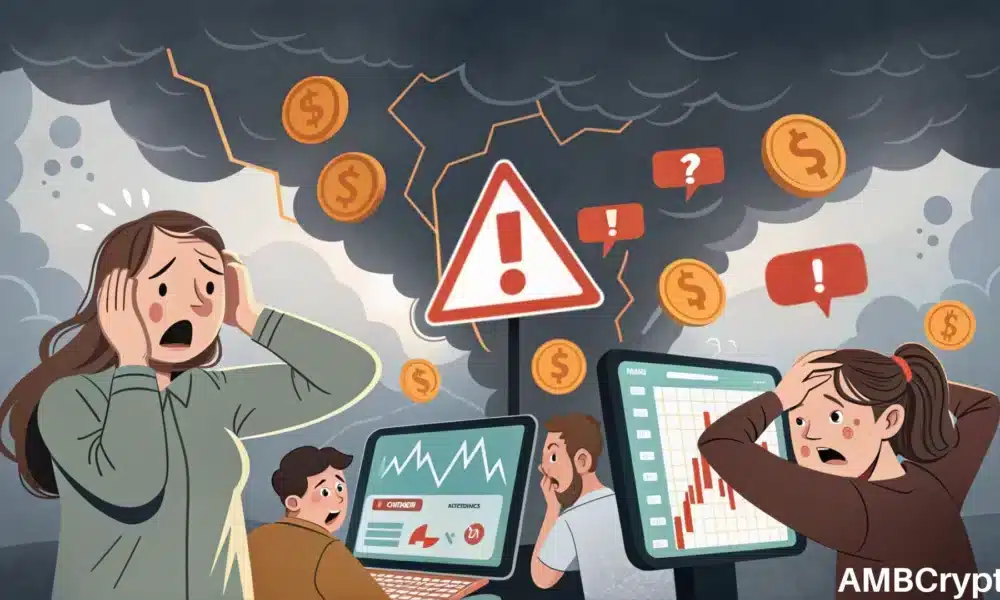
The consequences of these legal troubles have severely impacted the PUMP token’s market performance. At press time, the value of PUMP recorded a significant decline of 14%, settling at a low of $0.0018—an alarming 80% drop from its peak of $0.009. As panic set in among investors, the overall market capitalization dipped to approximately $644 million, showcasing a steady outflow of capital. Data from CoinGlass indicated that exchange inflows rose to $24 million, overtaking outflows, which totaled $22.9 million. This trend was further underscored as the Spot Netflow surged 144.88%, indicating aggressive selling behavior. The futures market reflected a similar sentiment, with outflows drastically outpacing inflows, resulting in a Futures Netflow of -$3.21 million—a clear indication of market instability.
The ongoing legal proceedings and market panic have subjected PUMP to significant downward pressure, leading investors across both spot and futures markets to swiftly divest their holdings. As a consequence, the Relative Strength Index (RSI) for PUMP dramatically fell into the oversold zone, currently resting at 28. Meanwhile, the Directional Movement Index (DMI) also dipped to 11, signaling a strong bearish momentum. These technical indicators suggest that unless market sentiment shifts positively, PUMP could experience further declines, potentially reaching even lower all-time lows. A much-needed rally would likely require PUMP to first reclaim the $0.0025 mark, enabling it to restore some confidence among buyers.
The evolving scenario surrounding Pump.fun and the PUMP token serves as a cautionary tale in the cryptocurrency space. While the platform once fostered an environment ripe for innovation and the rapid emergence of new tokens, it has now become embroiled in legal complexities that have left many investors in disarray. Industry participants are keeping a close watch on the outcome of the expanded class-action lawsuit, as it may set significant precedents for how similar platforms operate moving forward. As the mess unfolds in the courtrooms, traders and investors alike need to remain vigilant, understanding the inherent risks involved in the memecoin landscape.