



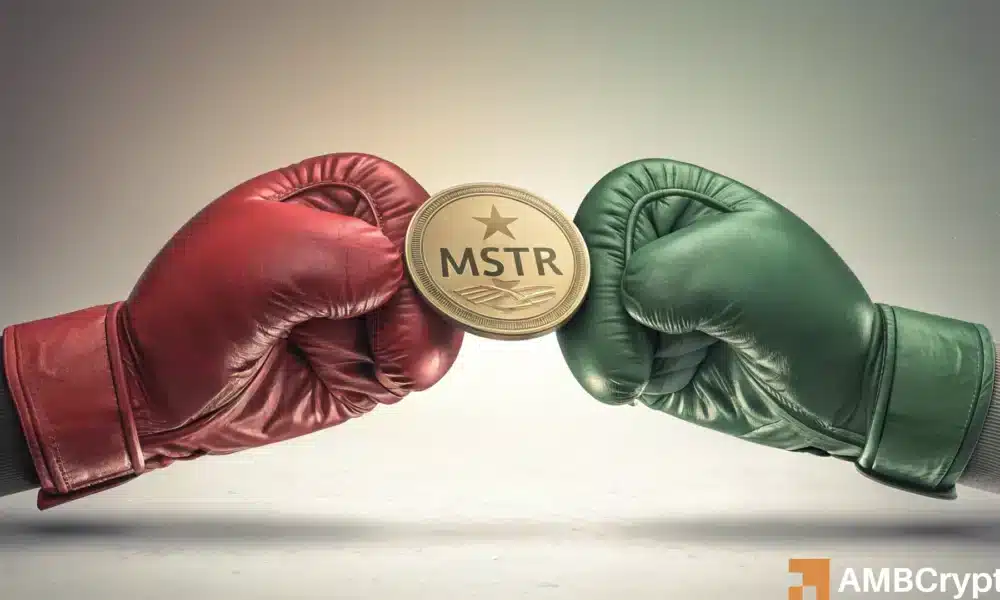

The Current Market Dynamics: Fear and Greed in Bitcoin Investments
The cryptocurrency market is witnessing significant swings between fear and greed, particularly as we enter February. The Fear and Greed Index is deep in the extreme fear zone, historically indicative of capitulation phases where long-term holders (HODLers) sell off their positions to lock in losses. This climate has led to increased caution among investors, especially regarding Bitcoin Digital Asset Treasuries (DATs). Notably, investor Michael Burry has raised alarms about the bankruptcy risks for firms holding Bitcoin DATs, such as MicroStrategy (MSTR), emphasizing the potential pitfalls of this volatile asset.
With MSTR facing unrealized losses of nearly $900 million due to Bitcoin’s plummet below its average cost basis, the risk perception appears justified. Yet, amid these challenges, Michael Saylor, MSTR’s CEO, maintains unwavering confidence in Bitcoin. He recently reiterated his commitment to acquiring 5% of Bitcoin’s total supply, framing the current dip as an attractive opportunity to purchase Bitcoin at discounted prices. This divergence in sentiment has created a polarized outlook within the market; skeptics view the volatility as a deterrent, while supporters regard Saylor’s ambitious targets as signs of enduring confidence in Bitcoin.
Market Sentiment: Separating Fear from FOMO
Investors, especially those aware of Burry’s track record—including his prescient call around the 2008 financial crisis—are paying close attention to his insights on Bitcoin. The skepticism surrounding MSTR’s viability revolves around its substantial unrealized losses; hence, caution seems prudent. However, not all analysts share this pessimism. There are indicators suggesting MSTR’s stability. Although MSTR has approximately $8.24 billion in debt, it has no immediate debt obligations due until 2028-2030. Its Bitcoin holdings are valued at around $53.54 billion, creating a robust coverage buffer of 6.5 times its liabilities.
This financial positioning leads to projections that MSTR can withstand the current wave of fear, misinformation, and uncertainty (FUD) in the market. The firm has a history of resilience; during a previous downturn when Bitcoin dipped below their cost basis—down to about $16,000 from around $30,000—MSTR held onto its Bitcoins rather than liquidating assets under pressure. This strategy appears to have fortified investor confidence.
Assessing MSTR’s Resilience and Future Outlook
One key aspect of MSTR’s strategy is its careful financial planning, which includes a solid cash reserve to manage cash flow. The company has set aside a 2.5-year cash runway to cover interest and dividend payments, providing additional financial resilience against market temptations and volatility. This proactive approach enables MSTR to hold onto its Bitcoin through turbulent times, avoiding forced liquidation even in extreme market downturns.
Michael Saylor’s target of acquiring 1 million Bitcoin does not seem far-fetched given MSTR’s current financial health and strategic maneuvers. With no Bitcoin-backed debt, MSTR’s actions reinforce its stance on Bitcoin as a reliable store of value. Thus, while skepticism may linger, MSTR’s ongoing Bitcoin purchases signal a proactive approach in the face of fear, encouraging other investors to consider the possibilities that the market may offer.
The Greed Signal: MSTR’s Influence on Market Dynamics
Despite the surrounding fear related to Bitcoin investments, MSTR’s strategies are sending out a strong greed signal in the market. The company’s substantial Bitcoin holdings and commitments indicate a belief in the cryptocurrency’s long-term viability, which helps to keep fear at bay and generate a sense of urgency among potential investors. This dynamic illustrates how MSTR and its leadership are counteracting the prevailing fears with calculated moves designed to capitalize on market dips.
Investors who align with Saylor’s vision may find themselves on the cusp of investment opportunities that could arise from current fear-driven pricing. The psychological aspect of investing in a volatile market like cryptocurrency cannot be understated; fear can lead to panic selling, while greed can trigger higher investment inflows. MSTR, by maintaining its acquisition strategy, serves as a case study in leveraging market psychology to its advantage.
Final Thoughts: Navigating Cryptocurrency Volatility
In conclusion, the cryptocurrency market is rife with contradictions as investor sentiment oscillates between fear and greed. MicroStrategy’s financial robustness, backed by its substantial Bitcoin holdings, provides a considerable buffer against market uncertainties. Saylor’s plans and ongoing purchases form a narrative that challenges the predominant fear in the market, introducing elements of FOMO (fear of missing out) among potential investors.
As such, while the volatility and risks associated with Bitcoin and Digital Asset Treasuries remain, MSTR’s approach demonstrates a powerful counter-narrative that may attract more investors looking for long-term gains. By taking a calculated stance in a fear-driven market, MSTR reinforces the perspective that opportunities can be seized even when the overall market sentiment appears negatively charged.
Investors must remain vigilant and consider diverse strategies while navigating this environment. Understanding the nuanced balance between fear and greed can empower them to make more informed decisions, potentially paving the way for future success in the cryptocurrency landscape.