

The Impact of Geopolitical Tensions on Iran’s Crypto Market: A Detailed Overview
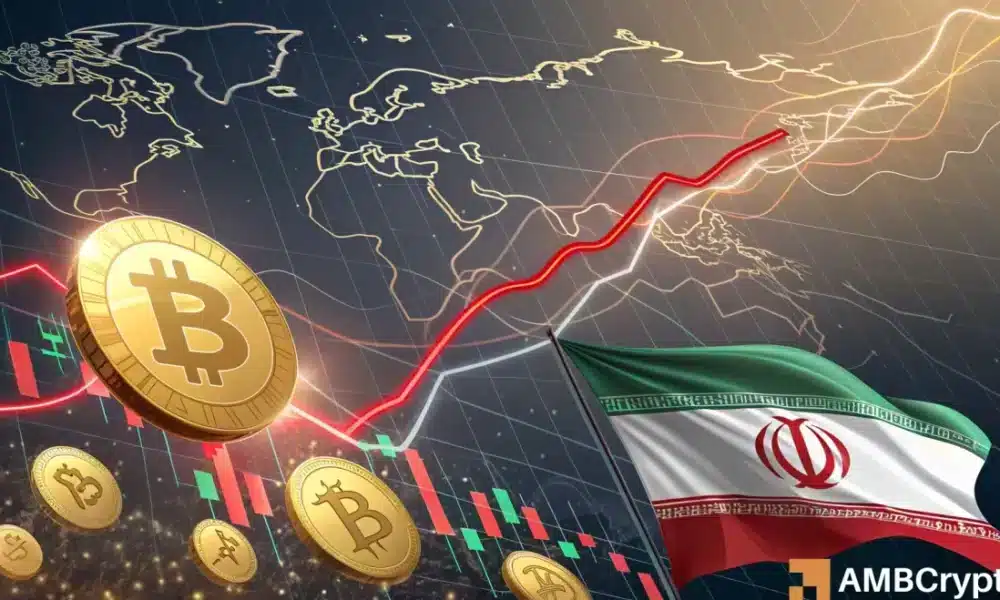
As the world entered March, headlines focused on escalating tensions and conflict, particularly following U.S. and Israeli strikes on Tehran on February 28th. This surge in geopolitical unrest had immediate repercussions for Iran’s cryptocurrency landscape, notably resulting in significant outflows from Nobitex, the country’s largest crypto exchange. With nearly $3 million withdrawn shortly after the strikes, questions arose about the state of confidence in Iran’s economy and whether these actions indicated capital flight.
Nobitex has become a cornerstone of Iran’s digital economy, processing an impressive $7.2 billion in transactions in 2025 and catering to more than 11 million users. For many Iranians, this exchange offers a crucial avenue to convert the rapidly depreciating Iranian Rial into more stable cryptocurrencies like Bitcoin and USDT. Given the economic conditions—marked by concerns over the Rial, valued at approximately 1,314,545 per U.S. dollar—one could surmise that the recent withdrawal spike symbolizes a desperate shift towards safer assets amid fears of financial instability.
However, leading analysts caution against hastily labeling this situation as a clear case of capital flight. Ari Redbord, the Global Head of Policy at TRM Labs, provided insight by stating that the fluctuations in crypto transactions do not unequivocally point to an overwhelming financial exodus. Instead, he suggests that what we observe is a market grappling with volatility, exacerbated by strict regulatory measures and connectivity issues. The notion of ‘capital flight’ would traditionally imply a significant loss of faith in the domestic economy, yet in Iran, the landscape is complicated by the government’s interventions and infrastructure limitations.
Following the military strikes, the Iranian government enforced a crippling 99% internet blackout, which hampered market access and significantly affected trading dynamics. Retail investors found themselves cut off, automated trading systems stuttered, and market makers experienced disruptions. According to TRM Labs, transaction volumes plummeted by 80% from February 27 to March 1, indicating that the $3 million surge on Nobitex was likely an internal liquidity management tactic rather than widespread panic-driven withdrawals. Hence, the portrayal of mass economic escape may not accurately depict the reality, as restrictions transformed the crypto market into one characterized by state control rather than chaos.
Historical patterns underscore the complexity of Iran’s crypto landscape. Instances of civil unrest in the past have also led to spikes in withdrawals and prompt government responses, often including internet blackouts. For example, a similar wave of withdrawals occurred on January 9 during prior unrest. On a global scale, while fear gripped local markets, the overall cryptocurrency market capitalization rose by 2.37%, reflecting resilience in the broader market albeit coupled with a Crypto Fear and Greed Index rating of 14, indicating "Extreme Fear" among investors.
This divergence highlights a key observation: while citizens in conflict zones may resort to cryptocurrencies to safeguard their assets during crises, such as those seen in Venezuela or Iran, the overall market dynamics can appear less tumultuous. Consequently, while the immediate responses in Iran reflect unease, the global cryptocurrency markets continue to present themselves as reasonably stable environments, albeit with fragile confidence levels among investors.
In summary, while Iranian citizens are reacting swiftly to geopolitical tensions, various factors, including exchange restrictions and governmental control, hinder the capacity for large-scale economic shifts. With the Rial trading near historic lows, cryptocurrencies maintain their allure as protective financial instruments against devaluation. While volatility continues to characterize the crypto landscape, it remains clear that digital assets serve an essential role for individuals in Iran striving to navigate an uncertain economic climate.