




The Dual Faces of Ethereum: Staking Growth Amidst Price Decline
Introduction to Ethereum’s Current Landscape
As Ethereum (ETH) continues to evolve, it finds itself at a crossroads marked by a strong long-term outlook juxtaposed against a sharp decline in price. Recent data reveals that while investor confidence has surged, the digital asset struggles to maintain its price, highlighting a complex narrative. This article will explore the dynamics of Ethereum’s staking activity, the rise of tokenized real-world assets (RWAs), and the implications of institutional investments on its ecosystem.
Surge in Staking Activity
One of the most compelling aspects of Ethereum’s current landscape is its staking pool, which has exceeded 80.95 million ETH, representing over 50% of the total supply. This unprecedented milestone illustrates a growing commitment among holders to secure the network through its proof-of-stake (PoS) system. The nature of staking inherently reduces the liquid supply of ETH available in the market, creating a scenario in which more assets are locked away for potentially lucrative returns rather than active trading. During periods of market quietness, this trend often accelerates as investors prioritize yield over volatility, signaling a noteworthy shift in trader behavior.
Tokenized Real-World Assets: A Game Changer
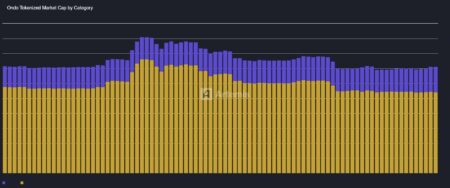
Another major development influencing Ethereum’s stance in the financial ecosystem is the exponential growth of tokenized RWAs. As of now, the market for these assets has surged to over $17 billion, a staggering 300% increase year-over-year. This surge reflects a growing demand for blockchain solutions in private credit, government treasuries, and commodities. Major financial institutions like BlackRock, JPMorgan, and Franklin Templeton have begun exploring these tokenized products, further validating Ethereum’s position as a foundational layer for innovative financial solutions. Projections indicate that the RWA market could skyrocket to $2 trillion by 2028, and even reach $11 trillion by 2030 according to ARK Invest. As such, Ethereum stands at the forefront of this burgeoning financial landscape.
Institutional Confidence
Recent revelations about the holdings of significant players provide insight into the institutional confidence in Ethereum. A noteworthy example is Bitmine Immersion Technologies, which announced holdings of 4.37 million ETH—approximately 3.62% of the circulating supply. Valued at around $8.7 billion, this investment constitutes a substantial portion of the company’s overall crypto and cash reserves. These developments illustrate that while retail sentiment may be tepid due to price fluctuations, institutional players are increasingly committed to Ethereum’s long-term potential.
Disconnection Between Fundamentals and Price
Despite these promising fundamentals—such as increasing staking activity and institutional investment—the price of ETH remains under pressure, recently dipping below the $2,000 mark and stabilizing around $1,995. This situation presents an almost paradoxical disconnect between strong underlying metrics and market sentiment. While the market may exhibit caution, particularly among traders who are monitoring momentum indicators, the fundamentals suggest a much more robust positioning for ETH in the long term.
Conclusion
As we observe the current dual narrative surrounding Ethereum, it becomes clear that while short-term price trends may falter, the long-term outlook remains optimistic. Over 50% of Ethereum’s total supply is staked, reflecting a strong belief in its future potential. Additionally, the increasing engagement of institutional players in tokenized RWAs underscores the asset’s growing importance in the broader financial ecosystem. As the industry grapples with the prevailing market sentiment, Ethereum continues to build a strong foundation for sustainable growth, positioning itself for significant developments in the years ahead.