



Privacy and Profit: Ethereum’s Bold Step into Anonymous Gifting and Its Future in 2026
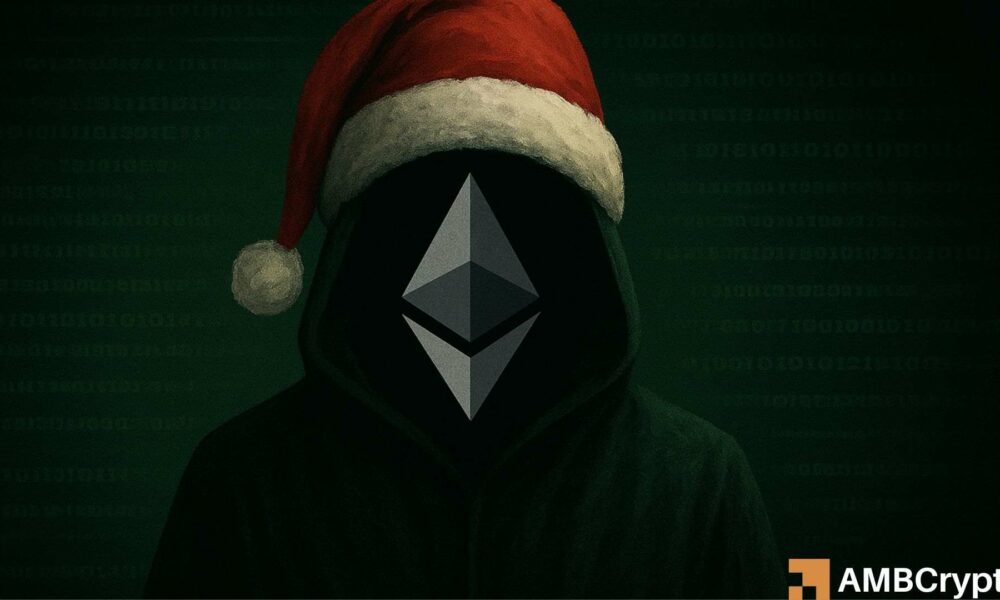
As global conversations about privacy continue to intensify, particularly in 2025, the crypto markets have seized this narrative, making it both a timely and lucrative topic. With the holiday season in full swing, Ethereum developer initiatives like the ‘Secret Santa’ protocol aimed at enhancing anonymous gifting have garnered widespread attention. This effort represents Ethereum’s ongoing commitment to privacy, first unveiled in a significant roadmap release by the Ethereum Foundation in September. The roadmap outlines comprehensive plans to bolster privacy at all levels of the Ethereum chain, addressing user-facing wallets, private payments, and transaction protocols for both retail and institutional transactions.
The advancements in privacy protocols signify that Ethereum is not complacent about security matters. The ongoing development of private wallet functionalities through the Kohaku framework is a demonstration of this commitment. As we look forward to 2026, Ethereum’s focus on privacy intertwines with essential goals such as scaling and the integration of artificial intelligence (AI). A pivotal component of Ethereum’s strategy hinges on enhancing transaction throughput while reducing costs through recent scaling efforts, such as Pectra and Fusaka, which aim to position Ethereum as a competitive player alongside platforms like Solana.
The ongoing debate surrounding Ethereum’s Layer 1 (L1) versus Layer 2 (L2) solutions has emerged as a critical aspect of its evolution. In light of Vitalik Buterin’s recent assertions that low transaction rates empower developers to build directly on the L1, industry experts are torn. Dan Smith from Blockworks raised concerns about the straightforwardness of this assertion, suggesting that L2s, which utilize blobspace most efficiently, should not be seen merely as competitors to L1 but as distinct entities serving unique functions in the ecosystem. By drawing an analogy between L2s as carpenters and L1s as lumber yards, he highlights the complex dynamics at play.
Counterarguments, however, defend Buterin’s perspective, emphasizing that both L1s and L2s coexist strategically, vying for the same user base. Proponents argue that successful models can balance healthy competition and collaboration, much like Apple’s distribution through various channels. For example, while Base, a Coinbase-incubated L2, generated $3.4 million in fees recently, it only contributed $3,700 back to the Ethereum mainnet as “rent.” This discrepancy has sparked discussions about tokenomics, with many analysts positing that L2s extract more economic value from Ethereum than they return, impacting the valuation of ETH itself.
As Ethereum navigates these multifaceted challenges, the future remains uncertain yet promising. The urgency to capture more value for the Ethereum L1, as propounded by Buterin, has met with reservations from segments of the community. Industry watchers are keenly observing how upcoming scaling solutions and privacy enhancements will reshape ETH’s tokenomics and overall market demand. Ethereum’s strategic positioning capitalizes on the growing need for privacy in the digital age while responding to the pressures of value capture and distribution within its ecosystem.
In summary, as 2025 transitions into 2026, Ethereum stands at a crucial crossroads where privacy, scalability, and economic dynamics converge. The ongoing privacy initiatives and the vigorous discourse surrounding L1 versus L2 solutions signify Ethereum’s proactive stance in capitalizing on current trends while preparing for the challenges that lie ahead. The success of these initiatives could ultimately redefine the landscape of decentralized finance and elevate Ethereum’s role in a privacy-conscious future.