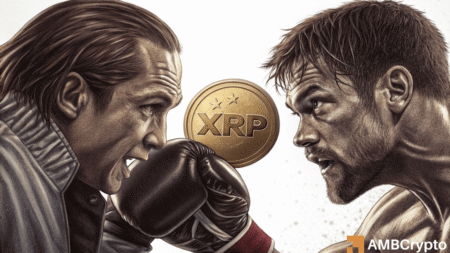




Eric Trump vs. Jamie Dimon: The Clash of Banking Views in the Age of Blockchain
In a rapidly evolving financial landscape, Eric Trump has ignited significant debate surrounding the relevance of traditional banking institutions. On May 16, during an interview on CNBC, he questioned the necessity of banks like JPMorgan Chase, advocating instead for the advantages of blockchain technology. With the ongoing transformation of the financial sector, Trump believes that decentralized finance (DeFi) offers a more efficient and transparent alternative to traditional banking. His assertions come amid warnings from JPMorgan Chase CEO Jamie Dimon about recession risks fueled by global uncertainties.
Trump’s comments directly challenge the operational integrity of major banks, prompting listeners to consider, "What can the current banking system offer that blockchain cannot?" He emphasized the benefits of improved efficiency and lower costs associated with DeFi, indicating a shifting tide towards digital solutions that can better serve a modern economy. By voicing these concerns, Trump aligns himself with a burgeoning movement that sees blockchain as the future of finance, which raises questions about the place of conventional banks in this new ecosystem.
Conversely, Jamie Dimon remains wary of the broader economic context impacting financial markets. He pointed out in a recent Bloomberg interview that ongoing domestic and international pressures—such as elevated interest rates, rising deficits, and profound global conflicts—contribute to market instability. Dimon noted a significant probability (50%) of a U.S. recession, cautioning that such uncertainty complicates the business landscape. While Trump champions a future dominated by blockchain, Dimon critiques it, labeling Bitcoin as “worthless” and “a fraud.” This rivalry between the two figures underscores the fundamentally different philosophies guiding the future of finance.
As Eric Trump backs his father’s administration and its stance on cryptocurrency, he referenced the crypto community’s growing discontent with banks, stating that traditional financial institutions "made the biggest mistake of their lives." His remarks during the Consensus conference in Toronto reflect a broader sentiment that banks must adapt to the innovations brought by blockchain to survive. Trump’s assertions extend beyond mere personal beliefs; they echo the prevailing view among proponents of digital currencies who argue that established financial institutions must evolve or risk becoming obsolete.
The UAE’s emergence as a prominent crypto hub underscores this shift. Eric Trump pointed to the efficiencies of decentralized technologies as emblematic of future financial transactions. Traditional banking is increasingly viewed as outdated, costly, and sluggish in comparison. His message is clear: the future belongs to those willing to embrace innovation. In the face of resistance from figures like Dimon, who staunchly oppose cryptocurrencies, the need for adaptation may determine the survival of many legacy banks amid digital disruption.
Market conditions also fluctuate, with Bitcoin recently hovering around $102,996.80, though it experienced a slight dip of 0.74%. This demonstrates the volatility associated with digital currencies, an aspect repeatedly underscored by skeptics like Dimon. However, even naysayers like Peter Schiff are beginning to acknowledge the growing significance of cryptocurrencies, albeit tongue-in-cheek. This recognition highlights the increasing relevance of Bitcoin, compelling even its harshest critics to reconsider their positions.
In conclusion, the ongoing dialogue between Eric Trump and Jamie Dimon signals a crucial moment in the financial sector. As traditional banks grapple with the challenges posed by blockchain and cryptocurrencies, opinions vary widely about the future of finance. The contrasting views of these two prominent figures speak volumes to the urgency of adaptation within banking systems. With the rise of decentralized technologies on the horizon, the fate of traditional financial institutions hangs in the balance as they navigate the complexities of a rapidly changing economic landscape. The future of finance may very well depend on how swiftly traditional banks can embrace innovation and meet the demands of an increasingly tech-savvy populace.