


Understanding Bitcoin’s Market Dynamics: Institutional Accumulation Amidst Uncertainty
In recent weeks, Bitcoin (BTC) has showcased a notable rise in mid-term holder activity, doubling the UTXO (Unspent Transaction Output) band from 6 million to 12 million. This trend indicates a growing conviction among investors to hold onto their assets despite Bitcoin experiencing a slight dip of 1.79%, landing at $104,950. The increase in UTXO is a strong signal that professional or institutional investors are turning to accumulation rather than cashing out during periods of volatility. Historical patterns suggest this behavior from mid-term holders often precedes significant price rallies, potentially creating a bullish setup for Bitcoin if the trend continues. However, while mid-term accumulation seems positive, short-term demand appears fragile, necessitating a cautious approach from traders awaiting crucial confirmation signals.
Binance Dominance: A Shift in Spot Market Activity
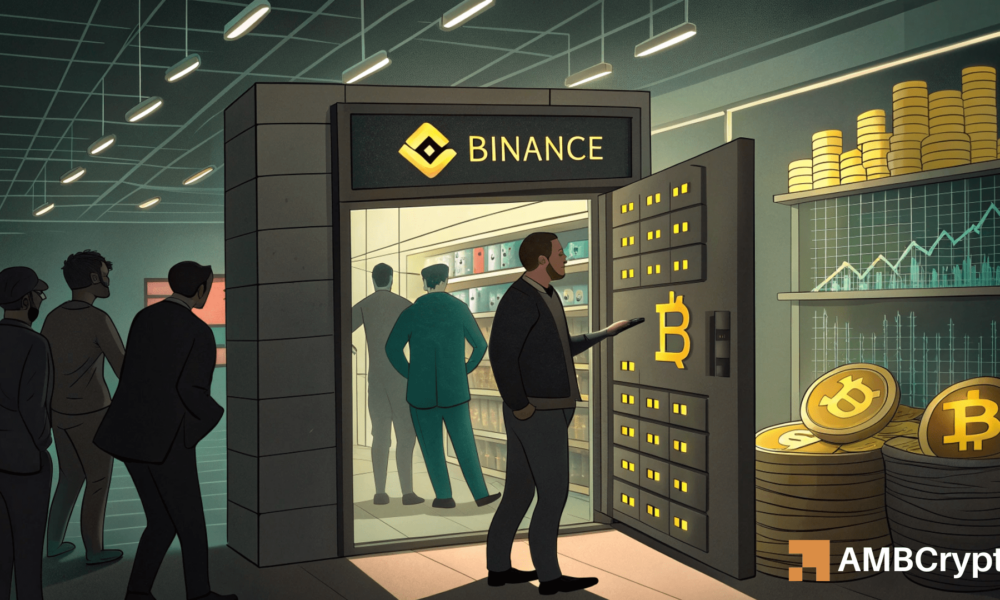
An astonishing shift in spot market activity has recently been observed, with Binance capturing an impressive 53% of Bitcoin’s trading volume, up from 24% in just a single day. This sudden surge suggests a massive influx of capital, likely driven by institutional players reallocating their strategies to tap into Binance’s deep liquidity and favorable trading fees. Such accelerated consolidation of spot trading volume can often signal an impending period of high volatility, especially when it is rooted in strategic accumulation ahead of potential price movements. Additionally, this growing centralization in trading platforms like Binance could reshape price discovery dynamics and overall market behaviors as institutional interest continues to escalate.
The Scarcity Narrative: Analyzing the Stock-to-Flow Ratio
Bitcoin’s Stock-to-Flow (S/F) ratio has surged to 580, contrasting sharply with historical averages. This metric serves as a gauge of Bitcoin’s circulating supply against its annual issuance. A jump in this ratio typically indicates tightening supply and could signify long-term bullish potential. However, it’s important to note that such a high S/F ratio could be influenced by numerous factors, including a decrease in miner selling and fluctuations in on-chain activity. While the elevated S/F ratio supports the idea of a looming supply shock, it alone cannot drive price growth. For sustained appreciation, increased demand and broader market participation are essential. Simply put, if investor interest doesn’t rise, the high S/F levels may not translate to immediate gains.
Market Sentiment: Indecision Among Traders
BTC’s social metrics indicate a troubling trend of indecision within the market. Recently, Bitcoin’s Social Dominance fell to 19.88%, and the Binance Funding Rate stabilized at a neutral 0.001%. Such metrics point to diminishing crowd engagement and a lack of assertive control by either bulls or bears. Historically, when social interest declines alongside stable funding rates, markets often brace for volatility as they await catalysts. The absence of strong sentiment or leveraged trading means the market may remain within a range, potentially delaying significant movements. For Bitcoin to move decisively, we may need to witness a resurgence in trader engagement and directional funding.
Address Activity: A Sign of Underlying Concerns
Despite Bitcoin’s recent price stability above $100K, the Price-DAA (Daily Active Addresses) Divergence remains in negative territory. This disconnect raises concerns regarding market sustainability, as increased address activity typically corresponds with genuine price movement. The divergence signifies fewer unique users engaging on the network, creating doubts about the strength of current price levels. Without a corresponding rise in address activity, it’s difficult to justify the longevity of this price stability, suggesting that speculative or hollow price movements could be at play.
Conviction vs. Exhaustion: The Current Market Outlook
Bitcoin’s market stands at a critical juncture, characterized by a clash between strong accumulation by long-term holders and diminishing interest from the broader investor community. The increase in UTXOs and Binance’s elevated market share signals growing institutional confidence; however, that confidence is juxtaposed against signs of retail engagement fatigue. For Bitcoin to achieve a durable breakout, a harmonious alignment between institutional buying trends and rekindled retail enthusiasm is necessary. Until we see this balance, Bitcoin is left in a precarious position, oscillating between the potential for a breakout and the threat of market exhaustion.
In summary, as Bitcoin navigates through this period of institutional accumulation and weaker retail interest, market players need to stay informed. Monitoring key indicators like UTXO growth, trading volume shifts on exchanges, the S/F ratio, and sentiments from active addresses will be crucial in shaping the market’s outlook. The interplay between institutional strategies and retail participation could ultimately determine Bitcoin’s trajectory in the days to come.