



Aster: Navigating Towards 2026
In a landscape marked by volatility, Aster [ASTER] emerged as a beacon of resilience following the merger of Astherus and APX Finance nearly three months ago. While the broader cryptocurrency market has taken a hit as Q4 turned bearish, Aster has demonstrated stability, largely attributed to its comprehensive roadmap and strategic planning. As we look ahead, the key question that arises is: what does the future hold for Aster in 2026?
Aster’s 2026 Roadmap
AsterDex has outlined an ambitious roadmap for 2026, focusing on the enhancement of infrastructure, token utility, ecosystem development, and community engagement. The core vision involves a synergistic approach where these foundational elements reinforce one another, creating a continuous cycle of growth. The roadmap details several critical milestones. In December 2025, Aster will implement a shield mode aimed at facilitating private high-leverage trading and Time-Weighted Average Price (TWAP) strategies. Following this, mid-December will see the rollout of upgrades that expand Real-World Asset (RWA) markets, culminating in the launch of the Aster chain testnet for community testing by year’s end.
As we transition into the first quarter of 2026, Aster plans to launch its Layer-1 chain, introduce Aster Code for developers, and establish a smooth fiat on/off ramp to attract new users. By the second quarter, the focus will shift to launching a staking mechanism, instituting on-chain governance, and providing smart-money tools that will empower users to track leading traders in the market. Collectively, these developments signal Aster’s ambition to evolve beyond merely being a decentralized exchange (DEX) into a full-stack liquidity network.
Aster’s Token Management Strategy
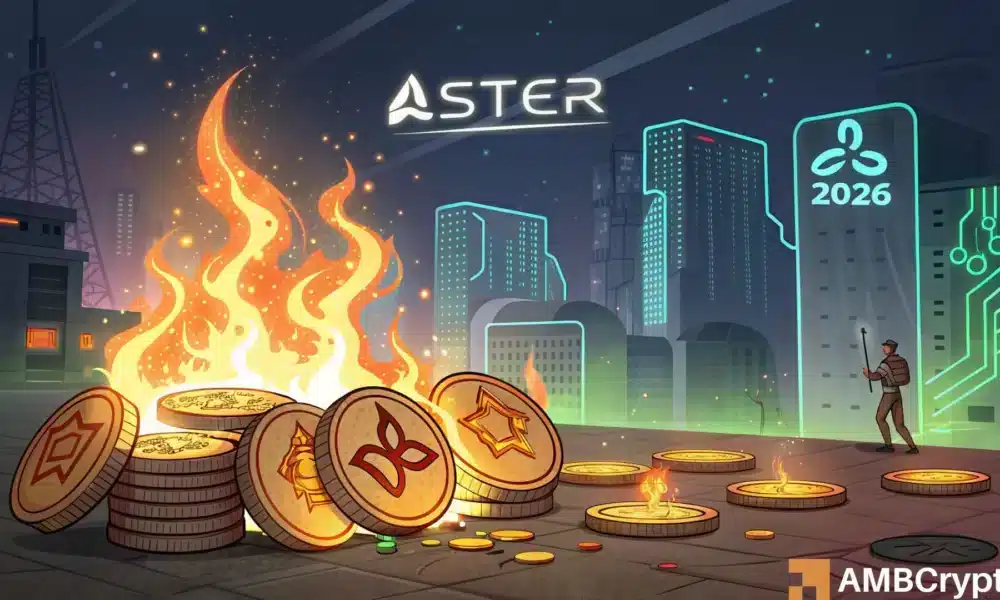
To undergird its 2026 vision, AsterDex has undertaken aggressive deflationary measures to stabilize the market and enhance token value. Recently, the team conducted the S3 buyback program, successfully buying back 155.7 million tokens, which they then burned as part of their commitment to reducing supply. This included a significant burn of 77,860,328 ASTER tokens, valued at approximately $89.8 million, permanently removing them from circulation. The remaining tokens were locked away, with a portion allocated for airdropping to further stimulate community engagement.
To date, AsterDex has purchased a total of 10.1 million tokens, amounting to an expenditure of $10.5 million. When combined with previous acquisitions, they have acquired 165.8 million tokens valued at approximately $173.3 million. By controlling the supply through buybacks and burns, Aster is creating long-term scarcity, which could position the token for price appreciation if demand remains robust.
Market Impact and Price Predictions
The ongoing buyback and burn strategies have effectively absorbed selling pressure brought on by the open market, allowing Aster to maintain stability. After the broader market rebounded from a dip in early December, ASTER found itself trading within a parallel consolidation range, exhibiting gradual upward momentum. Demand has begun to outweigh selling pressure, as suggested by indicators like the Stochastic Momentum Index, signaling potential for further price gains.
This improved market context positions Aster favorably on the price charts. If demand holds steady, it is projected that Aster could reclaim the mid-band of the Bollinger Bands, currently at approximately $1.1. A successful breach of this level could pave the way for Aster to reach the upper band at $1.3. However, these optimistic scenarios hinge on the strength of market participants to maintain prices above the crucial support level of $1. Failing to hold this mark could lead to a retreat toward lower support levels around $0.91.
Community Engagement and Ecosystem Development
As Aster seeks to strengthen its position in the crypto market, active community engagement will be pivotal. The rollout of on-chain governance mechanisms will empower users to participate in decision-making processes, fostering a sense of ownership and responsibility among token holders. This type of active participation not only enhances user experience but also drives organic growth, as engaged communities are often more likely to support and promote the project.
Moreover, the introduction of smart-money tools will provide users with invaluable insights into trading strategies from experienced market players. These features are designed to level the playing field, enabling all users to make informed trading decisions, thereby contributing to a more robust and vibrant ecosystem.
Final Thoughts
AsterDex’s unveiled roadmap for 2026 showcases its determination to evolve into a comprehensive liquidity network while leveraging deflationary tokenomics to solidify its market position. The aggressive buyback and burn initiatives demonstrate a commitment to long-term value creation, which could prove advantageous for both the project and its community. With planned features such as staking, on-chain governance, and smart-money tools, Aster is set to enhance its user experience significantly.
In summary, the future appears promising for Aster. As it prepares to navigate the complexities of the crypto landscape, its strategic focus on infrastructure, community, and continuous improvement will be key to sustaining growth and mitigating risks associated with market volatility. As we move closer to 2026, Aster could emerge as a leader in the decentralized finance space, provided it adheres to its roadmap and responds adeptly to market dynamics.