



Altcoin Market Analysis: Trends and Implications for Investors
The altcoin market is currently experiencing a significant decline in trading volume, plummeting to approximately $26.5 billion from past peaks exceeding $100 billion. This sharp contraction indicates a worrying trend across the cryptocurrency landscape. Notably, Binance has processed around $7.7 billion, while other exchanges collectively handled roughly $18.8 billion. This data confirms a broad-based weakening in market activity, with Binance’s share rising to nearly 40%, reflecting a concentration of trading on this largest exchange as overall participation declines.
The Shift in Altcoin Dynamics
As altcoin engagement diminishes, it’s clear that market participants are becoming increasingly risk-averse. Previous high-volume periods, particularly observed in February and October 2025—with volumes reaching $40–50 billion on Binance and up to $91 billion across other platforms—highlight strong demand conditions. Currently, as trading volumes fall, it becomes evident that reduced risk appetite is impacting both trading pairs and sizes. While capital appears to be retracting rather than exiting the market completely, the reduced activity is likely to diminish volatility. This decline may precede a phase of renewed positioning when market sentiment stabilizes, leading to a resurgence in liquidity.
Liquidation and Capitulation: A Closer Look
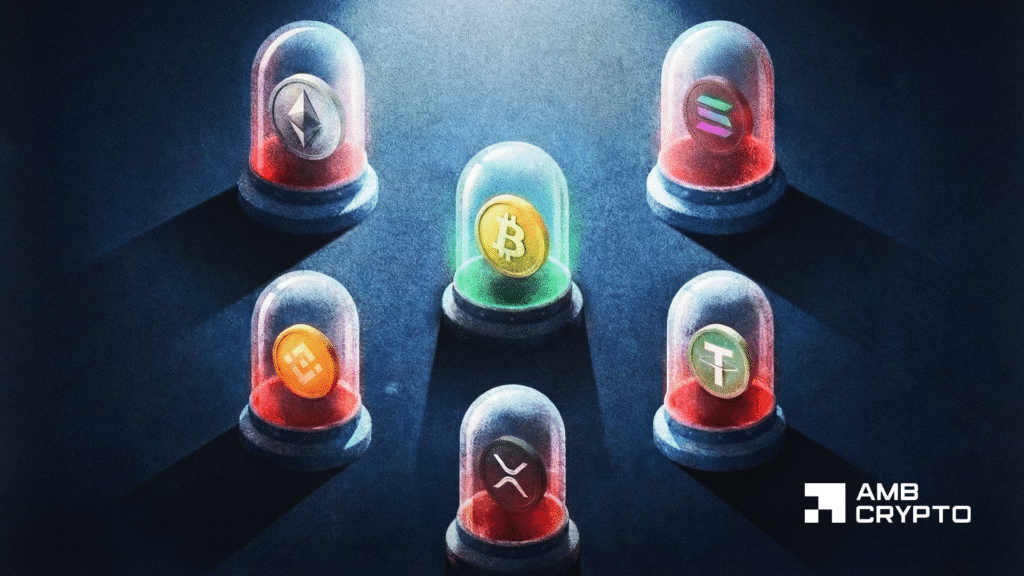
In the latest developments, the altcoin market is entering what could be described as a capitulation phase, where nearly 38-40% of altcoin assets are trading near their all-time lows. This trend signals a clear deterioration within a broad range of assets, suggesting that the current sell-off is not isolated but rather indicative of widespread weakness. Contrarily, Bitcoin has maintained stronger performance relative to altcoins, highlighting a clear divergence between major cryptocurrencies and riskier assets. This liquidity rotation towards Bitcoin is a sign that investors are seeking refuge in what they perceive to be a safer asset amid a tumultuous market, resulting in diminished demand and liquidity for altcoins.
Selling Pressure and Market Sentiment
Despite the pressure on altcoins, the extreme readings within the market indicate that selling pressure may be nearing exhaustion. Investors are pulling back from risk exposure, choosing to preserve capital rather than engage in speculative activities. This cautious approach suggests a fragile market structure where downside risks persist. However, there is a silver lining; if liquidity returns, it could lay the groundwork for potential accumulation opportunities, particularly for undervalued altcoins that have suffered due to current sell-offs.
Market Stability and Derivatives Activity
As we delve deeper into the market structure, it becomes apparent that stress is building without a complete capitulation. The Bitcoin Short-Term Holder SOPR (Spent Output Profit Ratio) is hovering around 0.98, indicative of realized losses near -12%. Historically, these levels have often preceded more significant market resets; however, recent selling appears to be controlled rather than aggressive. Additionally, liquidations remain limited, totaling around $234 million—with $127 million linked to long positions—demonstrating that forced exits are currently minimal.
Navigating the Future: Investor Considerations
Another significant factor to watch is the quality of liquidity, which has deteriorated as evidenced by Binance’s Futures-to-Spot ratio reaching a 1.5-year high. This metric indicates that derivatives trading is growing at a faster pace than spot demand, suggesting a fragile balance. If spot demand fails to recover, markets may face renewed volatility, further complicating the already challenging landscape for altcoin traders.
Conclusion: Implications for Altcoin Investors
In summary, the altcoin market is facing a precarious situation marked by diminishing volumes and thinning liquidity, with many assets approaching pivotal capitulation levels. Although this shift includes a rotation of liquidity to Bitcoin, conditions may eventually favor accumulation opportunities for undervalued altcoins if demand stabilizes. Investors must navigate these complex dynamics carefully, weighing the risks and opportunities that lie ahead in one of the most volatile markets in finance. By remaining vigilant and adaptable, cryptocurrency traders can better position themselves for potential rebounds as market sentiment evolves.