


The Current State of Solana: A Deep Dive into Market Dynamics
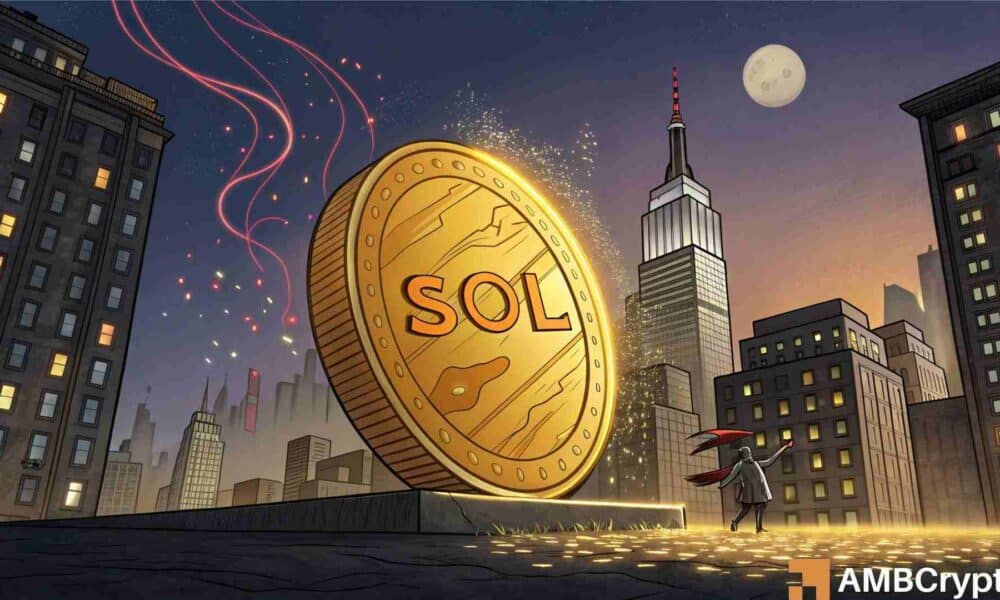
The cryptocurrency landscape is in a state of flux, notably with Solana (SOL) witnessing a significant decline in its price. As of December 23, 2025, the overall crypto market dipped by 1.65%, influenced heavily by Bitcoin and Ethereum, which lost 2.45% and 2.75%, respectively. This downward trend has sparked concerns among intraday traders, particularly as nearly $90 million worth of long-leveraged positions face liquidation risks. Solana specifically fell by 1.55%, trading at approximately $124.30. Despite this decline, trading volume for SOL surged over 17%, reaching $3.55 billion, indicating that market participants are actively considering the implications of current price movements.
The Over-Leveraged Environment
Traders currently exhibit a strong bullish sentiment, with a noticeable imbalance in leveraged positions. The SOL exchange liquidation map reveals that intraday traders have amassed significant long positions at $123.30, coupled with substantial short positions at $129.50. Specifically, the data shows $89.54 million in long positions against $204.18 million in short positions. This disparity suggests that many traders are betting against a price rise above $129.50. Such dynamics often lead to heightened volatility, as liquidation events can create rapid price movements in either direction.
Accumulation Amid Uncertainty
Despite the bearish outlook for intraday traders, other market participants are showing interest in accumulating SOL. Notably, over $8.77 million worth of SOL has reportedly flowed out of exchanges and into wallets, hinting at potential bullish accumulation. This trend may serve as a buffer against further price declines. Additionally, there have been consistent inflows into U.S. Solana spot exchange-traded funds (ETFs) since December 4, reflecting stronger market interest and an influx of fresh capital from Wall Street investors. Such inflows posit that despite short-term fluctuations, the long-term perspective on Solana remains optimistic.
Technical Analysis: Support and Resistance Levels
When looking at Solana’s recent price action, technical analysis from AMBCrypto presents a nuanced view. The weekly charts highlight a critical support level around $117, a threshold that could signal a potential downturn if breached. More granular analysis of the daily charts indicates a consolidation pattern, with SOL facing resistance at $128.23 and support at $123.50. Should the price break below $123.50, there could be significant downward pressure towards the broader support level of $117. Conversely, a decisive breakout above the $128.23 resistance could rejuvenate bullish momentum, possibly leading to higher price targets.
Investor Sentiment: A Diverging Perspective
The contrasting sentiment between intraday traders and long-term investors reveals the complexity of the current crypto environment. While short-term traders face a challenging landscape marked by potential liquidations, institutional investors and crypto enthusiasts seem undeterred by recent price movements. This divergence suggests that the upcoming market behavior may rely heavily on broader economic indicators and macroeconomic conditions, especially as investors weigh the potential of both Solana and the overall crypto ecosystem.
Conclusion: Opportunities Amidst Volatility
As it stands, Solana is positioned at a crucial junction. Intraday traders face risks with substantial long positions at risk due to recent price movement, while the broader perspective from both Wall Street and crypto-native investors indicates an underlying bullish sentiment. For prospective investors, this environment provides both challenges and opportunities—one that requires careful monitoring of market dynamics. The current phase could serve as a prime opportunity for those looking to accumulate SOL, especially if support levels hold firm and institutional interest continues. The cryptocurrency sector remains not just a battleground for price movements but a vibrant arena for investment strategies and risk assessments.