



Understanding Ripple’s XRP: Current Trends, Losses, and Institutional Demand
Ripple’s XRP has recently faced significant challenges, slipping below the critical $2 mark and remaining there for over a week. This decline demonstrates ongoing bearish pressure in the market, placing substantial strain on investors, particularly treasury firms, whose portfolios have suffered considerable losses. Notably, Evernorth, a key player in XRP acquisition, reported an alarming unrealized loss of $225 million. This article will explore the dynamics contributing to XRP’s struggles, the contrasting behavior of Spot ETFs, and future possibilities for this cryptocurrency.
The Deteriorating Situation for XRP Stakeholders
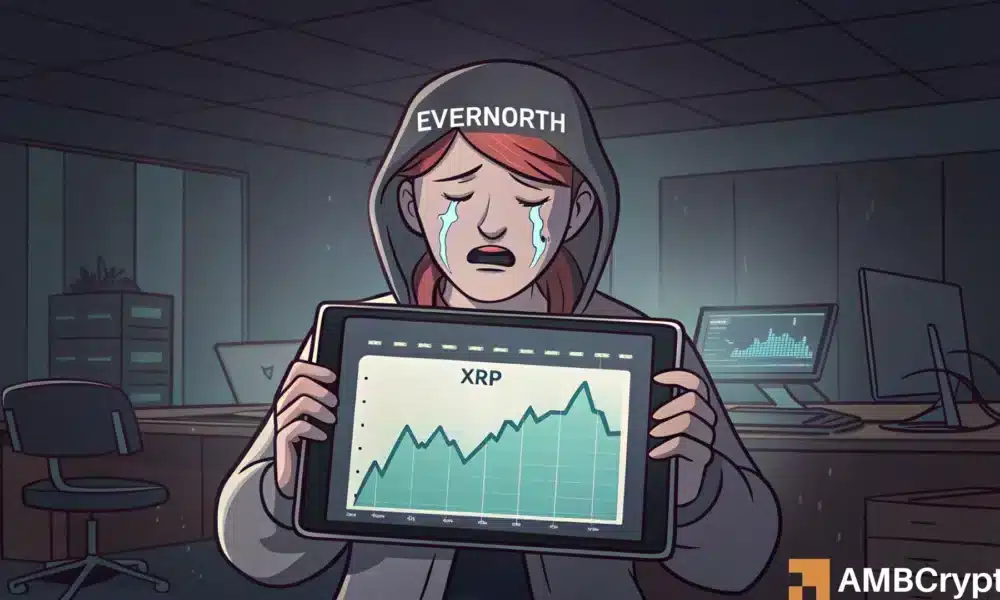
Between late October and December, Evernorth made aggressive moves to accumulate XRP, purchasing a staggering 388.7 million tokens at a total cost of approximately $947.1 million. This acquisition positioned Evernorth as the largest public company exclusively focused on XRP. Nonetheless, the overall downturn in the cryptocurrency market saw XRP’s price plummet from $2.60 to $1.80, resulting in a significant paradigm shift for the investment. What once was a $71 million unrealized profit has morphed into an unprecedented $225 million unrealized loss. This deterioration reveals a fragile market condition fraught with uncertainty and potential capitulation.
Spot ETFs: A Paradox in XRP Accumulation
While Evernorth faced dire losses, interest in Ripple’s XRP has surprisingly thrived through Spot ETFs. Notably, since their inception over a month ago, XRP Spot ETFs have exhibited uninterrupted net inflows, collectively surpassing $1.25 billion in total net assets. This rising tide of ETF interest starkly contrasts the dismal situation for individual investors like Evernorth, suggesting robust institutional confidence in XRP’s long-term prospects. This anomaly highlights a disconnection between current market realities and institutional demand, indicating a possible rebound on the horizon.
Analyzing the Weakness in XRP’s Performance
Despite the growing institutional appetite reflected by ETF inflows, XRP has experienced intense selling pressure from both retail and whale investors. This selling frenzy creates an imbalance, as Capital Flow Strength indicates significantly greater outflows compared to inflows. As of late November, Capital Flow and Capital Flow Strength have stayed negative, signaling a troubling trend for XRP’s market structure. The current bearish sentiment is further supported by negative Accumulation/Distribution Money Flow (ADMF), showcasing a clear dominance of sellers over buyers.
The Risk of Further Declines
With selling continuing to outweigh any potential buying pressure, market conditions for XRP remain precarious. Analysts predict that if this trend prevails, XRP could slip further, with forecasts suggesting a potential decline toward the $1.50 mark. For a sustainable reversal in XRP’s price trajectory, a considerable influx of purchases from institutional investors is crucial. Specifically, XRP needs to regain the $2 support level not just temporarily but hold it consistently to instill confidence in the market.
The Perspective of Long-Term Investors
In light of the drastic changes faced by XRP stakeholders like Evernorth, long-term investors must navigate their strategies carefully. Many, including firms focusing on accumulating XRP, might choose to hold their positions and ride out the current market volatility. Such an approach reflects a belief that the altcoin will rebound as institutional demand continues to signal potential long-term value. However, the inherent risks posed by ongoing bearish pressure create a need for vigilance and strategic assessment among all investors.
Conclusion: Navigating the Uncertain Waters of XRP
Ripple’s XRP stands at a crossroads, grappling with significant unrealized losses primarily driven by bearish market trends, particularly impacting treasury firms like Evernorth. However, the complementary growth in Spot ETFs illustrates an intriguing dichotomy in investor behavior, underlining that institutional interest remains robust, even in adverse conditions. As XRP continues to experience heightened selling pressure, all eyes will be on institutional players and their impending actions, which will likely determine whether XRP can reclaim its status above the crucial $2 mark. Ultimately, the evolving landscape poses both challenges and opportunities for investors eager to capitalize on XRP’s potential resurgence.