




Signs of Stabilization in Crypto Investment Products: Insights from Recent Data
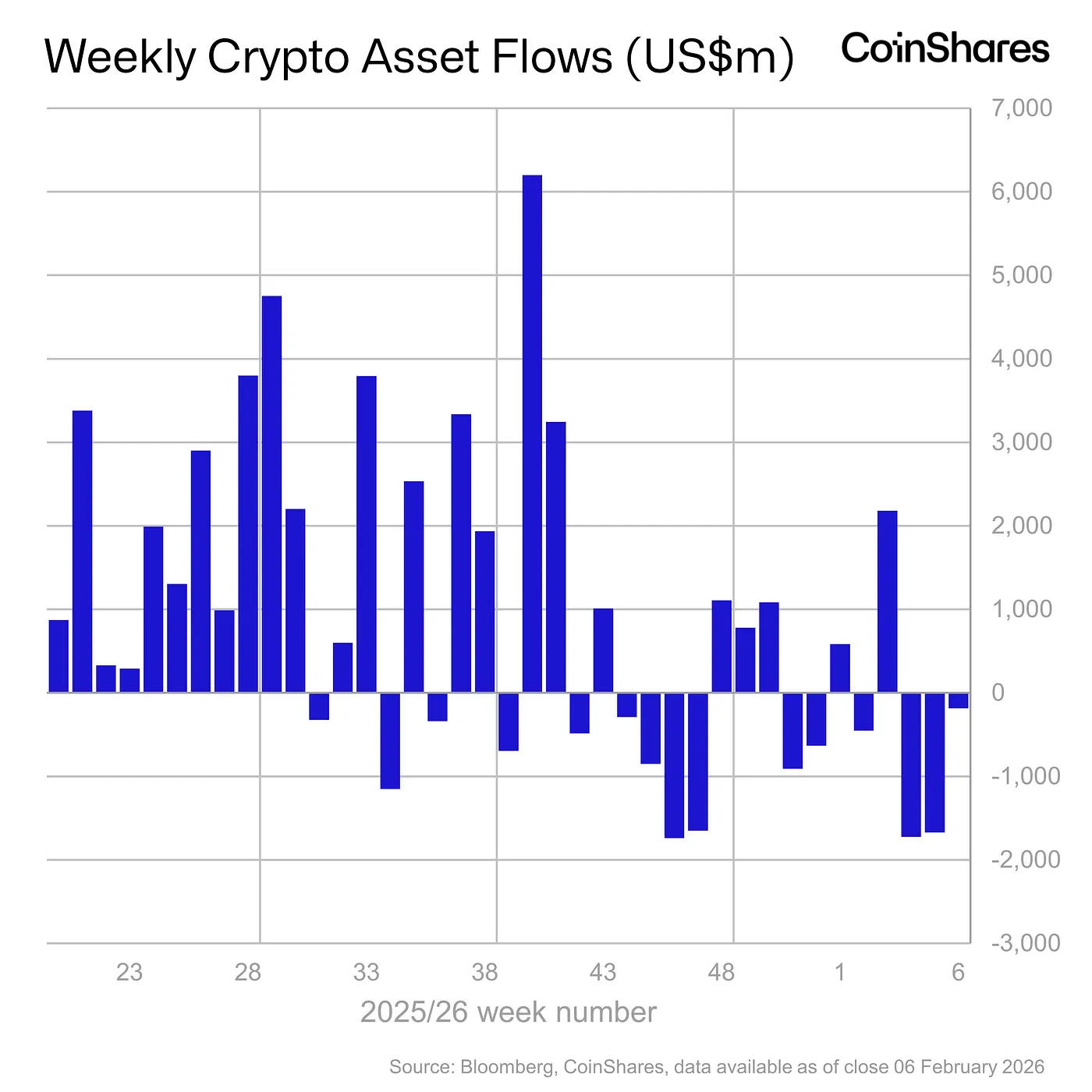
Recent data from CoinShares indicates that crypto investment products from major asset managers, including BlackRock, Fidelity, and Grayscale, are experiencing a significant slowdown in net weekly outflows. This trend is seen as an early sign of stabilization after a tumultuous period for digital asset markets. In the past week, global funds backed by cryptocurrencies reported net outflows of $187 million, a stark decrease compared to the previous two weeks, which saw approximately $1.7 billion withdrawn from the sector.
Understanding Flows and Investor Sentiment
James Butterfill, Head of Research at CoinShares, asserts that the pace of fund flows serves as a more reliable indicator of investor sentiment than their mere direction. Historically, shifts in outflow speed have preceded notable changes in investor behavior, which might suggest that the current data signals a possible inflection point in the marketplace. Although crypto prices are still under pressure, this slowdown could imply that the market is nearing a local bottom, indicating potential for a rebound as investor sentiment shifts.
Current Market Dynamics
Despite the decrease in net outflows, the prevailing price environment remains challenging. Bitcoin has seen a decline of about 9% over the past week, though it has made a slight recovery towards the $70,000 mark. Other major cryptocurrencies continue to trade lower, reflecting the overall bearish sentiment. CoinShares reports that total assets under management have dropped to $129.8 billion, the lowest since March 2025, amidst regulatory announcements that spooked investors during that period.
Surge in Trading Activity
Interestingly, while outflows have moderated, trading activity has surged. Exchange-traded products related to cryptocurrencies reached a record volume of $63.1 billion this past week, surpassing the previous high recorded in October. This spike in trading volume may indicate that investors are actively repositioning their portfolios as they reassess risk amid tightening liquidity conditions in the market. Understanding these dynamics is crucial for stakeholders as they navigate through this evolving landscape.
Uneven Flows Across Regions and Assets
The crypto flows are unevenly distributed across various regions and asset classes. CoinShares data reveals that European markets led the way in inflows, with Germany topping the list at $87.1 million, followed by Switzerland, Canada, and Brazil. However, Bitcoin was the largest source of outflows, totaling $264 million, making it the only major asset to experience net withdrawals during the reporting week. On a more positive note, select altcoins have seen renewed interest: XRP led inflows with $63.1 million, followed by Solana at $8.2 million and Ethereum at $5.3 million.
Spot ETF Performance
The analysis extends to U.S. spot crypto ETFs, which exhibited mixed results from February 2 to February 6. Bitcoin spot ETFs recorded substantial net outflows of $318 million, while Ethereum ETFs witnessed $166 million in net outflows. Interestingly, on February 6 alone, Bitcoin ETFs experienced a surge with $371 million in net inflows, contrasting with Ethereum’s $16.75 million in net outflows. Even Solana spot ETFs experienced modest outflows of $8.92 million, while XRP ETFs shone with $39.04 million in net inflows, showcasing the shifting investor interests within the space.
Conclusion: Outlook for Crypto Investment Products
The data from CoinShares presents an intriguing picture of the current state of crypto investment products. While short-term challenges persist in terms of outflows and price pressures, the signs of stabilization in weekly flows could signal a significant change in investor sentiment. As fluctuations in trading volumes and regional disparities continue to shape the landscape, investors and stakeholders should remain vigilant. The evolving dynamics within the crypto markets underscore the importance of informed decision-making as opportunities and risks continue to coexist.