



Bitcoin Acquisitions: Strategy’s Recent Expansion and Financial Outlook
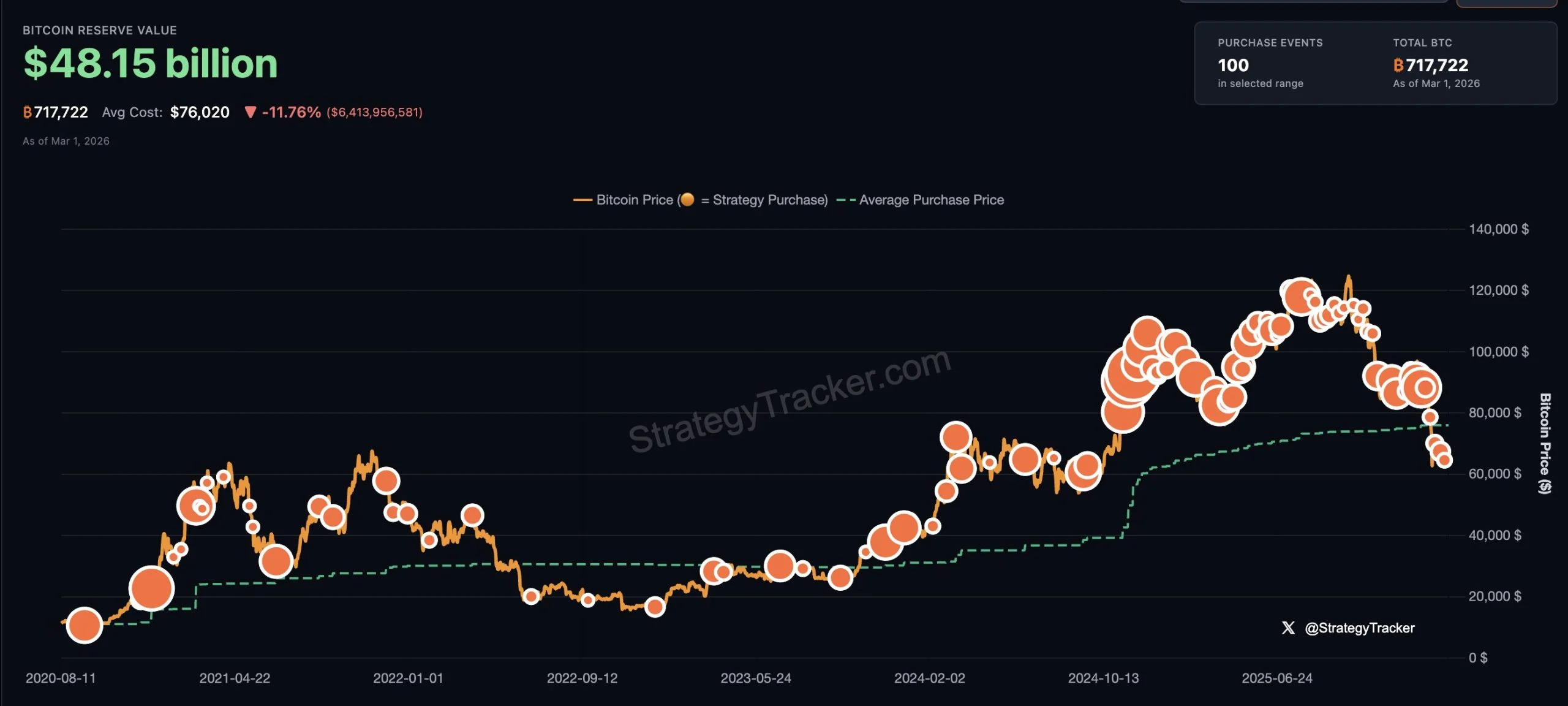
In a significant move within the cryptocurrency realm, Strategy, a prominent Bitcoin treasury firm, recently disclosed the acquisition of an additional 3,015 BTC from February 23 to March 1. This stash was secured for around $204.1 million, averaging $67,700 per Bitcoin, as per an 8-K filing submitted to the Securities and Exchange Commission. With this latest acquisition, Strategy’s total Bitcoin holdings have surged to an impressive 720,737 BTC, valued at approximately $47.5 billion. It’s noteworthy that these acquisitions have been completed at an average procurement cost of $75,985 per Bitcoin, culminating in a total expenditure of around $54.8 billion, including various fees and expenses. As co-founder Michael Saylor highlighted, this massive portfolio represents about 3.4% of the capped 21 million Bitcoin supply, indicating a potential unrealized loss of around $7.3 billion at current market prices.
The strategic funding for these acquisitions primarily stemmed from the firm’s class A common stock and the perpetual Stretch preferred stock offerings. Recently, Strategy successfully liquidated 1,730,563 MSTR shares, yielding approximately $229.9 million, while also divesting 71,590 STRC shares for about $7.1 million. Following these transactions, the company boasts $7.6 billion worth of MSTR shares and $3.5 billion worth of STRC shares still available for future issuance. Across various programs, Strategy is committed to raising a total of $84 billion through equity offerings and convertible notes targeting Bitcoin acquisitions by 2027. This ambitious goal is complemented by an array of perpetual preferred stock options that include STRK, STRC, STRF, and STRD, catering to different risk profiles and investor needs.
Michael Saylor consistently alludes to the firm’s ongoing acquisitions through social media, recently dubbing the latest purchasing phase as "The Turn of the Century." On a similar note, Strategy had previously amassed an additional 592 BTC for approximately $39.8 million, further consolidating its growing Bitcoin reserves. The strategic emphasis on the STRC perpetual Stretch preferred stock has gained favorable attention from analysts. For instance, Benchmark analysts have endorsed Strategy’s approach, maintaining a buy rating with a $705 price target, suggesting considerable upside potential of roughly 444%. This highlights the pivotal role that STRC is playing in bolstering Strategy’s Bitcoin holdings and creates a pathway for accelerated growth through enhanced per-share Bitcoin accumulation.
Anchorage Digital, another notable player in the cryptocurrency infrastructure space, has also revealed its strategic alignment with Strategy by disclosing holdings of STRC shares. This partnership reinforces the collaboration between companies focused on optimizing Bitcoin’s utility and value in the broader digital landscape. Nathan McCauley, co-founder and CEO of Anchorage, pointed out the symbiotic nature of their relationship, emphasizing that operationalizing Bitcoin infrastructure alongside treasury strategies signals a strong alignment between their visions.
In the context of a broader industry assessment, data from Bitcoin Treasuries indicates that 193 public companies have embraced some form of Bitcoin acquisition model, with leading players such as Marathon Digital Holdings, Tether-backed Twenty One, and several others joining the fray. However, many of these companies, including Strategy, have experienced substantial declines in market value from their summer 2025 peaks, primarily due to compressions in market cap-to-net asset value ratios. Strategy, for example, has seen its stock plummet by 72%. Currently, its market-adjusted Net Asset Value (mNAV) is reported at around 0.99.
Recent trading metrics reveal that Strategy’s common stock experienced a minor decline of 0.8% last week. Specifically, it fell by 2.9% on Friday, closing at $129.50. This drop aligns with Bitcoin’s 2.8% dip during the same timeframe, highlighting the interconnectedness between Bitcoin prices and the overall performance of companies heavily invested in the cryptocurrency. This reflects the larger volatility inherent to the cryptocurrency market and raises questions about the future trajectory of Bitcoin investments.
In conclusion, Strategy’s aggressive acquisition strategy showcases a unique approach to capitalizing on Bitcoin’s potential, even amidst market fluctuations. While the firm’s recent acquisitions may imply unrealized losses, the enduring belief in Bitcoin’s long-term value positions Strategy as a significant player in the digital asset landscape. Additionally, the alignment with institutional partners and the robust funding strategies underscore a commitment to growth and sustainability within the crypto sphere. Delving deeper into these financial maneuvers will be crucial in understanding the evolving dynamics of Bitcoin investment strategies and their implications for institutional investors and the market as a whole.