




Bitcoin’s Price Fluctuations: Analyzing Recent Trends
The recent decline in Bitcoin (BTC) towards the $60,000 mark has sparked a wave of analysis from industry experts. According to K33, a research and brokerage firm, this price movement may represent a local bottom, marked by "capitulation-like conditions" across various trading platforms and assets. This article delves into the factors influencing Bitcoin’s recent performance and the potential implications for future trading.
Understanding "Capitulation-like Conditions"
K33’s research, led by Head of Research Vetle Lunde, identifies several indicators that suggest extreme market stress. Key metrics, including trade volumes hitting the 95th percentile and funding rates collapsing to levels reminiscent of the March 2023 U.S. banking crisis, highlight significant market activity. Moreover, options skews have risen to extreme levels typically associated with previous market downturns. Such indicators suggest that the recent sell-off could be interpreted as a significant capitulation, possibly setting the stage for a rebound in prices.
Historical Context of Oversold Indicators
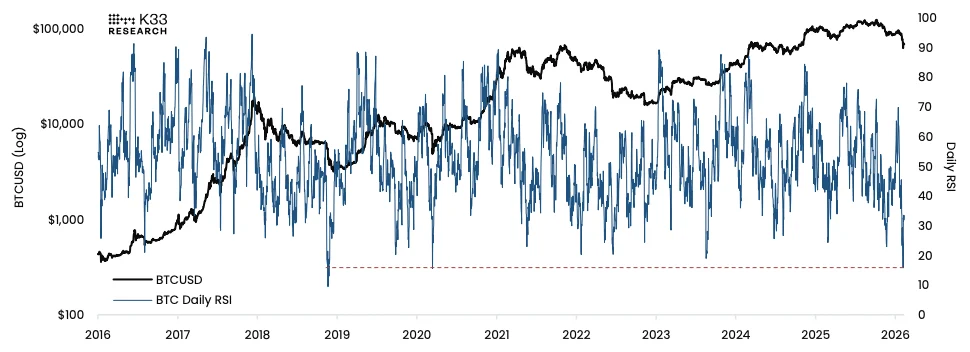
Bitcoin’s recent plunge saw its Relative Strength Index (RSI) drop to 15.9, marking it as the sixth most oversold reading since 2015. Historical patterns reveal that prior instances of similar RSI levels—such as those in March 2020 and November 2018—coincided with major market cycle lows. This historical perspective strengthens the argument that Bitcoin’s descent towards $60,000 could reflect a local bottom, offering traders an opportunity for future gains once the market stabilizes.
Market Sentiment and Fear Metrics
Market sentiment, as reflected by the Crypto Fear & Greed Index, indicates a pervasive climate of pessimism. During the recent sell-off, this index dipped to 6, marking one of the lowest readings ever recorded. Such extreme fear often signals potential buying opportunities for savvy investors who can recognize the underlying value of the asset. When sentiment eventually shifts, it may lead to increased buying pressure and a potential rebound in Bitcoin’s price.
Hyperactive Trading Dynamics
The spike in trading activity during this tumultuous period also warrants attention. Two-day Bitcoin spot volume surged to $32 billion on February 6, marking one of the highest trading volumes in recent history. Historical comparisons indicate that such peaks often accompany local price extremes, followed by periods of consolidation. Marked trading volumes, combined with the volatility seen in derivatives markets, underscore the hyperactive trading environment surrounding Bitcoin, which may stabilize over the coming weeks.
Looking Ahead: The Potential for Consolidation
According to K33, the combination of extreme market conditions suggests that Bitcoin could enter a phase of stagnant consolidation lasting several weeks or even months. This projected range between $60,000 and $75,000 could see diminished trading activity, though a retest of local lows may also occur as market participants reassess their positions. The lack of significant downside pressure below the recent low further supports the notion of a potential bounce back, presenting a cautiously optimistic outlook for Bitcoin traders.
Conclusion: A Cautious Approach to Bitcoin Trading
Navigating the volatile world of Bitcoin investment requires a balanced approach, especially when faced with sharp price fluctuations. As emerging metrics indicate potential capitulation and local market bottoms, investors would be wise to tread carefully while remaining vigilant about market trends and sentiment shifts. By understanding the implications of the current landscape, traders can position themselves for potential opportunities as Bitcoin transitions toward stability in the months ahead.