


Increasing Institutional Capital Inflows into Crypto Markets: Insights and Projections for 2026
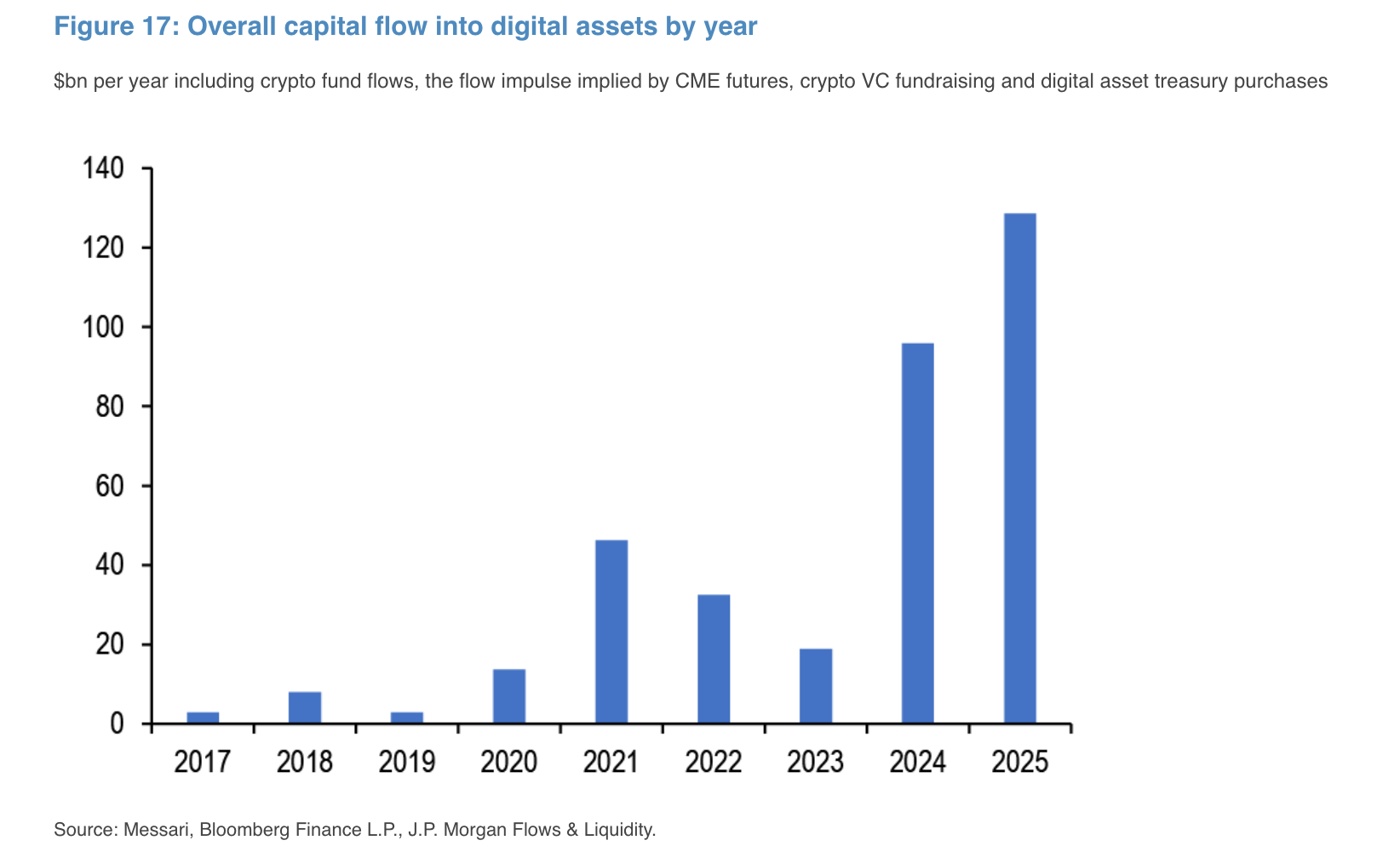
The cryptocurrency market witnessed unprecedented growth in 2025, with capital inflows reaching a record high of nearly $130 billion, representing a roughly one-third increase from 2024, according to JPMorgan analysts. This surge is largely attributed to rising interest from institutional investors, a trend expected to continue into 2026. The analysts foresee that significant regulatory measures, such as the U.S. Clarity Act, will further spur institutional adoption and engagement with digital assets, encompassing areas like venture capital funding, mergers and acquisitions, and initial public offerings in diverse sectors including stablecoin issuers and blockchain infrastructure.
Overview of 2025 Capital Flows
In 2025, the inflows predominantly stemmed from bitcoin and ether exchange-traded funds (ETFs), largely driven by retail investors. Notably, digital asset treasury (DAT) companies made substantial bitcoin purchases outside of strategic guidelines. However, the increased capital flow contrasts sharply with the decreased buying activity observed in bitcoin and ether futures on the Chicago Mercantile Exchange (CME), indicating a retreat of institutional investors and hedge funds from the market during this period.
The Role of Digital Asset Treasuries
According to JPMorgan, DATs contributed significantly to the total digital asset inflows, with an estimated $68 billion originating from these entities. Out of this, approximately $23 billion was attributed to strategic purchases, consistent with prior-year figures. However, a striking increase in DAT investments—up to $45 billion in 2025 from just $8 billion in 2024—illustrates the growing trend of large institutions investing in digital assets. Despite these contributions, it appears that the market momentum diminished later in the year, particularly from October onward, suggesting a cooling period among major holders.
Insights into Venture Capital Funding
The landscape of crypto venture capital funding continued to evolve in 2025, albeit remaining considerably below the highs achieved in 2021 and 2022. While funding modalities saw a modest increase over 2024, the actual number of deals experienced a steep decline, with a noticeable shift toward later-stage funding rounds. This pattern indicates that early-stage startups are facing increased challenges in securing investment, partially due to the redirection of capital towards treasury strategies offering immediate liquidity rather than long-term venture opportunities.
Regulatory Factors Influencing Capital Flows
The regulatory environment also plays a crucial role in shaping capital inflows into the cryptocurrency sector. Analysts noted that despite a more favorable regulatory backdrop in the U.S., the growth in venture funding remained relatively muted. Institutions and venture firms are increasingly prioritizing treasury strategies, which provide quick access to liquidity, further contributing to the shift in funding dynamics away from early-stage investment opportunities.
Projections for 2026 Capital Inflows
Looking ahead, JPMorgan’s analysts anticipate that capital inflows into cryptocurrencies will continue to grow in 2026. This anticipated increase is expected to be driven more by institutional investors rather than the retail market or DAT companies. The easing of crypto de-risking behaviors among both retail and institutional investors signals a potential return to a more stable investment climate.
Conclusion: The Future of Cryptocurrency Investments
As the cryptocurrency market matures, institutions are poised to play an increasingly significant role in shaping its future. With regulatory clarity likely to encourage further adoption and investment, the landscape for capital inflows into digital assets appears robust for 2026 and beyond. The shift towards institutional engagement, combined with a reassessment of venture funding dynamics, indicates a transformative period approaching for the cryptocurrency space. Investors and stakeholders should prepare for the evolving market trends that will undoubtedly define the landscape of digital assets in the coming years.
In summary, the growth trajectory of capital inflows into the crypto market signals a promising future, centered on institutional participation. The anticipated regulatory changes and shifting investment strategies will create fertile ground for innovation and growth within the sector.