




Hut 8’s 2025 Financial Performance: Analyzing the Transition Towards AI and Energy Infrastructure
In the world of cryptocurrency mining, Hut 8, a prominent player known for its Bitcoin mining operations, has recently reported a significant financial shift for the full year of 2025. The company posted a staggering net loss of $248 million, a stark contrast to its net income of $331.4 million in 2024. This volatility underscores the impact of unrealized digital asset losses which overshadowed the revenue growth experienced throughout the year.
Growth in Revenue Amidst Financial Challenges
Despite the losses, Hut 8 demonstrated a commendable increase in revenue, rising to $235.1 million from $162.4 million the previous year. This growth was fueled by multiple segments: $23.2 million from power generation and managed services, $9.6 million from digital infrastructure, and a substantial $202.3 million from compute operations. In the fourth quarter alone, the company achieved remarkable revenue growth, climbing to $88.5 million from just $31.7 million the year prior. However, this progress was overshadowed by a quarterly net loss of $301.8 million due to $401.9 million in unrealized digital asset losses.
Adjusted EBITDA Highlights
The adjusted EBITDA for Hut 8 paints a clear picture of the company’s financial struggles, coming in at a negative $135.4 million, compared to a positive $555.7 million in 2024. This shift can be primarily attributed to the mark-to-market fluctuations tied to Bitcoin price movements. Such adjustments highlight the inherent risks associated with digital assets and how they can influence a company’s financial stability.
Strategic Transition to AI Infrastructure
Hut 8 is not solely focusing on its losses; the company is keenly transitioning towards AI infrastructure, emphasizing its future trajectory. A significant milestone in this strategic shift was the signing of a 15-year lease with Fluidstack, providing 245 megawatts of IT capacity at its River Bend campus in Louisiana. This lease represents a remarkable $7 billion in base-term contract value and is financially backed by Google, further solidifying Hut 8’s position in the energy market.
Expanding Development Pipeline
As of the end of 2025, Hut 8 showcased an impressive development pipeline totaling 8,500 megawatts, which includes 330 megawatts currently under construction and over 1,200 megawatts actively in development. Additionally, there is potential expansion capacity at River Bend, which could support up to 1,000 megawatts, subject to power expansion approvals. This ambitious pipeline suggests a forward-thinking approach, enabling Hut 8 to adapt to the evolving technological landscape through energy infrastructure tailored for the AI industry.
Financial Health and Market Performance
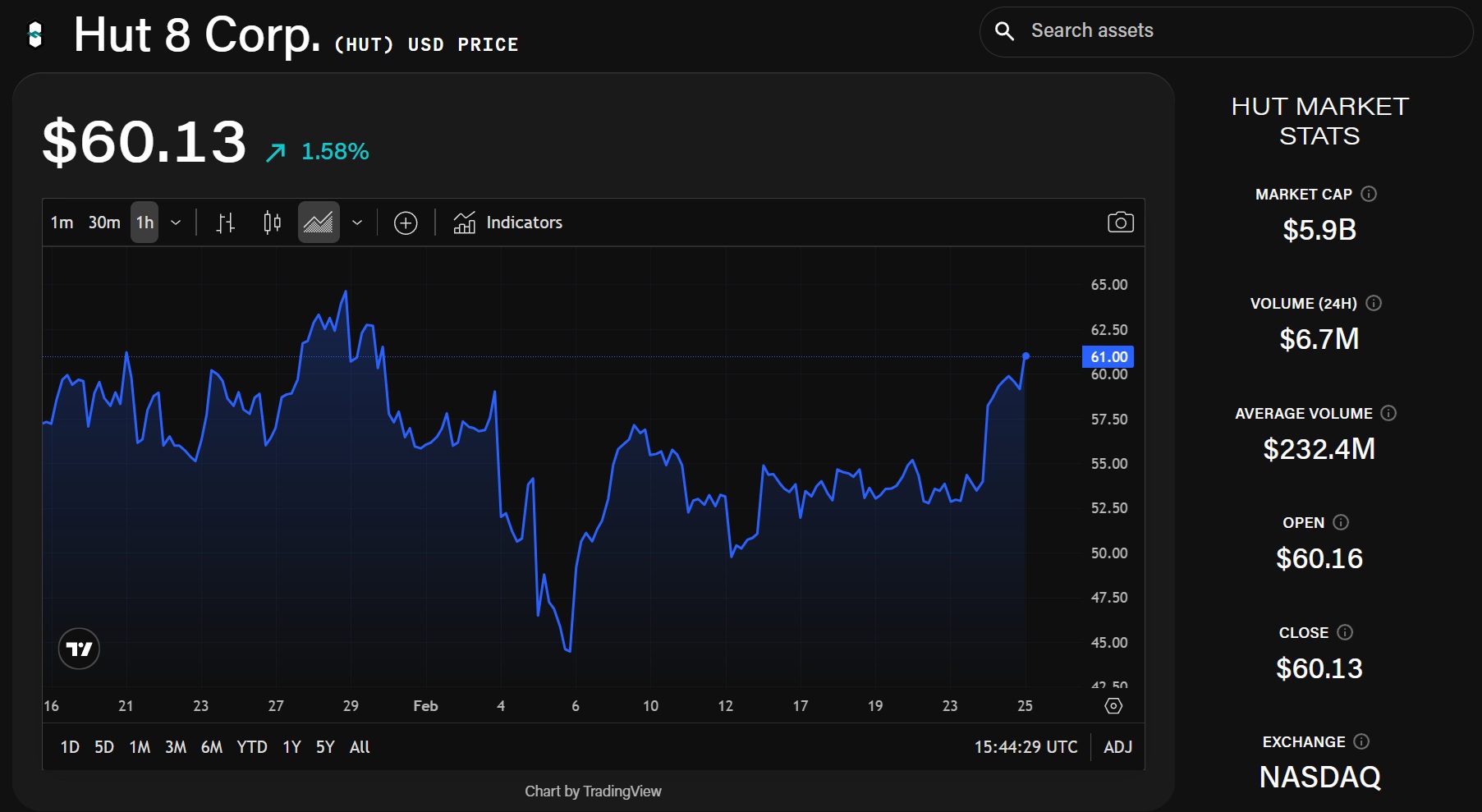
Despite the financial turbulence, the market appears to maintain a level of confidence in Hut 8’s future. Shares of Hut 8 (HUT) were trading just above $60, reflecting a modest increase of about 1.5% on the trading day as reported. Notably, the stock had briefly surged to a four-year high of $66 the previous month, marking a remarkable gain of over 300% in the past year, even as Bitcoin prices fell approximately 27% during the same timeframe. This indicates resilience and optimism among investors regarding Hut 8’s strategic pivots.
Conclusion: Looking Forward
In summary, Hut 8’s financial performance in 2025 presents a complex narrative of impressive revenue growth shadowed by significant losses tied to digital assets. The company’s strategic transition into AI infrastructure and energy services represents a proactive approach to future challenges and opportunities in the evolving tech landscape. As Hut 8 continues to expand its development pipeline and engage strategic partnerships, its ability to navigate the volatility of the cryptocurrency market and capitalize on burgeoning sectors like AI will be paramount to its long-term success. For investors and stakeholders alike, keeping an eye on Hut 8’s next moves may prove beneficial, as the landscape of digital assets and energy infrastructure continues to evolve.