



Bitcoin Sees Price Drop: Galaxy Digital Adjusts Forecast Amid Market Changes
This week, Bitcoin’s price dipped below the $100,000 threshold, prompting Galaxy Digital to revise its year-end price target for 2025 from $185,000 to $120,000. Analysts indicate that Bitcoin has entered a "maturity era," marked by significant institutional investment and reduced volatility. Alex Thorn, the head of research at Galaxy Digital, stated that despite a challenging environment, Bitcoin’s long-term fundamentals remain intact. However, he noted that the year has been characterized by substantial distribution by large holders, diminished retail engagement, and significant exchange-traded fund (ETF) influences.
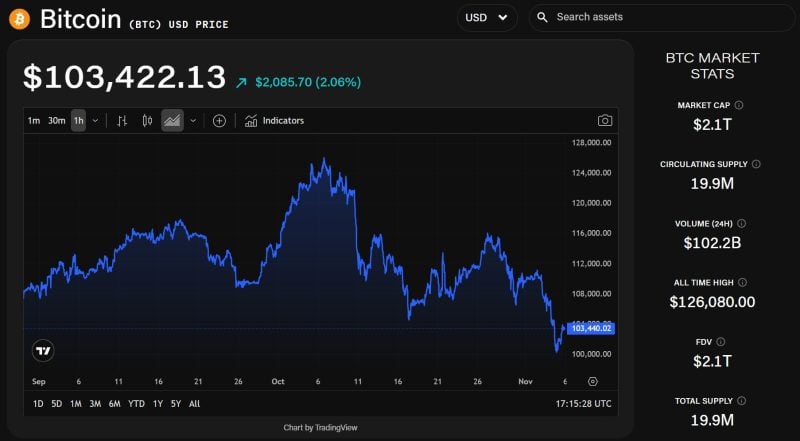
When Bitcoin fell from approximately $107,000 to below $99,000, it triggered a cascade of liquidations, wiping out over $1.3 billion in leveraged positions. As of Wednesday, the price of Bitcoin has rebounded slightly, hovering just above $103,400. Analysts remain cautious, calling the market "fragile" due to recent ETF outflows and a decrease in trading liquidity, alongside ongoing distribution from long-term holders. Galaxy Digital pointed out that approximately 470,000 Bitcoin (roughly $50 billion) was redistributed from long-term wallets, representing a shift towards institutional demand.
Market Sentiment and Resistance Levels
Despite Bitcoin’s structural soundness over the long term, analysts suggest that the cryptocurrency might face challenges maintaining the $100,000 mark. If it can stabilize above this level, the ongoing bull market, which has lasted nearly three years, will likely persist, albeit at a slower pace for future gains. The market is sensitive right now, with several factors contributing to this atmosphere of uncertainty, including ETF outflows and reluctance from retail investors. Galaxy also highlighted that this redistribution represents the "institutionalization of Bitcoin supply," creating strong resistance levels at critical price points.
This year’s capital flows have also turned away from Bitcoin, influenced by the surge in interest toward domains like artificial intelligence (AI) and gold investments. With record inflows into AI as investors seek opportunities within data centers and gold’s resurgence as a safe-haven asset during geopolitical turmoil, Bitcoin is facing increased competition for investor interest. Thorn emphasized that in a liquidity-rich market, investor attention is limited—leading to a perception that 2025 may not be Bitcoin’s standout year compared to AI or high-growth equities.
The Impact of Liquidations on Market Confidence
The recent October 10 liquidation event, which resulted in a 35% reduction in crypto futures open interest, continues to weigh heavily on market sentiment. K33 Research analyst Vetle Lunde described the current state of Bitcoin as a "crucial inflection point" following this dramatic crash. Although bearish sentiment prevails, Lunde anticipates that selling pressure will eventually ease, creating an opportunity for a bullish reversal based on returning risk appetite among investors.
Onchain analytics firm CryptoQuant painted a more dire scenario, with its head of research, Julio Moreno, predicting that Bitcoin could plummet to around $72,000 within the next one to two months if it fails to hold the $100,000 support level. Moreno cited declining spot demand and negative ETF flow as significant factors for this potential downturn. The market dynamics illustrate the fragility of Bitcoin’s position, particularly in light of large-scale sell-offs by long-term holders.
The Shift Toward Institutional Demand
Galaxy Digital’s findings reflect a significant shift in Bitcoin’s investor landscape, leaning heavily toward institutional players. This transformation, however, has implications for pricing resistance and market volatility. As institutional capital flows into Bitcoin, traditional models of demand may no longer apply, leading to a complex interplay between market dynamics and pricing. This transition towards a more institutional-centric market also suggests that the price movements of Bitcoin could increasingly be tied to broader financial market trends rather than micro-level trading behaviors.
Consequently, investors must adapt to this evolving environment, emphasizing the importance of staying informed. With the rise of institutional participants, the narrative surrounding Bitcoin is changing, and the cryptocurrency is likely to continue experiencing volatility influenced by a variety of external factors.
The Influence of Broader Investment Narratives
This year has highlighted the interplay between various investment narratives. The attractiveness of sectors like AI and the strong performance of gold have pulled capital away from Bitcoin, challenging its standing as a preferred investment option. The shift in focus toward these growth sectors has positioned Bitcoin in a secondary role, as many investors chase opportunities in areas showing pronounced growth potential.
Moreover, as traditional markets face fluctuations and uncertainty, the competition for capital becomes increasingly fierce. Consequently, Bitcoin’s ability to draw attention and investment will depend significantly on how it can differentiate itself from other investment avenues, particularly as institutional participation grows. Investors are advised to remain vigilant, as these shifts could have lasting impacts on overall market sentiment.
Looking Ahead: A Cautious Optimism?
Despite the recent turbulence in the Bitcoin market, analysts maintain a cautious optimism about its long-term prospects. The fundamentals of Bitcoin remain robust, and if the cryptocurrency can hold its ground above the pivotal $100,000 mark, it stands a good chance of continuing its upward trajectory. However, the evolving landscape underscored by institutional flows, ETF influences, and changing investor sentiments is reshaping market dynamics in unprecedented ways.
In conclusion, Bitcoin’s recent price actions, alongside institutional shifts and competitive investment narratives, paint a complex picture of the cryptocurrency’s future. Investors and analysts alike will need to navigate these treacherous waters carefully, remain attuned to market signals, and adapt strategies in response to changing conditions. As the cryptocurrency matures, its influence on the broader investment landscape will undoubtedly continue to develop, making it a topic of keen interest and analysis within the financial community.